
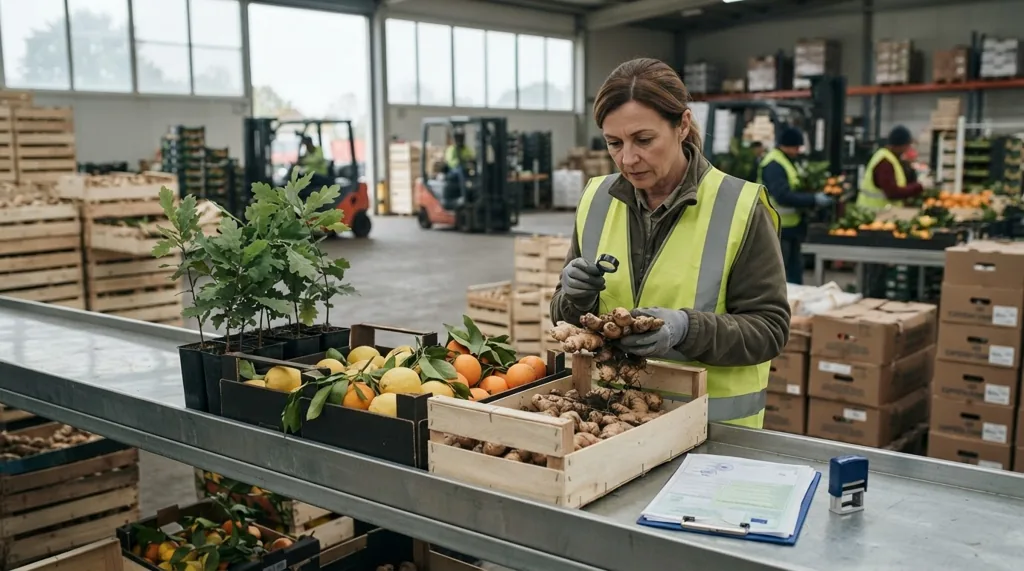
European Union imports of ginger, turmeric, citrus, some fruit trees and oak and chestnut plants need new certificate statements from 15 October 2026.
The European Commission’s new plant-health rules for imported ginger, turmeric, citrus fruit, fruit trees and oak and chestnut wood apply from 15 October 2026.
The rules come from Commission Implementing Regulation (EU) 2026/826, adopted on 14 April 20261. It changes the European Union’s (EU) main list of plant pests and the import conditions linked to them1.
In short, many shipments of these goods now need an extra statement on their plant-health certificate. Without the right statement, a shipment can be refused at the EU border2.
What did the European Commission change?
The regulation amends Implementing Regulation (EU) 2019/2072, the EU rulebook that lists harmful plant pests and the import conditions for plants and plant products1. It was published in the Official Journal of the European Union on 15 April 20263.
Regulation (EU) 2026/826 step by step
The regulation entered into force on 5 May 20263. Some parts applied from that day. The parts on new pests, the new import conditions and the ginger and turmeric rules apply from 15 October 20261.
The Netherlands Food and Consumer Product Safety Authority (NVWA), the Dutch inspection agency, announced the change on Aug. 31, 20262. It said the new rules and certificate statements apply at the moment goods enter the EU2.
Why does the EU want new certificate statements?
The European Commission said new scientific information from pest risk studies was available1. These studies came from the European Food Safety Authority, the European and Mediterranean Plant Protection Organization (EPPO) and EU member states1.
EPPO studied three insects in detail1. They are a beetle that bores into oak and chestnut trees (Agrilus bilineatus), the citrus fruit borer (Gymnandrosoma aurantianum) and a weevil (Naupactus xanthographus)1. The regulation now lists all three as Union quarantine pests, meaning pests the EU must keep out of its territory1.
The Dutch agency said the oak beetle is a large risk to important trees such as chestnut and oak2. The aim of all the new rules is to stop new quarantine pests from entering the EU and spreading inside it2.
Why are ginger and turmeric now covered?
The regulation targets a bacterium that harms plants, called Ralstonia pseudosolanacearum1. The bacterium was found on imported plants of turmeric (Curcuma longa) and ginger (Zingiber officinale)1.
Outbreaks have also been reported in EU nurseries that grew ginger plants1. The bacterium was found in water samples in Hungary and the Netherlands1. For that reason, the EU now lists it as a pest already present in the EU1.
The new rules cover two groups of goods1:
- Ginger and turmeric plants for planting, under customs codes such as ex 0601 10 90 and ex 0602 90 50.
- Ginger and turmeric roots for eating (rhizomes), under customs codes ex 0910 11 00 and ex 0910 30 00.
Both groups need the new statement when they come from any country outside the EU1. The Dutch agency said Switzerland is the one exception2.
How can a ginger shipment meet the rules?
The plant-health certificate must carry an official statement from the exporting country1. The statement must confirm one of three choices1:
- The goods come from a country recognised as free from the bacterium.
- The goods come from an area declared free from the bacterium by the national plant-health agency. That area must be named under "place of origin" on the certificate.
- The goods come from a registered farm or production site that the national plant-health agency supervises.
Extra steps for a registered ginger or turmeric site
| Requirement | Details |
|---|---|
| Registration | Site registered and supervised by national plant-health agency |
| Inspection | Site and surrounding land inspected before harvest |
| Testing | Representative sample tested with molecular methods before export |
| Traceability | Shipment traceable to the site until export |
The third choice has extra steps1. Officials must inspect the site and the land around it before harvest and find no sign of the bacterium1. Before export, a representative sample must be tested with molecular laboratory methods and found free of the bacterium1. The shipment must also stay traceable to that site until export1.
The Dutch agency said the certificate statement must show which of these choices was met2. That means exporters must arrange the testing before the goods leave, not on arrival.
What changes for oak and chestnut trees?
The regulation adds a new entry for young trees and other plants of chestnut (Castanea) and oak (Quercus)1. It covers these plants from Canada, Türkiye and the United States1. Tissue cultures, pollen, fruit and seeds are not covered1.
Two ways for oak and chestnut plants to qualify
| Question | Pest-free area | Protected growing site |
|---|---|---|
| Origin | Canada, Türkiye, United States | Canada, Türkiye, United States |
| Main condition | Area declared free of oak beetle | Grown at least two years there |
| Official checks | Status sent to Commission in writing | At least two inspections each year |
The certificate must confirm one of two choices1:
- The plants come from an area declared free of the oak beetle. The exporting country’s plant-health agency must first tell the European Commission in writing about that status.
- The plants grew for at least two years before export in a site with physical protection against the beetle. Younger plants must have grown there all their lives.
In the second choice, officials must inspect the site at least twice each year and find no sign of the beetle1.
The rules also reach wood. The Dutch agency said oak and chestnut wood and wood products from Canada, Türkiye and the United States need a new certificate statement2.
Which fruit trees and citrus fruit are affected?
New rules also cover plants for planting of three fruit species because of the weevil2. These are kiwi (Actinidia deliciosa), cherimoya (Annona cherimola) and persimmon, also called kaki (Diospyros kaki)2. The Dutch agency said these plants face extra conditions for growing or inspection in their country of origin2.
Citrus fruit from Central America, South America and the Caribbean also faces new rules because of the citrus fruit borer2. Each of these shipments now needs a new certificate statement as well2.
The regulation lists these plants and products in the EU rulebook’s annexes on special import conditions and on certificates1. So the fruit, plants and wood all need a plant-health certificate with the correct wording.
What else changes on 15 October 2026?
The regulation also widens some older rules to more countries1. Outbreaks of a tree-boring beetle (Agrilus planipennis) took place near Kazakhstan’s border with Russia1. Certain plants and wood from Kazakhstan are now added to the countries covered for that pest1.
The regulation also adds Israel and Taiwan to several existing entries1. These cover fruit such as peppers, papaya and guava, and the insects that attack them1. The Commission said these two places had been left out by mistake1.
Other parts update customs codes, known as CN codes, in the EU rulebook1. Some codes had been deleted or replaced in the EU’s customs list1. In addition, nine insect species are removed from the list of quarantine pests1.
Who must act before goods reach the border?
Plant-health certificates are issued by the authorities of the exporting country4. So exporters and their national plant-health agencies must carry out the inspections and tests first. They must then write the correct statement on the certificate.
The Dutch agency explains that a shipment is only allowed into the EU with the right statements on its certificate4. If a statement is missing, the importer is responsible for obtaining it4. This can be done by asking the country of origin for a replacement certificate4.
Electronic certificates are also possible4. They are only valid if they are exchanged through the EU’s TRACES computer system4.
The Dutch agency has added the new statements to its checklists for imports2. It said importers can avoid refusal at a Dutch port by checking these points with suppliers before shipping2.
Key points on the EU plant-health certificate rules
The table below sums up the main facts.
| Question | Answer |
|---|---|
| What changed? | New import conditions and certificate statements |
| Who issued it? | European Commission |
| Which law? | Implementing Regulation (EU) 2026/826 |
| Which goods? | Ginger, turmeric, citrus, some fruit trees, oak and chestnut |
| Which pests? | A plant bacterium, oak beetle, citrus fruit borer, weevil |
| Ginger from where? | All non-EU countries except Switzerland |
| Oak and chestnut from where? | Canada, Türkiye and the United States |
| Citrus from where? | Central America, South America, Caribbean |
| What must shipments carry? | Plant-health certificate with new statement |
| In force since | 5 May 2026 |
| New rules apply from | 15 October 2026 |
Since 15 October 2026, these shipments must reach the EU border with the new statement already on the certificate. A shipment without it can be refused, and the importer must obtain a replacement certificate from the country of origin4.
Sources
- ↩ L_202600826EN.000101.fmx.xml https://eur-lex.europa.eu/legal-content/EN/TXT/HTML/?uri=CELEX:32026R0826
- ↩ Nieuwe fytosanitaire eisen voor verschillende importproducten vanaf 15 oktober 2026 | NVWA https://www.nvwa.nl/actueel/nieuws/2026/08/31/nieuwe-fytosanitaire-eisen-voor-verschillende-importproducten-vanaf-15-oktober-2026
- ↩ Implementing regulation – EU – 2026/826 – EN – EUR-Lex https://eur-lex.europa.eu/legal-content/EN/ALL/?uri=CELEX%3A32026R0826
- ↩ Fytosanitaire certificaten en bijschrijvingen | NVWA https://www.nvwa.nl/onderwerpen/plant/importeren-planten-en-plantaardige-producten/fytosanitaire-certificaten-en-bijschrijvingen