
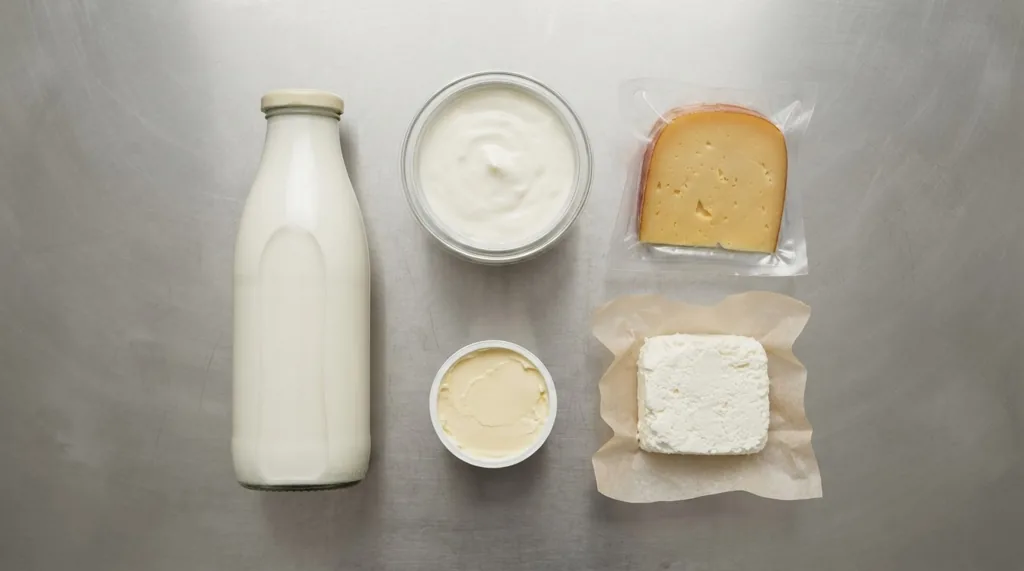
Ukraine has amended its milk and dairy product safety requirements to strengthen quality controls across key product categories Milk and dairy products.
Ukraine’s Ministry of Agrarian Policy and Food has proposed new safety rules for milk and dairy products, notified abroad on Sept. 30, 20261.
The draft order sets fixed dates for raw milk quality limits, adds new testing rules, and changes marking rules for bulk dairy shipments1. It will take effect on the day it is officially published2.
In short, raw milk limits will apply from fixed dates in 2028 and 2029, not from the end of martial law. Dairy goods moved in tankers or large containers can carry their identification mark details in the shipping papers instead of on each pack.
What is Ukraine changing for milk and dairy products?
The ministry published the draft order on its website with the date Sept. 24, 20262. It amends the ministry’s Order No. 118 of 12 March 2019, which sets Ukraine’s safety and quality requirements for milk and dairy products2. That 2019 order was registered with the Ministry of Justice on June 7, 20192.
Ukraine then told other members of the World Trade Organization (WTO) about the draft. It did so in notification G/SPS/N/UKR/278, dated Sept. 30, 20261. This is a notice under the WTO agreement on food safety and animal and plant health measures.
The notification lists the main changes1:
- Fixed start dates for raw milk criteria: 1 January 2028 and 1 January 2029.
- A new definition of "milk raw material".
- A wider exemption for food made for the producer’s own use.
- New sample checks on fat and protein content in raw milk.
- More testing methods, including reference methods for fat and protein.
- Clearer rules for using milk and colostrum that fail the requirements.
The draft also touches packaging materials and identification marks. For that reason, Ukraine notified it under the WTO agreement on technical rules for goods as well1.
Why did the ministry act on dairy rules?
The notification gives food safety as the objective of the draft1. It says no international standard applies to it1.
The draft order names its legal basis. It rests on Article 7 of Ukraine’s law on the basic principles and requirements for food safety and quality3. It also cites Ukraine’s national program to bring its laws in line with European Union (EU) law3. The Cabinet of Ministers approved that program on April 1, 2026, by resolution No. 4383.
The draft also changes the legal basis written at the top of the 2019 order. It replaces a reference to the law on milk and dairy products with a reference to the food safety law2.
When will the raw milk limits apply?
Under the current text, some raw milk criteria start a set time after martial law ends. One group starts two years after martial law ends or is cancelled. Another starts one year after2.
Raw milk criteria start dates, now and in the draft
| Criteria group | Current rule | Draft order |
|---|---|---|
| First group | Two years after martial law ends | 1 January 2029 |
| Second group | One year after martial law ends | 1 January 2028 |
The draft replaces these open dates with calendar dates2:
- The two-year rule becomes 1 January 2029.
- The one-year rule becomes 1 January 2028.
The change applies in two subpoints of point 3 of the 2019 order2. Dairy plants and their foreign buyers gain fixed dates they can plan around. Before, nobody could know when these limits would start.
How will labs check raw milk samples?
The draft adds a new test for whether a raw milk sample is "representative", meaning it truly reflects the milk it came from4. Labs must test raw milk for fat and protein content at least twice a month4. These tests must run at the same time as the other required raw milk tests, in one authorised lab4.
Largest allowed gap from last month’s average, %
A sample is unsuitable in two cases4:
- Its colour, smell or texture, or the lab tests, show it was sampled or transported badly.
- Its fat result differs by more than 10%, or its protein result by more than 8%, from the seller’s average for the previous month.
The lab will not count an unsuitable sample or its results4. It must tell the dairy business and the food safety authority at once, through the authority’s online system4.
How is the monthly average for fat and protein worked out?
The lab calculates the average from all of that business’s raw milk results for one calendar month4. It uses two decimal places4.
If there is no average for the previous month, the lab uses the most recent monthly average. That average may be no more than three calendar months old4. If there is no such average either, the lab uses the average of all raw milk samples it received from all businesses in that month4.
When a sample is rejected, the business must still keep up the minimum number of samples set by the rules4. A bad sample does not reduce how often milk must be tested.
Which testing methods are added?
The draft adds two reference methods, the methods used to settle any dispute over a result4:
- DSTU EN ISO 1211:2022, a weighing method for fat content in milk.
- DSTU EN ISO 8968-1:2022, the Kjeldahl method for nitrogen and crude protein in milk and dairy products.
New reference testing methods
| What is tested | Standard |
|---|---|
| Fat in milk | DSTU EN ISO 1211:2022, weighing method |
| Protein in milk and dairy | DSTU EN ISO 8968-1:2022, Kjeldahl method |
Labs may also use other methods for freezing point, and for fat and protein4. These methods must first be checked against the reference methods under a national or international protocol4. The reference lab for milk and dairy testing, chosen by the food safety authority, must recommend them4.
What changes for milk and colostrum that fail the rules?
The draft now covers colostrum, the first milk an animal gives after birth, as well as milk4. Such milk or colostrum can still be used after heat treatment that gives a negative alkaline phosphatase test, a check that shows the heating was strong enough4.
This applies when the milk comes from cows, buffaloes, sheep, goats or other female animals that test negative for tuberculosis and brucellosis. The animals must also show no signs of these diseases4. Sheep and goats vaccinated against brucellosis under an approved control plan also qualify, if they show no signs of disease4.
Milk from such sheep or goats has a second use. It may go into cheese ripened for at least two months4.
The draft also replaces the word "preparations" with "medicinal products" when it speaks of veterinary drugs and their residues4. This changes wording, not limits.
What changes for dairy packaging and identification marks?
All materials and objects that touch milk and dairy products must meet Ukraine’s law on food contact materials4. This applies at every stage of production and sale4.
Dairy businesses must put an identification mark on the packaging. The mark must follow rules made under Article 32 of Ukraine’s law on state control of food, feed and animal health4.
The draft adds an exemption for bulk goods4. It covers products in transport containers or large packs meant for further processing or packing at another plant. It also covers liquids and powders carried loose or in tankers4. For these goods, the mark details must be in the accompanying shipping documents4. They may also appear on the outside of the container4.
A plant that makes both covered and non-covered foods may use one identification mark for both4.
Who else is affected by the dairy draft?
The draft widens the exemption for food made for the producer’s own use. Today it covers primary production. It will also cover preparing, processing or storing dairy products for own use4.
The draft defines "milk raw material" for the first time4. It means milk that has had basic physical treatment, such as filtering or cooling4. It also covers dairy products made only of milk parts, such as milk fat, milk protein or lactose, that are used to make other foods4.
The draft deletes the words "direct supply" from points 11 and 12 of the dairy rules4. It also changes "productive animals" to "animals kept to produce food"4.
The WTO notice says all trading partners may be affected1. Foreign dairy makers selling into Ukraine, and Ukrainian exporters, will need to follow the new marking and testing rules once the order takes effect.
How does this fit with Ukraine’s 2026 dairy order?
The notification lists a second, separate dairy measure as a related document1. It is Order No. 801 of Jan. 19, 2026, on requirements for milk, dairy products and spreadable fats1. Ukraine’s Ministry of Economy, Environment and Agriculture issued it1.
Ukraine’s official law database shows that Order No. 801 enters into force on 1 January 20295. It was published in Ukraine’s Official Gazette on March 24, 20266. The new draft amends the older 2019 order, not Order No. 801.
What happens next for the draft order?
Trading partners have 45 days from the date of circulation to comment1. The notification was circulated on Sept. 30, 20261. Comments go to Ukraine’s national enquiry point at the Secretariat of the Cabinet of Ministers1.
The dates of adoption and publication are still to be decided1. The order will take effect on the day of its official publication2. The minister of agrarian policy and food, Taras Vysotskyi, is named as signatory on the draft2.
Key points on Ukraine’s dairy safety draft
The table sums up the draft order.
| Question | Answer |
|---|---|
| What is it? | Draft amendments to dairy safety rules |
| Who issued it? | Ministry of Agrarian Policy and Food |
| Which rules change? | Order No. 118 of 12 March 2019 |
| Which goods? | Milk and dairy products |
| WTO notice | G/SPS/N/UKR/278, Sept. 30, 2026 |
| Raw milk limits start | 1 January 2028 and 1 January 2029 |
| Fat and protein tests | At least twice a month |
| Sample rejected if | Fat off by 10%, protein by 8% |
| Bulk shipments | Mark details in shipping documents |
| Comment period | 45 days from circulation |
| Start date | Day of official publication |
The next step is the end of the 45-day comment period that began on Sept. 30, 2026. After that, the ministry can adopt the order, and it will apply from the day it is published.
Sources
- ↩ NOTIFICATION NOTIFICATION NOTIFICATION http://www.spsvietnam.gov.vn/Data/File/Notice/12301/NUKR278.pdf
- ↩ Про внесення змін до наказу Міністерства аграрної політики та продовольства України від 12 березня 2019 року № 118 | Міністерство аграрної політики та продовольства України https://minagro.gov.ua/npa/pro-vnesennia-zmin-do-nakazu-ministerstva-ahrarnoi-polityky-ta-prodovolstva-ukrainy-vid-12-bereznia-2019-roku-118
- ↩ 26_05060_00_x.pdf https://members.wto.org/crnattachments/2026/SPS/UKR/26_05060_00_x.pdf
- ↩ 26_05060_01_x.pdf https://members.wto.org/crnattachments/2026/SPS/UKR/26_05060_01_x.pdf
- ↩ Про затвердження Вимог до молока… | від 19.01.2026 № 801 https://zakon.rada.gov.ua/go/z0318-26
- ↩ Про затвердження Вимог до молока… | від 19.01.2026 № 801 (Текст для друку) https://zakon.rada.gov.ua/laws/show/z0318-26/print