
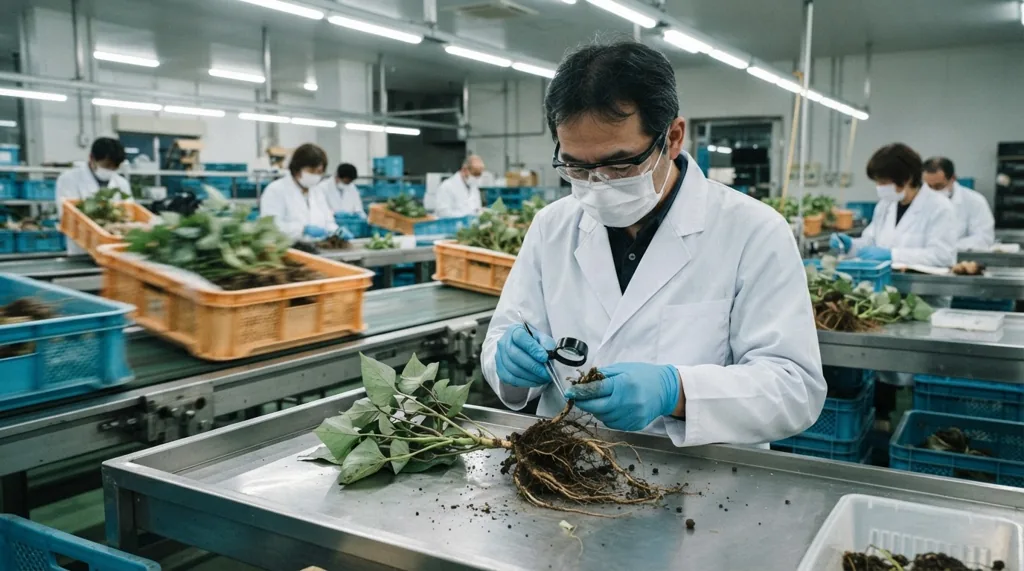
Japan has implemented emergency measures to mitigate the risk of introducing Meloidogyne enterolobii, a plant parasitic nematode, into the country.
Japan’s Ministry of Agriculture, Forestry and Fisheries (MAFF) has required pest-free certificates for 28 more kinds of plants since July 29, 2026, to keep out a root nematode.
The pest is Meloidogyne enterolobii, a tiny root-knot worm that lives in soil and plant roots1. The emergency rule covers the roots and other underground parts of live plants for planting from listed countries2.
In short, a nursery plant from a listed country now needs an extra statement on its plant-health certificate. Without it, Japanese inspectors will test the shipment or, for newer certificates, destroy it or send it back.
Why did Japan act on Meloidogyne enterolobii?
MAFF already lists Meloidogyne enterolobii as one of Japan’s important quarantine pests, meaning pests that must be kept out of the country1. Japan’s plant protection rules already demanded checks for this worm on certain plants from certain countries3.
New information then showed that 9 groups of plants (genera) and 19 single species also host the worm1. These plants were not on Japan’s existing list, so the worm could enter Japan through them3.
MAFF told the World Trade Organization (WTO) about the step in an emergency notice, G/SPS/N/JPN/1426, dated Aug. 3, 20261. The notice says the emergency rule applies before Japan formally amends the Ordinance for Enforcement of the Plant Protection Act, the regulation that lists banned plants and conditions1.
The plant protection service, MAFF’s border agency for plants, also wrote letters to the countries concerned3. It sent them to places from which Japan had inspected imports of the newly listed plants in the past 3 years3.
Which plants does the July 29 rule cover?
The rule covers the underground parts of live plants that can be planted and grown2. This means roots, bulbs and similar parts sold with nursery plants. The 9 plant groups are2:
- Angel’s trumpet (Brugmansia)
- Bottlebrush and paperbark trees (Melaleuca, also called Callistemon)
- Gardenia
- Privet (Ligustrum)
- Willow (Salix)
- Syzygium, a group of tropical trees and shrubs
- Tibouchina, a flowering shrub
- Washingtonia palms
- Zelkova trees
Plants added on July 29, 2026, by type
The list was built from scientific papers and pest databases, which the annex names for each plant2.
The 19 single species include several vegetables and herbs2:
- Celery and celeriac (Apium graveolens, including its varieties)
- Hot peppers (Capsicum chinense and Capsicum frutescens)
- Parsley (Petroselinum crispum)
- Agarwood tree (Aquilaria malaccensis)
- Butterfly bush (Buddleja davidii)
- Bluebeard (Caryopteris × clandonensis)
- Crape myrtle (Lagerstroemia indica)
- Lantana (Lantana camara and Lantana montevidensis)
- Noni (Morinda citrifolia)
- Rain tree (Samanea saman)
- Euphorbia hypericifolia, Hibiscus grandiflorus, Leonotis nepetifolia, Pentas lanceolata, Physalis angulata, Sageretia thea and Urena lobata
One group is left out. Plants grown in sterile conditions and sealed in test tubes or flasks are not covered, if they arrive free of the pest1.
Which countries must certify their plants?
The rule applies to shipments from a long list of countries and territories in six regions2. In Asia, these are India, Sri Lanka, Thailand, Chinese Taipei, Viet Nam and China, excluding Hong Kong2.
In Europe, the list names Switzerland and Portugal2. In Africa, it names Egypt, Kenya, Côte d’Ivoire, Senegal, Togo, Nigeria, Niger, Burkina Faso, Benin, Malawi, South Africa and Mozambique2.
The United States is covered, except for the Hawaiian Islands2. In Latin America, the list names Guatemala, Costa Rica, Brazil, Venezuela, Mexico and the West Indies2. The West Indies entry includes more than 25 Caribbean islands and territories, among them Cuba, Jamaica, the Dominican Republic and Puerto Rico2. Australia is the only country listed for Oceania2.
What must exporting countries certify?
Each exporting country’s National Plant Protection Organization (NPPO), its official plant-health agency, must confirm two things2. Both must be true for every covered shipment:
- The plants were grown at a farm or site, including a greenhouse, where the worm has never been found, or where it was found and wiped out.
- Officials inspected the plants at that site during the growing season. They tested the soil or growing medium and the roots and found no worm.
What the plant-health certificate must confirm
| Requirement | Details |
|---|---|
| Growing site | Worm never found, or found and wiped out |
| Site inspection | Officials inspect plants during the growing season |
| Lab testing | Soil and roots tested and found free of the worm |
| Extra statement | Fulfills item 13 of the Annexed Table 2-2 |
The plant-health certificate, or a certified copy, must then carry an additional declaration, an extra written statement2. MAFF gives this sample wording: "Fulfills item 13 of the Annexed Table 2-2 of the Ordinance for Enforcement of the Plant Protection Act (MAF Ordinance No73/1950)"2.
Item 13 is the existing entry for this worm in Japan’s list of import-controlled plants3. The new rule simply extends its conditions to the newly listed plants3.
What happens to shipments without the statement?
The plant protection service set out a two-stage approach on its import inspection page3. It applies to goods sent as cargo, by post or carried in travellers’ bags3.
Shipments without the extra statement
| Date | Plants caught | What happens |
|---|---|---|
| July 29, 2026 | 9 groups and 19 species | Inspectors test at least 10% of inspection quantity |
| Aug. 28, 2026 | 9 groups and 19 species | Destroyed or sent back |
| Sept. 30, 2026 | Hosta plants and Italian plants | Inspectors test at least 10% of inspection quantity |
| Oct. 30, 2026 | Hosta plants and Italian plants | Destroyed or returned |
For plants unloaded in Japan from July 29, 2026, with a certificate issued on or before Aug. 27, 2026, inspectors run their own tests3. They test at least 10% of the standard inspection quantity3. They check the roots and growing medium using the Baermann method, a lab method that draws worms out of soil and roots3.
For certificates issued on or after Aug. 28, 2026, the rule is stricter. A shipment without the required statement will be destroyed or sent back3. Both stages run "for the time being," with no end date given3.
The agency also warns that inspections will take longer than before3. Inspectors will take roots and other plant parts from each inspection lot for testing3. Any lot in which the worm is found will be destroyed or returned3.
Who is affected by the new nematode checks?
Japanese nurseries, garden centres and plant importers who buy these plants from the listed countries are affected first. Their shipments can now be held for testing, and a shipment with the worm will not enter.
Growers abroad must grow these plants on sites their plant-health agency can vouch for. That agency must inspect the site during the growing season and run soil and root tests before it signs the certificate. The cost and time of that work fall on the exporting side.
Vegetable growers and seedling sellers are also in scope. Celery, parsley and hot pepper plants for planting are on the list, not only ornamental shrubs and trees2. The rule covers plants for planting, not fresh vegetables for eating2.
How did the rule change on Sept. 30?
Japan widened the rule a second time on Sept. 30, 20263. MAFF received information that the worm occurs in Italy, which was not on the country list3. It also learned that a hosta plant, Hosta plantaginea, is a host3.
Japan therefore asked Italy to meet the item 13 conditions for all covered plants3. These include the plants already in item 13, the 9 groups and 19 species from July, and Hosta plantaginea3.
Japan also asked the countries that had shipped Hosta plantaginea to Japan in the past 3 years to meet the same conditions for that plant3. MAFF told other WTO members in a second emergency notice, G/SPS/N/JPN/14333.
The second step has a 30-day transition period at the border3. For hosta plants and Italian plants unloaded from Sept. 30, a certificate issued on or before Oct. 29, 2026, leads to testing of at least 10% of the inspection quantity3. From Oct. 30, 2026, a newly issued certificate without the statement means the shipment is destroyed or returned3.
Which international rules does Japan cite?
Japan’s WTO notice says the measure follows the International Plant Protection Convention1. It names Article 7 of the convention and two of its standards, ISPM 1 and ISPM 201. Japan states that the measure conforms to these international standards1.
The notice also points to Japan’s published list of banned plants and the pest-by-pest conditions in Annexed Table 2-21. Viet Nam’s plant-health notification office has also reported the measure to its own exporters, confirming the July 29, 2026 start4.
Key points on Japan’s Meloidogyne enterolobii rule
The table sums up the emergency measure and its later extension.
| Question | Answer |
|---|---|
| What changed? | Extra certificate statement for more host plants |
| Who issued it? | Japan’s Ministry of Agriculture, Forestry and Fisheries |
| Which pest? | Meloidogyne enterolobii, a root-knot worm |
| Which goods? | Underground parts of live plants for planting |
| How many plants? | 9 plant groups and 19 species |
| Which countries? | Listed countries in six regions, Italy from Sept. 30 |
| Who must act? | The exporting country’s plant-health agency |
| Start date | July 29, 2026 |
| Strict stage | Certificates issued from Aug. 28, 2026 |
| Shipments without statement | Destroyed or sent back |
| Next date | Oct. 30, 2026, for Italy and hosta plants |
From Oct. 30, 2026, Italian nursery plants and hosta plants arriving without the extra statement on a newly issued certificate will be destroyed or returned3. Any lot found carrying the worm faces the same result3.
Sources
- ↩ syubyo200831-19.pdf https://www.maff.go.jp/pps/j/information/attach/pdf/syubyo200831-19.pdf
- ↩ 26_04023_00_e.pdf https://members.wto.org/crnattachments/2026/SPS/JPN/26_04023_00_e.pdf
- ↩ 種苗類検査の適切な実施に向けた対応について:植物防疫所 https://www.maff.go.jp/pps/j/information/syubyo200831.html
- ↩ G/SPS/N/JPN/1426 – VĂN PHÒNG SPS VIỆT NAM http://www.spsvietnam.gov.vn/en/gspsnjpn1426