
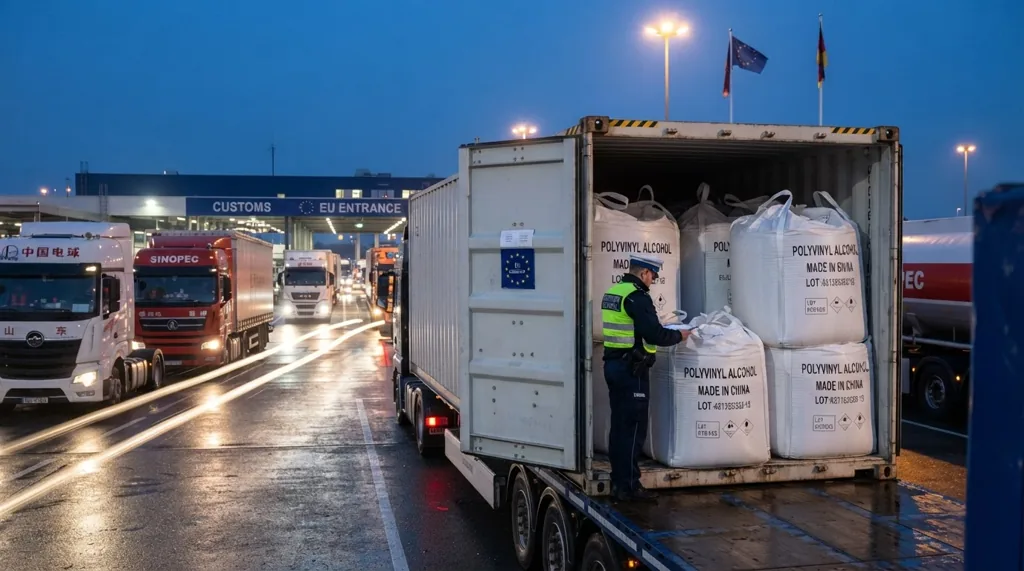
European Union customs must register imports of certain Sinopec Group polyvinyl alcohol resins from China from Oct. 10, 2026, so anti-dumping duties can be charged later.
The European Commission has ordered customs authorities in all EU member states to register imports of certain polyvinyl alcohols made in China by the Sinopec Group, starting Oct. 10, 2026, so that anti-dumping duties can later be charged on them after a reopened investigation1.
The measure is Commission Implementing Regulation (EU) 2026/2245 of 8 October 2026, published in the Official Journal on Oct. 9, 20261. It comes with a separate notice, published the same day, that reopens the original 2020 anti-dumping investigation for the Sinopec companies2.
In short, every shipment of this Sinopec plastic resin entering the EU will now be recorded by customs. If the reopened investigation ends with a new duty rate, the EU can use that record to charge the duty on these shipments afterwards.
What is the Sinopec PVA registration order?
Polyvinyl alcohol, or PVA, is a plastic resin that dissolves in water. Registration means customs keeps a record of each import, so that a duty can be charged later on goods already cleared1. It is not a new duty by itself.
The Commission acted under Article 14(5) of Regulation (EU) 2016/1036, the EU’s basic law on dumped imports1. Anti-dumping duty is an extra import tax on goods sold abroad below their normal price. The regulation says the purpose of registration is to make sure duties, if any, can be charged retroactively, meaning on imports made before the final decision1.
The Commission took this step on its own initiative1. No EU producer had to ask for it.
Which polyvinyl alcohol imports are covered?
The order covers only one group of goods from one group of makers. The goods are polyvinyl alcohols in the form of homopolymer resins, whether or not they contain unhydrolysed acetate groups1.
Which Sinopec PVA shipments customs registers
| Criterion | Condition |
|---|---|
| Form | Polyvinyl alcohol homopolymer resins |
| Viscosity | 3 to 61 mPa s, 4% solution at 20 °C |
| Degree of hydrolysis | 80.0 to 99.9 mol %, ISO 15023-2 method |
| Tariff codes | CN ex 3905 30 00, TARIC 3905 30 00 91 |
| Origin and maker | China, made by the Sinopec Group |
The resins must meet two technical limits, both measured by the ISO 15023-2 method1:
- Viscosity of 3 to 61 mPa s, measured in a 4% water solution at 20 °C.
- Degree of hydrolysis of 80.0 to 99.9 mol %.
These goods fall under CN code ex 3905 30 00, with TARIC code 3905 30 00 911. The "ex" means only part of that tariff heading is covered.
The goods must also originate in China and be made by the Sinopec Group1. Article 1 of the regulation names two makers:
- Sinopec Chongqing SVW Chemical Co. Ltd
- Sinopec Great Wall Energy & Chemical Ningxia Co.
PVA from other Chinese makers is not part of this registration order. The court rulings concerned only the Sinopec duty rate2.
Why did the Commission reopen the PVA case?
The story starts in 2019. On July 30, 2019, the Commission opened an anti-dumping investigation into PVA from China3. It followed a complaint lodged on June 19, 2019 by Kuraray Europe GmbH, on behalf of producers making more than 60% of EU output of PVA3.
That case ended with Commission Implementing Regulation (EU) 2020/1336 of 25 September 20203. It placed definitive anti-dumping duties on certain PVA from China3.
The Sinopec companies challenged the 2020 regulation in court. On Feb. 21, 2024, the EU General Court partly annulled it, in Case T-762/20, as far as it set the duty rate for the Sinopec Group1. The court found a manifest error of assessment, meaning a clear mistake, in how the Commission cut Sinopec’s export price2.
What did the EU courts decide on Sinopec’s export price?
The dispute is about how the duty rate was calculated. The Commission had treated Sinopec Central-China, a seller in the group, as a trader working on commission. It then lowered Sinopec’s export price to reflect that2.
From the 2019 complaint to registration
A lower export price makes the gap with the normal price larger. A larger gap gives a higher duty. The General Court said the Commission had not shown enough evidence that Sinopec Central-China acted like a commission agent2.
The Commission appealed. On Sept. 3, 2026, the Court of Justice of the European Union ruled in Case C-319/24 P2. It overturned the General Court on three other price adjustments, but confirmed the finding on the commission-agent adjustment2.
As a result, the 2020 regulation stays partly annulled for the Sinopec duty rate1. The notice says the rate should be recalculated without that adjustment2.
How does the reopened investigation work?
The Commission’s notice of initiation reopens the original investigation only for Sinopec Chongqing, Sinopec Ningxia and Sinopec Central-China2. It picks up at the point where the court found the mistake2.
Findings that the courts did not reject stay valid2. So the Commission does not start the whole case again. It only redoes the part on Sinopec’s export price.
The notice states the goal: to decide whether the duties could be imposed again at a revised level from the date the 2020 regulation first entered into force2. The answer could also be no.
What changes for importers of Sinopec PVA?
From Oct. 10, customs will register each shipment of the covered Sinopec resin1. Importers will not pay any extra duty because of registration alone.
The risk comes later. The Commission will judge the conditions for charging duties retroactively in the regulation that sets definitive duties at the end of the reopened case1. The regulation says any future liability will come from the final findings1.
The Commission did not give an estimate of how much might be owed. It said it did not find it appropriate to provide one at this time1.
The order also freezes refunds. National customs authorities must not decide on any request for repayment or remission of anti-dumping duties on Sinopec goods until the final regulation is in force1. Remission means cancelling a duty that has not yet been paid. Importers who have asked for money back after the court ruling will have to wait.
Who can take part, and by when?
All interested parties may send views, information and evidence to the Commission2. The notice names in particular the Chinese exporting producers concerned and the EU industry2.
Time to respond after the Oct. 9 notice, days
Written submissions must reach the Commission within 10 days of the notice’s publication on Oct. 9, 2026, unless the notice says otherwise2. Exporting producers and the EU industry may also ask to be heard by the investigation team2. A request to be heard must be in writing, give reasons, and arrive within 15 days of publication2.
A party that does not cooperate can be judged on the facts available. The notice warns that the result may then be less favourable to that party2.
When does the Sinopec registration end?
The regulation enters into force on the day after its publication in the Official Journal, which is Oct. 10, 20261. Registration expires nine months after that date1.
The reopened case will end with a Commission regulation concluding the re-examination1. That later act will set the Sinopec duty rate and decide whether registered imports pay it.
Key points on the Sinopec PVA registration
The table sums up the order and the reopened case.
| Question | Answer |
|---|---|
| What changed? | Customs must register Sinopec PVA imports |
| Who issued it? | European Commission |
| Legal act | Implementing Regulation (EU) 2026/2245 |
| Which goods? | Certain polyvinyl alcohol resins |
| Tariff codes | CN ex 3905 30 00, TARIC 3905 30 00 91 |
| Which makers? | Sinopec Group companies in China |
| Why? | Court partly annulled the 2020 Sinopec duty rate |
| Start date | Oct. 10, 2026 |
| How long? | Nine months |
| Refund requests | Frozen until the final regulation |
| Comments due | Within 10 days of Oct. 9, 2026 |
| Hearing requests | Within 15 days of Oct. 9, 2026 |
Registration runs for nine months from Oct. 10, 2026, and the comment period on the reopened case closes 10 days after the Oct. 9 notice2. The final regulation will decide whether Sinopec PVA already shipped must pay a new, recalculated duty.
Sources
- ↩ Implementing regulation – EU – 2026/2245 – EN – EUR-Lex https://eur-lex.europa.eu/eli/reg_impl/2026/2245/oj
- ↩ EUR-Lex – 52026XC05252 – EN – EUR-Lex http://data.europa.eu/eli/C/2026/5252/oj
- ↩ Implementing regulation – 2020/1336 – EN – EUR-Lex https://eur-lex.europa.eu/eli/reg_impl/2020/1336/oj