
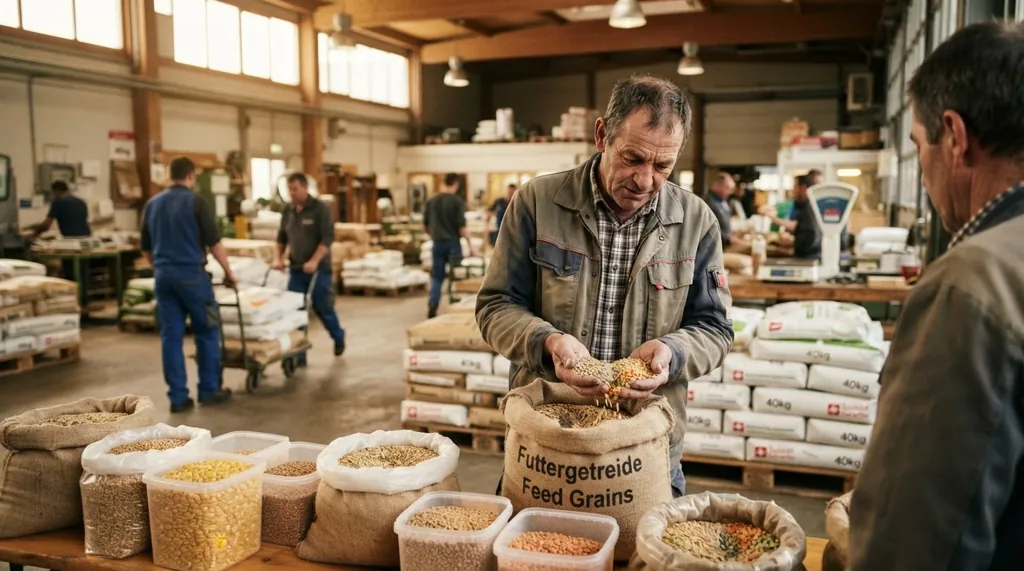
Switzerland has set new, mostly lower import duties on 130 tariff lines of feed cereals, pulses, feed flours and coarse grains for food from 1 October 2026.
Switzerland’s Federal Office for Agriculture (BLW) has set new, mostly lower import duties on 130 tariff lines of feed grains, pulses, cereal products and coarse grains for food, in force from 1 October 20261.
The change comes in an amendment to the Agricultural Import Ordinance, published in the official collection of federal law as AS 2026 4931. It replaces Annex 2 of the ordinance, the list of duties for seed grain, animal feed, oilseeds and coarse grains for food1.
In short, a shipment of feed barley, feed maize, feed oats or feed peas that clears Swiss customs from 1 October pays less duty per 100 kg than it did in September. Barley, oats and maize imported for food inside the tariff quota also pay less.
What did the BLW change on 1 October?
The amendment gives Annex 2 a new text1. The annex lists each tariff line with a duty in Swiss francs per 100 kg gross weight, which means the weight of the goods with their packing1. A star marks each rate that is newly set1.
By count of the stars in the annex, 130 tariff lines carry a new rate. The other lines keep the rate they had before. The BLW signed the amendment on Sept. 21, 2026, and it took effect on Oct. 1, 20261.
The rates in Annex 2 can differ from the general Swiss customs tariff1. For the goods it lists, the annex sets the duty that customs charges.
Which goods get lower duties?
The new rates cover four broad groups of farm goods:
- Feed cereals: wheat, rye, barley, oats, maize, rice, triticale, fonio, quinoa and other grains imported to feed animals.
- Coarse grains for food: barley, oats and maize imported for people to eat inside the tariff quota.
- Pulses for feed: dried peas, chickpeas, beans, lentils and similar crops, plus guar beans and sweetcorn for feed.
- Cereal products for feed: flours, grits, flakes and crushed grains made from wheat, maize, oats, rice and other cereals.
The annex also sets new rates on some products from chapter 23 of the tariff, the chapter for residues and prepared animal feed1. These include bran-type residues (lines 2302.1010 to 2302.4091) and some prepared feeds (lines 2309.9011 to 2309.9089)1.
Most oilseed lines in chapter 12, such as soybeans, rapeseed and sunflower seed, carry no star1. Their duties stay where they were.
How much lower are the feed grain duties?
The BLW publishes a table of import charges for feed, oilseeds and grain each month. Its September table shows the rates in force on Sept. 1, 20262. Comparing it with the new annex shows the size of each cut. In this article, every September rate comes from that table, and every October rate from the annex.
Feed grain duty from 1 October, francs per 100 kg
For feed barley (line 1003.9059), the duty falls from 9 francs to 6 francs per 100 kg1. For feed oats (line 1004.9039) it falls from 4 francs to 1 franc2. The new annex sets 1.00 franc for that line1.
For feed maize (line 1005.9039), the duty falls from 4 francs to 2 francs per 100 kg1. For feed wheat (lines 1001.1939 and 1001.9939) and feed rye (line 1002.9039), it falls from 10 francs to 7 francs2. The annex confirms 7.00 francs for each of these lines1.
Feed rice drops to zero. The four rice lines for feed that contain no other grain (1006.1029, 1006.2029, 1006.3029 and 1006.4029) paid 1 franc in September2. They are now duty-free, at 0.00 francs1.
Grain mixes for feed that contain other cereals, marked "G" in the BLW table, paid 10 francs per 100 kg in September2. These lines now pay 9 francs1.
What happens to the three coarse grains for food?
Switzerland lets a fixed amount of coarse grain for food in at a low duty. This is a tariff quota, a set volume that enters at a lower rate before a higher rate applies. For coarse grains for food it is quota No. 282.
In-quota duty on grains for food, francs per 100 kg
| Grain | September 2026 | From 1 October 2026 |
|---|---|---|
| Barley for food | 2.05 | 1.40 |
| Oats for food | 0.70 | 0.20 |
| Maize for food | 1.00 | 0.50 |
The amendment cuts the in-quota duty on all three grains it covers:
- Barley for food (line 1003.9041): from 2.05 francs to 1.40 francs per 100 kg1.
- Oats for food (line 1004.9021): from 0.70 franc to 0.20 franc per 100 kg1.
- Maize for food (line 1005.9021): from 1.00 franc to 0.50 franc per 100 kg1.
The BLW table shows that each in-quota rate is a set share of the feed rate for the same grain2. The barley rate is 23% of the feed barley rate, oats 18% and maize 25%2. When the feed rate falls, the food rate inside the quota falls with it.
How much lower are the duties on pulses and feed flours?
The cuts on pulses for feed are smaller, mostly 1 franc per 100 kg. Dried peas for feed (line 0713.1011) fall from 4 francs to 3 francs per 100 kg1. Lentils for feed (line 0713.4011) fall from 5 francs to 4 francs1.
Guar beans for feed (line 0708.9010) fall from 5 francs to 4 francs1. Sweetcorn for feed, fresh or dried (lines 0709.9991 and 0712.9070), falls from 4 francs to 2 francs1.
Pulses for technical use, such as industrial processing, pay 10% of the feed rate2. So dried peas for technical use (line 0713.1012) fall from 0.40 franc to 0.30 franc1.
Cereal products for feed also pay less. Maize flour for feed (line 1102.2020) falls from 6 francs to 4 francs1. Oat flakes for feed (line 1104.1220) fall from 23 francs to 20 francs1. Wheat flour for feed (line 1101.0059) falls from 21 francs to 18 francs1.
Why does Switzerland change feed duties so often?
Feed imports into Switzerland work under a threshold price system3. The threshold price is the target price at which a feed can be imported with duty paid3. The BLW’s feed page says the threshold price helps make sure Swiss-grown crops still sell3.
The BLW runs this system under the Agricultural Import Ordinance and sets the duty3. It checks the border charges on feed every month3. When world prices move, the duty moves too, so the price of imported feed stays near the target.
The amendment rests on Article 20(5) of the Swiss Agriculture Act of April 29, 19981. The Federal Council’s report to parliament on tariff measures in 2025 says changes to border charges on feed, oilseeds and coarse grains for food are published on the BLW website4.
Who collects the duty, and what else is charged?
Two charges make up the border protection on feed: the customs duty and a guarantee fund contribution3. The guarantee fund contribution helps pay for Switzerland’s compulsory emergency stocks4.
The Federal Office for Customs and Border Security (BAZG), Switzerland’s customs service, collects the duty3. Réservesuisse, the organisation that runs the compulsory stocks, collects the guarantee fund contribution3. AS 2026 493 sets only the customs duty1.
In September, most feed cereals paid a guarantee fund contribution of 8 francs per 100 kg on top of the duty2. Feed barley, for example, paid 9 francs of duty and 8 francs of contribution2. The amendment does not set the contribution, so the total charge from October depends on both.
Some feeds also need a general import licence. When a feed falls under compulsory stockholding, the importer needs a general import licence (GEB), applied for through réservesuisse3. The BLW itself does not require an import licence for feed3.
Who is affected by the lower rates?
Swiss feed mills and livestock farmers that buy imported grain pay less duty on each shipment from October. A tonne of feed barley, for example, pays 60 francs of duty instead of 90 francs, based on the per-100 kg rates1.
Food makers that import barley, oats or maize within quota No. 28 also pay less. Exporters of feed grains, pulses and cereal flours to Switzerland face a lower duty at the border.
Customs brokers must apply the new annex rates from Oct. 1. The BLW states that its monthly table is a guide only, and that the legal act is binding2. For any line, the rate in AS 2026 493 is the one that counts.
When will the rates change again?
The BLW published its 2026 schedule of new border charges in November 20255. The October rates were due for publication on its website on Monday, Sept. 28, 20265.
Swiss feed duty dates
The next change is set for Nov. 1, 2026, with publication on Oct. 28, 20265. After that, new rates are due on Dec. 1, 2026 and Jan. 1, 20275. Each round can raise or lower the duty on any line, depending on prices.
Key points on Swiss feed and coarse grain duties
The table sums up the October change.
| Question | Answer |
|---|---|
| What changed? | New import duties on 130 tariff lines |
| Who issued it? | Federal Office for Agriculture (BLW) |
| Legal act | AS 2026 493, Annex 2 of the import ordinance |
| Which goods? | Feed cereals, pulses, feed flours, coarse grains for food |
| Feed barley duty | 6 francs per 100 kg, down from 9 |
| Feed wheat and rye duty | 7 francs per 100 kg, down from 10 |
| Barley for food, in quota | 1.40 francs, down from 2.05 |
| Oats for food, in quota | 0.20 franc, down from 0.70 |
| Maize for food, in quota | 0.50 franc, down from 1.00 |
| Who collects the duty? | BAZG, the Swiss customs service |
| Start date | Oct. 1, 2026 |
| Next change | Nov. 1, 2026 |
The rates in AS 2026 493 apply to shipments cleared from Oct. 1, 20261. The BLW’s next set of feed and grain duties is due on Oct. 28, 2026 and takes effect on Nov. 1, 20265.
Sources
- ↩ Verordnung über die Einfuhr von landwirtschaftlichen Erzeugnissen (Agrareinfuhrverordnung, AEV) https://www.fedlex.admin.ch/filestore/fedlex.data.admin.ch/eli/oc/2026/493/de/pdf-a/fedlex-data-admin-ch-eli-oc-2026-493-de-pdf-a.pdf
- ↩ Grenzbelastung für Futtermittel, Ölsaaten und Getreide.pdf https://www.blw.admin.ch/dam/de/sd-web/pFNEWoY7cIZi/Grenzbelastung%20f%C3%BCr%20Futtermittel%2C%20%C3%96lsaaten%20und%20Getreide.pdf
- ↩ Futtermittel für Nutztiere und Heimtiere https://www.blw.admin.ch/de/futtermittel
- ↩ Bericht über zolltarifarische Massnahmen im Jahr 2025 https://www.fedlex.admin.ch/filestore/fedlex.data.admin.ch/eli/fga/2026/201/de/pdf-a/fedlex-data-admin-ch-eli-fga-2026-201-de-pdf-a.pdf
- ↩ Publikationstermine 2026_d.pdf https://www.blw.admin.ch/dam/de/sd-web/3RE5vMX6L2f-/Publikationstermine%202026_d.pdf