
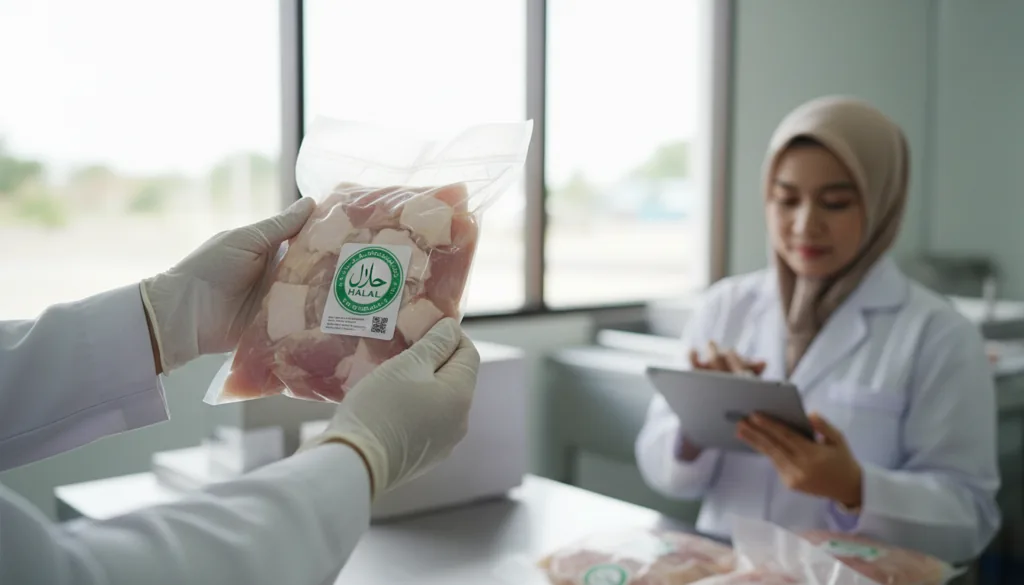
Indonesia has issued a draft regulation to establish mandatory duties for halal supervisors to ensure compliance and authenticity in halal products across all sectors including halal food, halal meat, halal beverages, halal cosmetics, and halal certified products
Indonesia’s halal regulator has set mandatory fees for halal supervisors, a move that will raise the delivered cost of every certified product sold in the country from next month.
The new tariff, published by the Halal Product Assurance Agency (BPJPH), covers food, meat, drinks, cosmetics and any other item that must carry a halal certificate before it can be sold. The charge is paid by the company that applies for the certificate, and the agency said it will be collected from 17 October 20261.
It is the last piece of a five-year roll-out that began in 2021. Large and medium-sized businesses have already been paying for halal certification since October 2024; the October 2026 deadline brings micro and small enterprises into the same regime. Importers of foreign-made goods have until the same date to comply, provided their home country has a mutual-recognition agreement with Indonesia1.
Who the new fees hit
The levy is calculated per supervisor-hour and varies by product risk. A low-risk food item such as bottled water will be charged Rp 150,000 ($9.50; £7.30) per hour; a high-risk product such as processed meat or a cosmetic containing animal-derived ingredients will cost Rp 300,000 per hour2. The agency estimates that a typical small food manufacturer will need between two and four hours of supervision, lifting its certification cost to between Rp 300,000 and Rp 1.2 million per product line3.
Supervisor fee by product risk
For importers, the fee is added to the cost of testing, documentation and the certificate itself. The agency said the combined cost will still be lower than the penalty for selling an uncertified product, which can reach Rp 2 billion or two years in prison2.
What the money pays for
The tariff replaces an earlier system in which the government subsidised the entire certification process. Under the new rules, the company applying for the certificate must pay for the supervisor’s time, travel and accommodation, plus a 10 % administrative fee2. The agency said the change is intended to make the system self-funding and to reduce the waiting time for an inspection from 30 days to 143.
From payment to certificate
Supervisors are trained and licensed by BPJPH. They verify that ingredients, production lines and storage areas comply with halal standards, and they witness the slaughter of animals. Their report is then sent to the Indonesian Council of Ulama (MUI), which issues the final fatwa and the certificate2.
The October 2026 deadline
Micro and small businesses—those with annual sales below Rp 2.5 billion or fewer than 20 employees—have been given an extra two years to comply. From 17 October 2026, every food and drink they sell must carry a halal certificate1. The agency said it will offer free training and low-interest loans to help them meet the deadline, but it has not yet published the list of approved lenders3.
Who is caught, and when
| Deadline | Who it catches | What falls due |
|---|---|---|
| October 2024 | Large and medium-sized businesses | Already paying for halal certification |
| 17 Oct 2026 | Micro and small enterprises | Every food and drink sold must carry a halal certificate |
| 17 Oct 2026 | Importers from countries with a mutual-recognition agreement | Same certification deadline |
| After Oct 2026 | Goods from countries without an agreement | Barred from entry unless certified by an Indonesian-approved foreign halal body |
Importers of foreign goods have the same deadline, but only if their country has signed a mutual-recognition agreement with Indonesia. So far, such agreements exist with Malaysia, Singapore, the United Arab Emirates and Saudi Arabia; talks with Australia, New Zealand and the European Union are still under way3. Goods from countries without an agreement will be barred from entry after October 2026 unless they carry a certificate issued by an Indonesian-approved foreign halal body1.
What the change replaces
Until now, micro and small businesses could use a self-declaration system. They filled out an online form, paid a small registration fee, and received a provisional certificate without an on-site inspection4. The system was introduced in 2021 to speed up certification for the smallest operators, but the agency said it was widely abused: some businesses declared ingredients they did not use, while others simply copied certificates from competitors4.
Self-declaration is out; inspection is in
The new regulation scraps self-declaration for micro and small businesses and replaces it with the same inspection process used for larger companies. The agency said the change is necessary to protect consumers and to bring Indonesia’s halal standards in line with those of Malaysia and the Gulf states2.
The bigger picture
Indonesia is the world’s largest Muslim-majority country and its halal market is worth an estimated $219 billion a year5. The government wants to turn the country into a global halal hub by 2029, and it sees mandatory certification as the first step3. The agency said the new fees will generate enough revenue to train 10,000 new supervisors and to open 34 regional offices by the end of 20273.
It also expects the change to lift exports. Many Muslim-majority countries require halal certification for imported food and cosmetics, and the agency said Indonesian exporters will now find it easier to meet those requirements3. The United States and the European Union do not require halal certification, but some importers in those markets ask for it voluntarily, and the agency said the new system will make it easier for Indonesian companies to supply them6.
The agency’s strategic plan for 2025-2029 sets a target of 15 million certified products by 2029, up from 9.8 million at the end of 20255. It said the new fees are a small price to pay for access to a market that is growing at 6 % a year and that is expected to reach $5 trillion globally by 20303.
Sources
- ↩ BPJPH Serukan Tertib Halal sebagai Strategi Penguatan Bisnis untuk Wajib Halal Oktober 2026 https://bpjph.halal.go.id/read/sambut-wajib-halal-oktober-2026-kepala-bpjph-serukan-tertib-halal-sebagai-strategi-penguatan-bisnis
- ↩ WTO TBT notification 26-04469 — Indonesia https://members.wto.org/crnattachments/2026/TBT/IDN/26_04469_00_x.pdf
- ↩ Strategic Plan 2025-2029 for BPJPH https://cmsbl.halal.go.id/uploads/Rencana_Strategis_BPJPH_2025_2029_896446ca2d.pdf
- ↩ Academic Draft and Regulation Proposal on Accelerating Halal and Hygienic Product Implementation in Samarinda City https://jdih.samarindakota.go.id/produk-hukum/382eb182-9d2a-11f1-b5a0-3868dd9db0ea?purpose=download
- ↩ BPJPH One Year as LPNK: Halal Certified Products Reach 9.8 Million https://bpjph.halal.go.id/read/1-tahun-bpjph-produk-bersertifikat-halal-tembus-9-8-juta
- ↩ BPJPH Offers Three Strategies for PCINU to Strengthen Indonesia’s Global Halal Supply Chain https://bpjph.halal.go.id/read/bpjph-tawarkan-tiga-strategi-bagi-pcinu-perkuat-peran-indonesia-dalam-rantai-pasok-halal-global