
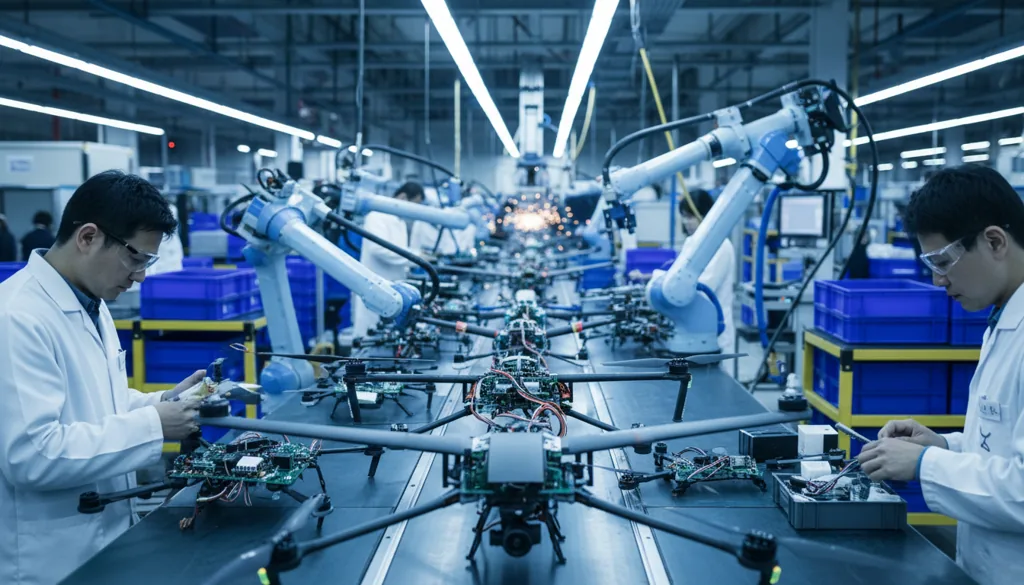
United States imposes tariffs on Unmanned Aircraft Systems (UAS) and their parts and components, effective 2026-08-28.
The White House has imposed new tariffs on imported drones and their parts, raising duties to up to 100% on some models from 28 August 2026 in a move aimed at protecting U.S. national security and boosting domestic production.
The measures target unmanned aircraft systems (UAS) and components, including drones weighing more than 25 kilograms and those with thermal imaging capabilities, as well as critical parts like motors, batteries, and docking stations. Smaller drones and less sensitive components face a 25% tariff, while imports from the UK, EU, Japan, South Korea, Switzerland, Liechtenstein, and Taiwan are hit with a 15% duty1. The changes come after a Commerce Department investigation found that U.S. reliance on foreign drone supplies posed unacceptable risks to military readiness and cybersecurity.
The tariffs and who they hit
The highest duties apply to drones with a maximum take-off weight above 25 kilograms, thermal imagers, and docking stations, which now face a 100% tariff1. Smaller drones—those under 25 kilograms—are subject to a 25% duty, as are most components not covered by the stricter rules. Imports from the UK receive a lower 10% tariff, while those from the EU, Japan, South Korea, Switzerland, Liechtenstein, and Taiwan are taxed at 15%2.
The tariff ladder, by product and origin
| Covered by | Rate | Applies to |
|---|---|---|
| Heavy and sensitive kit | 100% | Drones above 25 kg take-off weight, thermal imagers, docking stations |
| Standard band | 25% | Drones under 25 kg and most other components |
| Partner-country rate | 15% | EU, Japan, South Korea, Switzerland, Liechtenstein, Taiwan |
| UK rate | 10% | Imports from the UK |
| Onshoring carve-out | None | Firms with a plan approved by DHS or the Department of War to shift production to the U.S. |
The tariffs take effect in stages. The 100% and 25% duties on drones and sensitive components start on 28 August 2026, while tariffs on less critical parts begin 180 days later1. Companies that commit to shifting production to the U.S. under an "onshoring plan" approved by the Department of Homeland Security or the Department of War can avoid the new duties entirely2.
The Commerce Department’s investigation found that most U.S.-made drones still depend on foreign parts, leaving the country vulnerable to supply chain disruptions. Critical components like lithium-ion batteries, electronic speed controllers, and motors are overwhelmingly sourced from overseas, creating what the report called "unacceptable national security vulnerabilities"3.
Why the U.S. acted now
The tariffs are the latest in a series of measures under Section 232 of the Trade Expansion Act, which allows the president to restrict imports that threaten national security. The Trump administration has previously used the law to impose tariffs on steel, aluminum, and other goods, arguing that decades of offshoring left the U.S. dangerously dependent on foreign supply chains4.
How the U.S. got here
Drones have become central to modern military operations, from surveillance to strike missions, and the U.S. has struggled to keep pace with foreign competitors. The Commerce Department found that domestic production is insufficient to meet demand, particularly in a crisis, and that imports from adversarial nations could expose U.S. systems to cyber threats2. The new tariffs are designed to spur investment in U.S. manufacturing, reduce reliance on foreign suppliers, and ensure the country can scale production quickly in an emergency.
The move follows a June 2025 executive order aimed at securing American dominance in drone technology, which called for prioritizing U.S.-made systems and tightening export controls4. Earlier this year, the administration also declared a national emergency to protect the bulk-power system from foreign interference, citing similar concerns about supply chain vulnerabilities4.
Who pays and what it costs
The tariffs will raise the delivered cost of imported drones and parts, with the steepest increases hitting larger, more sophisticated models. A drone weighing 30 kilograms, currently priced at $10,000, would see its cost jump to $20,000 after the 100% duty1. Smaller consumer drones, which typically sell for $500 to $2,000, will face a 25% markup, adding $125 to $500 to their price5.
A 30 kg drone’s price tag, before and after the 100% duty
The burden falls heaviest on commercial operators, law enforcement agencies, and the military, which rely on heavier drones for tasks like infrastructure inspection, search-and-rescue missions, and battlefield surveillance. The Pentagon has warned that foreign-made drones could be compromised by malware or used to gather intelligence, making domestic alternatives a priority1.
For now, the tariffs do not apply to companies that agree to produce drones or components in the U.S. under an approved onshoring plan. The Commerce Department is expected to release details on how firms can qualify for the exemption in the coming months2.
What the tariffs do not change
The new duties do not affect drones or parts already in the U.S. or those shipped before the tariffs take effect. They also do not apply to components that are not "specially designed" for drones, such as generic batteries or motors that could be used in other products6.
What escapes the tariffs
Export controls on drones remain in place, though the Commerce Department has relaxed some restrictions on widely available models to help U.S. manufacturers compete abroad. The administration argues that outdated rules were pushing foreign buyers toward less restricted suppliers, undermining American influence6. The changes allow U.S. firms to sell certain drones without a license, provided they do not exceed performance thresholds like flight endurance or wind resistance.
The tariffs also leave untouched existing trade agreements with close allies. Drones and parts from the UK, EU, Japan, and other partners face lower duties than those from countries not covered by the exemptions, reflecting efforts to balance security concerns with diplomatic ties2.
The road ahead
The tariffs are set to remain in place indefinitely, though the Commerce Department will review their impact within two years. The administration has signaled that further measures could follow if domestic production does not ramp up quickly enough to meet demand5.
Industry groups have warned that the tariffs could disrupt supply chains for commercial operators, particularly in agriculture, construction, and emergency services, where drones are increasingly used for tasks like crop monitoring and disaster response. The higher costs may also slow adoption among smaller businesses and public agencies with limited budgets.
The move comes as the U.S. seeks to counter China’s dominance in drone manufacturing, which supplies an estimated 70% of the global market. The administration has framed the tariffs as a necessary step to ensure that critical technology remains under American control, even if it means higher prices in the short term1. The next test will be whether the policy succeeds in spurring enough domestic production to offset the loss of foreign suppliers—or whether it simply raises costs without reducing dependence on overseas parts.
Sources
- ↩ Fact Sheet: President Donald J. Trump Bolsters National Security and Strengthens U.S. Supply Chains by Imposing Tariffs on Drones and Their Parts and Components https://www.whitehouse.gov/fact-sheets/2026/08/fact-sheet-president-donald-j-trump-bolsters-national-security-and-strengthens-u-s-supply-chains-by-imposing-tariffs-on-drones-and-their-parts-and-components/
- ↩ Adjusting Imports of Unmanned Aircraft Systems https://public-inspection.federalregister.gov/2026-16979.pdf
- ↩ Adjusting U.S. Imports of Unmanned Aircraft Systems https://www.whitehouse.gov/presidential-actions/2026/08/adjusting-imports-of-unmanned-aircraft-systems-and-unmanned-aircraft-systems-components-into-the-united-states/
- ↩ President Trump Declares National Emergency to Secure Bulk-Power System https://www.whitehouse.gov/fact-sheets/2026/08/fact-sheet-president-donald-j-trump-declares-a-national-emergency-to-secure-americas-bulk-power-system/
- ↩ Adjusting Imports of Unmanned Aircraft Systems and Components into the United States https://www.federalregister.gov/documents/2026/08/19/2026-16979/adjusting-imports-of-unmanned-aircraft-systems-and-unmanned-aircraft-systems-components-into-the
- ↩ Streamlining Drone Export Controls https://www.federalregister.gov/documents/2026/08/14/2026-16628/streamlining-export-controls-for-drone-exports