
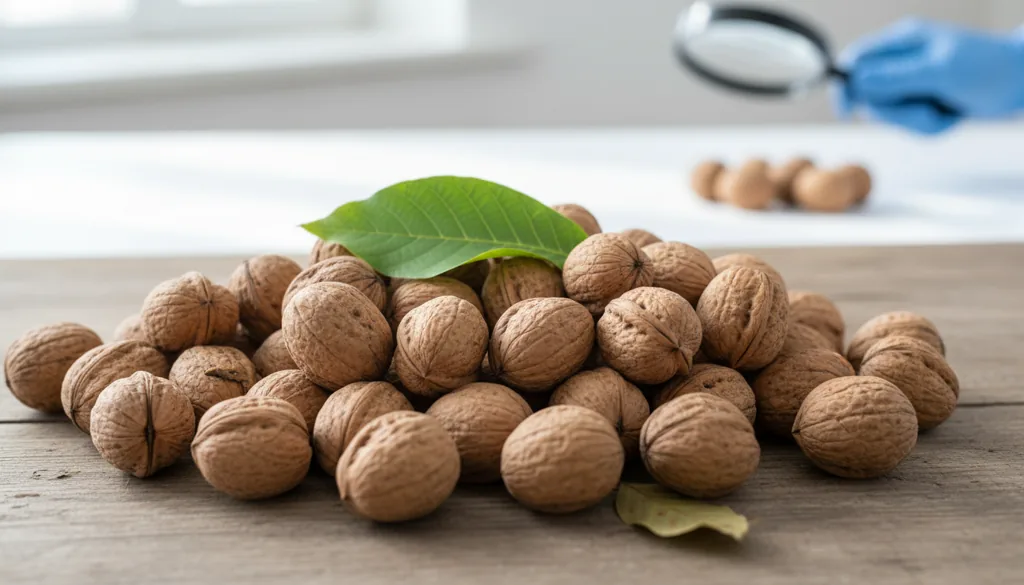
Colombia has established phytosanitary requirements for the importation into the country of in-shell walnuts (Juglans regia L.) originating in and coming from Chile for human consumption.
Colombia’s plant-health agency has set the first ever plant-health rules for in-shell walnuts shipped from Chile, a move that will add paperwork and inspection costs for every tonne that crosses the border. The new requirements, published on 17 July 2026, take effect the day they appear in the official gazette and cover only Chilean walnuts (Juglans regia L.) sold for human consumption. Importers must now pay for a certificate from Chile’s plant-protection agency, new packaging, and an on-arrival inspection that can tie up shipments for days.
The delivered cost of a tonne of Chilean walnuts will rise by roughly 3-5 % once the rules bite, according to the resolution’s own cost-benefit analysis. That is small enough to leave regional prices largely unchanged, but large enough to push some smaller traders out of the market. Colombia imported 12,400 tonnes of in-shell walnuts last year, almost all from Chile, and the new regime will apply to every kilogramme from the moment the gazette notice appears1.
It comes after a two-year risk assessment that began in March 2025 and was finalised in April 2026. The assessment identified five bacterial diseases and two fungal pests that could hitch a ride on walnut shells, and the new rules are designed to keep those out of Colombia’s orchards and packing houses1.
What the new rules demand
Every shipment must carry a plant-health certificate issued by Chile’s national plant-protection organisation. The certificate must state that the walnuts were inspected and tested in Chile and are free of the seven pests named in the resolution. Importers must also ensure that the nuts are packed in new, first-use containers and that every box is marked with the botanical name Juglans regia L.2.
What every shipment must now carry
On arrival, the shipment will be held at the port of entry until ICA inspectors complete a visual check and take samples for laboratory testing. If any pest is found, the entire shipment can be refused entry, re-exported, or destroyed at the importer’s expense. The resolution does not set a maximum inspection time, so delays of three to five days are possible2.
Who pays the bill
The importer pays for all of it: the Chilean certificate, the new packaging, the port inspection, and any storage fees while the shipment is held. The resolution does not cap those costs, and ICA has not published a fee schedule for the on-arrival tests. Industry estimates suggest the total compliance cost will run to about 150,000 Colombian pesos (US $37) per tonne, a figure that could double if the shipment is detained for several days1.
Estimated compliance cost per tonne, Colombian pesos
Small traders who bring in fewer than 20 containers a year will feel the pinch most sharply. For them, the fixed cost of the certificate and the risk of a failed inspection may make Chilean walnuts uncompetitive against other tree nuts that still enter under the old, lighter regime.
What the old rules looked like
Before the resolution, Chilean walnuts entered Colombia under the same general plant-health rules that applied to all nuts. Those rules required only a commercial invoice and a basic import declaration; no pre-shipment certificate was needed, and packaging could be reused. The new resolution replaces that light-touch regime with a product-specific set of controls that mirror the stricter rules Colombia already applies to avocados, citrus, and stone fruit from Chile3.
Chilean walnuts: regimes compared
| Requirement | Old regime | New regime | Peru & Ecuador |
|---|---|---|---|
| Scope | All nuts, general rules | In-shell walnuts only | Dedicated walnut protocol |
| Paperwork | Invoice, import declaration | Plus plant-health certificate | Certificate since 2022 |
| Packaging | Reuse allowed | New, first-use only | Certified packaging |
| On arrival | No inspection required | Port hold, visual and lab checks | Border inspection |
The change also brings Colombia into line with the Andean Community’s regional plant-health standards. Peru and Ecuador have required plant-health certificates for Chilean walnuts since 2022, so the new rules simply close a gap that left Colombia as the only Andean country without a dedicated walnut protocol1.
What happens if the rules are broken
Any breach of the new requirements—missing certificate, reused packaging, or unmarked boxes—can trigger fines of up to 100 million Colombian pesos (US $24,500) per shipment. Repeat offenders can be barred from importing walnuts for up to two years. The resolution also gives ICA inspectors police powers to seize and destroy non-compliant shipments on the spot2.
The rules do not set a grace period, so the first container that arrives after the gazette notice appears must meet every requirement or face immediate penalties. ICA has said it will publish guidance on its website, but the resolution itself is the only legally binding text, and it leaves no room for transitional leniency.
The next review
The resolution instructs ICA to review the rules within 24 months of publication. That review will look at whether the seven pests named in the resolution are still the only risks, whether the inspection regime is catching them, and whether the rules should be extended to walnuts from other countries. ICA has not said whether it will open a new public consultation before any changes, but the agency’s past practice suggests it will1.
How the rules arrived
In the meantime, the new regime will stay in place indefinitely. Importers who want to avoid the extra cost and delay can still bring in shelled walnuts, which remain subject to the old, lighter rules. For in-shell walnuts, however, the only way forward is compliance: a certificate, new boxes, and a port inspection for every shipment.
Sources
- ↩ WTO SPS notification 26-03906 — Colombia https://members.wto.org/crnattachments/2026/SPS/COL/26_03906_00_s.pdf
- ↩ Fitossanitary Requirements for Importing Walnut Nuts from Chile to Colombia https://www.ica.gov.co/getattachment/da3a9e98-4cda-4c8d-9bc8-99842e4dd1fe/2026R00013900.aspx
- ↩ Phytosanitary and Zoosanitary Import Documentation Requirements https://www.ica.gov.co/servicios_linea/sispap_principal/documentos/anexo12.aspx