

 Apr 28,2026
  By Alice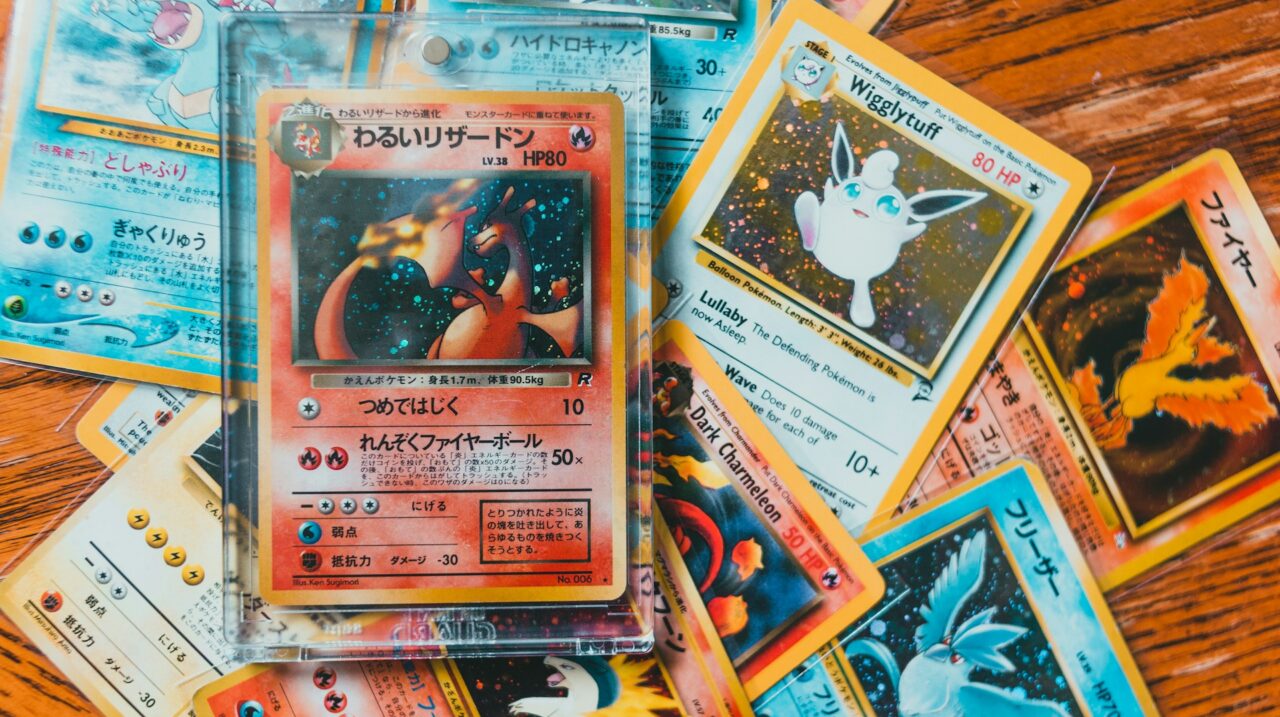
Trading cards, also known as collectible cards, have seen a surge in sales in recent years. According to Axios, from February 2024 to June 2025, trading cards have become a trend, and the sales of these collectible products have surged by more than 200% on eBay. The rise in popularity of game or cartoon characters and sports athletes drives people to buy trading cards. The intensity of people buying trading cards is solely for collection, hobby, and some tend to buy for investment. They hope that the price of limited edition cards will skyrocket in the future. Since the popularity of trading cards has gained traction, this is a chance to learn about this business. Then, we will explore the HS tariff code for trading cards, along with the major suppliers and market, and how to find the HS tariff code for trading cards.
What are Trading Cards and What are the Types of Trading Cards?
Trading cards are not only cardboard cards with a picture of game characters or sports athletes. In fact, these collectible cards are valuable assets and act as an investment. Therefore, trading cards are designed for the collection of some characters from games or sports, and even non-sports figures. The invention of trading cards is for facilitating the fans of pop culture, including game characters, legendary sports figures from the NBA or NFL, Hockey, or non-sport figures.
Not only character imagery, but some trading cards are also supplied with the statistics based on the character abilities, brands, rarity, and hologram to make them exclusive. The most interesting thing about trading cards is that they can be distinguished into several categories. The most common of trading cards is trading card games (TCG) due to the rise in popularity of Pokémon. Here is the complete list of category trading cards.
1. Trading Card Games (TCGs): TCGs are no doubt the most common collectible cards in the world. These cards depict the image of various popular game characters, such as Pokémon, Yu-Gi-Oh!, Digimon, and other game characters.
2. Sport Cards: These cards are the second most popular trading cards. As the name suggests, these cards illustrate the sports athletes from various branches, including baseball, football, soccer, tennis, and others.
3. Collectible Card Games (CCGs): Similar to TCGs, and sometimes they are called a synonym of CCGs. However, CCGs are different than TCGs, even if they also depict the various game characters, but CCGs focus less on trading parts. So, CCGs are focusing on the character story and their behaviours, abilities, and mores.
4. Non-Sport Cards: These cards represent the figures or characters from other than sports. Non-Sport Cards commonly illustrate anime characters, movies, television actors, or other entertainment characters.
5. Art or Customizable Cards: These cards differ from other trading cards because they mainly emphasize handcrafted and customizable art design on cardboard. Art cards can be a unique illustration from artists or a photo from photographers that are sold in a limited edition.
List of HS Codes for Trading Cards and Games
After understanding the meaning and types of trading cards. Let’s move to the point of the article, which is the HS tariff code for trading cards. The declaration of the HS tariff code for trading cards is a requirement for the export and import process. No surprise that the understanding of the structure of the HS tariff code for trading cards is crucial for international trade parties before sending collectible cards to the destination country.
According to the World Customs Organization (WCO), trading cards are classified under Chapter 49 along with printed books, newspapers, pictures, and others. However, there are no HS headings that specifically represent trading cards, thus, it can be classified under Heading 4911 that covers other printing matters, including pictures and photographs. Then, trading cards can be categorized under HS Subheading 4911.91, which mentions pictures, designs, and photographs.
Even though trading cards are identical to playing cards, the functions of the two cards are different. However, the HS tariff code for trading cards, specifically for games and sports figures, is under Chapter 95. The reason because it is still categorized as playing cards, such as regular playing cards, Uno, and others. The full 6-digit sequence of HS code for trading card games (TCGs) is 9504.40.
| HS Code Structure | Description |
| 4911.91 | Printed pictures, designs, and photographs |
| 4911.99 | Other printed pictures, designs, and photographs |
| 9504.40 | Playing cards, including characters of games and sports figures. |
Top 5 Trading Cards Exporters and Importers
To get to know more about the trade of collectible cards on the international stage, we will provide the data on the largest exporters and importers. This insight is essential to understand where the biggest suppliers of trading cards are and where the countries that act as the largest buyers are. These are the biggest exporters of trading cards under HS code 9504.40 in the world in 2024.
| Country | Total Export Value (USD) |
| Japan | 726,476,145 |
| United States | 368,079,644 |
| Germany | 356,535,437 |
| Netherlands | 305,634,342 |
| China | 303,118,163 |
Source: UN Comtrade Database, accessed April 6, 2026
As you can see, Japan is the largest exporter of trading cards because of the popularity of games and anime characters. Those characters, especially from Pokémon, have huge fan bases across the globe. The second position held by the United States is due to the largest popularity of sports cards from the NBA, NFL, and other sports branches’ athletes. The remaining largest trading card exporting countries include Germany, the Netherlands, and China.
| Country | Total Export Value (USD) |
| United States | 483,889,414 |
| Germany | 358,525,526 |
| France | 203,538,949 |
| United Kingdom | 151,754,847 |
| Macao | 123,660,981 |
Source: UN Comtrade Database, accessed April 6, 2026
The United States is the world’s largest importer of trading cards. Since there is an increased popularity of TCGs among people in the United States, most people buy through offline or online marketplaces, such as eBay. The remaining countries that act as European countries, including Germany, France, and the United Kingdom, dominate the biggest importers. Meanwhile, the last one is Macao, which is known as the hub of casinos in Asia.
How to Find the HS Tariff Code for Trading Cards
After understanding the largest trade route for trading cards, we shall know how to find the HS tariff code for trading cards. As we mentioned above, the declaration of the HS tariff code must follow the national standard in the destination country. Thus, a 6-digit HS code administered by the World Customs Organization (WCO) is only the initial step for declaration in the export and import process.
To make it simple, HSCodeMatch appears to assist you in finding the accurate HS tariff code for trading cards and other products instantly. You do not need to access the national websites of the destination country one by one to find a specific HS tariff code for trading cards. The following steps will guide you to find the correct HS code for collectible cards with HSCodeMatch. For example, we can use the largest exporter and importer of trading cards, namely Japan, to the United States.
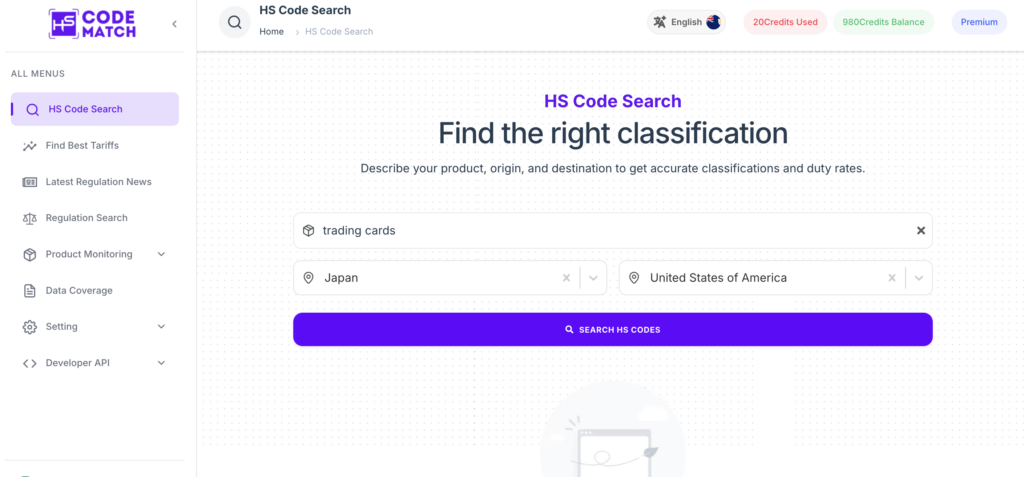
- Step 1: Access the HSCodeMatch homepage by clicking hscodematch.com. Choose the Go to App on the right-hand side of the HSCodeMatch page. Click the HS Code Search and fill in the product name with “trading cards,” and set the United States as the destination and Japan as the origin country.
- Step 2: HSCodeMatch instantly shows the most relevant HS tariff codes for trading cards. You just click the HS code 950440000000 in the United States or click View Details to see more of the HS code description and tariff rates on HS Code Details.
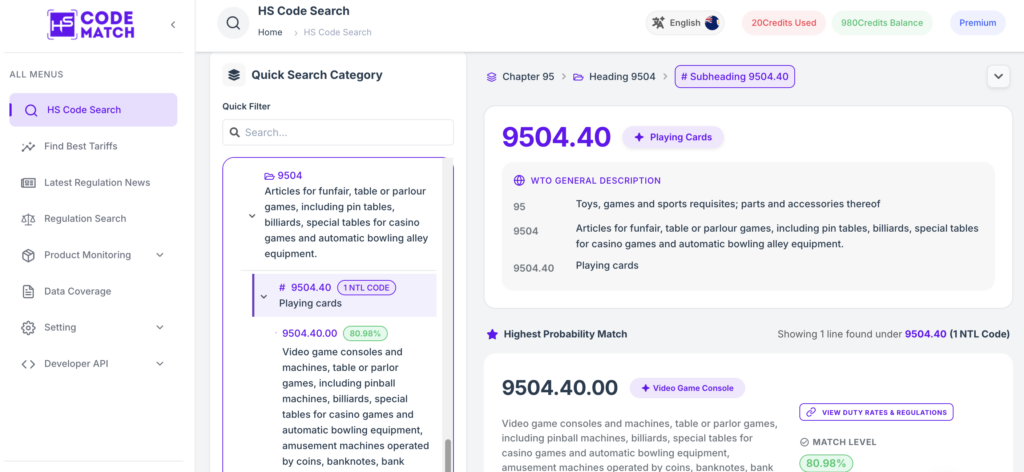
- Step 3: See, the HS Code Details provides the import duty rate and HS code description. This is important to help you check whether this is an accurate HS tariff code for the trading cards you are looking for or not.
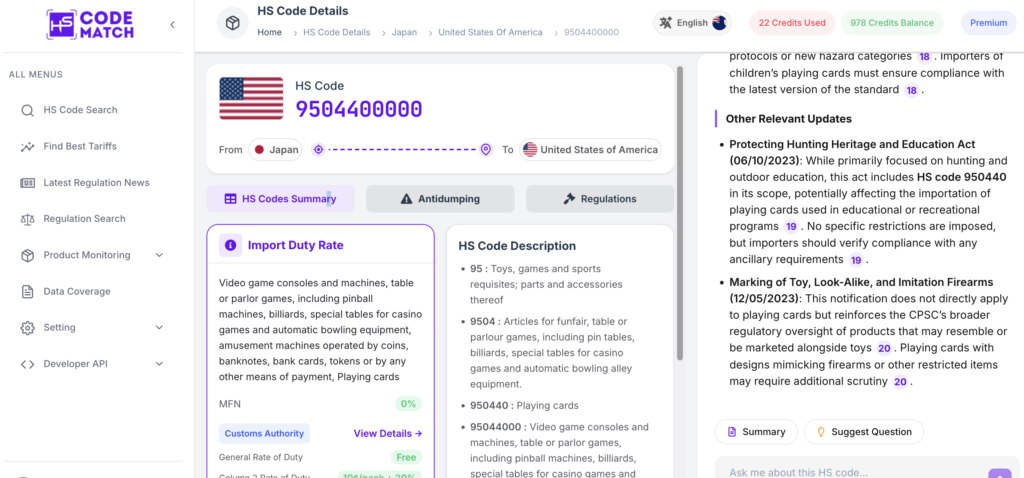
- Step 4: Move to the lower part of the HS Code Details, where you will find all applicable regulations in the United States and Japan regarding trading and playing cards. If there is any hesitation regarding some regulations of tariff rates, you can ask the AI Assistant to help you.
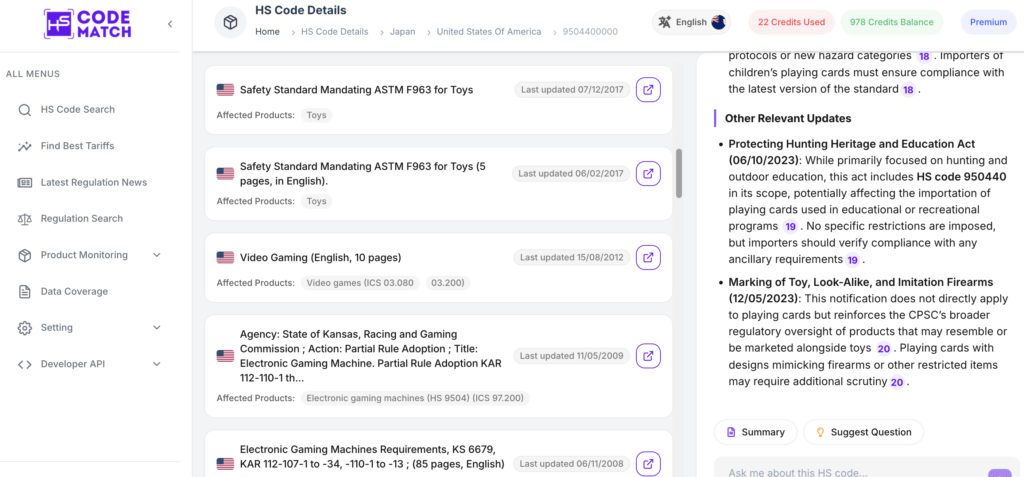
Here are examples of questions and answers from the AI Assistant on the HSCodeMatch application. Remember that all of the questions must be related to the exportation of trading cards from Japan to the United States.
Are there any additional tariff rates for exporting trading cards from Japan to the United States?
For exporting trading cards from Japan to the United States, the general tariff rate is 0% or free. Please note that if the shipping does not qualify for the General Rate of Duty, there is a possibility that the product is subjected to a Column 2 Rate of Duty of around 10¢ per pack plus 20%. On the other hand, a trading card from Japan is not eligible for the preferential tariff based on the US-Japan Trade Agreement (USJTA). Under this agreement, most of the preferential tariff only applies to the agricultural products, industrial products, and digital trade, and do not mention collectible products, including trading cards.
| Factor | Description |
| HS Code Classification | Trading cards can be classified under HS code 95044000 or 9705.00.00 in the United States |
| Tariff Rate | The general rate is free, and if not, it must be included in Column 2 Rate with 10¢/pack + 20%. |
| De Minimis Exemption | The shipping products under $800 are probably can get the free tariff rate under Section 321 in the United States. |
| FTA Eligibility | The import of trading cards from Japan to the United States is not eligible for preferential tariffs. |
What are the specific documentation requirements for exporting trading cards from Japan to the U.S.?
If you want to export trading cards from Japan to the United States, you obviously need several documents as a requirement. You can see the following documents to export trading cards in the United States.
- Commercial Invoice: A document required to explain the detailed value, quantity, description of products, and the declaration of the HS code.
- Packing List: A document that mentions the specification of shipping content, including weight and dimensions.
- Bill of Lading or Airway Bill: This is proof of shipment and details of the transportation.
- Certificate of Origin: A proof of the origin of products in order to be eligible for the preferential tariff regime under the Free Trade Agreement (FTA) with the United States.
- Safety Compliance Documentation: If the products are specifically for children, then they must obtain the certificate from a third-party organization. This documents as proof that they comply with the safety standard in the United States.
- Disposable Bingo Card Packing Slip: This document shows the disposable or mass-produced cards, including the trading cards.
What is the safety compliance documentation for trading cards import in the United States?
In order to export trading cards in the United States, the importers must obtain the Certificate of Compliance (CoC). This is important to ensure that trading cards meet the Consumer Products Safety Improvement Act (CPSIA). This document must inform the manufacturer’s name, information of the person in charge, date of production, and safety test results. There are requirements for the trading card for children under 12 years old as follows:
- Lead limits: Less than 100 ppm in accessible components.
- Phthalate limits: Less than 0.1% for phthalates in plasticized parts.
- Third-party testing: A compulsory safety testing by CPSC that must be conducted by certified laboratories.
- ASTM F963 compliance: This standard applies only to the trading card, which has a play value.
Conclusion
The trade of trading cards or collectible cards has been rising in the last few years. The increase in sales of the trading cards recorded in the United States, as the largest importer, is due to the popularity of Pokémon. Finding the HS tariff code for trading cards is quite challenging because it can be classified into Chapters 49 and 95. However, for the game-related trading cards, they are mostly classified under HS code 950440. Keep in mind that before exporting trading cards, you need to ensure that the trading cards are related to the game or sports or not. If the collectible cards are non-sports or game, then they can be included under HS code 491191 or 491199.
Frequently Asked Questions (FAQs) about HS Tariff Code for Trading Cards
1. What is the tariff rate for exporting trading cards from Japan to the United States?
The tariff rates for exporting trading cards from Japan to the United States is 0% or free. This is mentioned under the General Duty Rate.
2. Are there any safety compliance standards for trading cards in the United States?
Yes, there are safety standards for importing trading cards in the United States. However, these safety compliance particularly focus on trading cards for children under 12 years old.
3. Is HS code 950440 commonly used for poker cards?
Yes, poker and UNO cards are included as playing cards in HS codes standardization. Therefore, this HS code 950440 is specifically established for playing cards.
4. What is the specific national HS code or HTSUS for game-related trading cards in the United States?
The HS tariff code for trading cards, especially for game-related ones, is 9504400000. This is because trading cards are still related to the game or toys, similar to playing cards. Even though they are used solely for collection.
5. What are the primary factors to determine the HS tariff code for trading cards?
In order to determine the HS tariff code for trading cards, you need to look at the cards. If they are game or sport-related trading cards, then they can be included in HS code 950440.
Find and Match the Right HS Code for Your Products.
Try Our App