

 Apr 21,2026
  By Alice
Harmonized Standard (HS) code, no doubt, is the essential part of international trade. Without the declaration of an accurate HS code, the export and import process cannot be conducted. Instead, you will face penalties for not complying with the international standard. In order to stay compliant with international trade procedures, you need to find the up-to-date and most accurate HS code for your products. In this article, we will explain more to help you understand HS codes and national standard codes, and provide a step-by-step guide to finding the correct HS code easily and quickly.
What is the HS Code and the National Standard HS Code of Products?
HS code or HSN (Harmonized Standard Nomenclature) is a standardization or universal code from the World Customs Organization (WCO) for facilitating the export and import process. It has been used widely in more than 200 countries around the globe. The declaration of HS code is crucial for international trade because it serves as an identification code for the products intended to be exported and shipped across national borders. Here is an example of the structure of a 6-digit HS code for a banana.
| Code Number | Description |
| 08 | HS Chapter for edible fruits or nuts |
| 0803 | HS Heading for bananas, including plantains, whether they are dried or fresh |
| 080390 | HS Subheading for fresh banana |
However, the HS code with a 6-digit code is only the initial code or the basic code that is valid internationally. Moreover, all countries allow the creation of a variation code to identify tariff rates, import restrictions, and other import regulations. Unlike basic HS code, national standard HS code is an extended version of HS code with an 8 to 12-digit code depending on the policy of the country. Therefore, the national standard HS code must also be a consideration before sending the goods.
Instead of only using the standard version of the HS code, you must declare the national standard of the destination country. The national standard HS code has its own name, such as HTS (Harmonized Tariff Standard) code in the United States, CN (Combined Nomenclature) code in the European Union, NMC (Nomenclatura Comum do Mercosul) in the Mercosur or South American countries.
For example, if you want to export products to the EU, you need to follow the product classification based on the extension of the HSN code from EU countries. The list of HSN codes for EU or other nations can be found on each government official’s or customs website. Still, finding the HS code is quite complicated and needs a meticulous process to ensure accuracy.
How to Find HS Code of Products on the Government Website
In this digital era, the government of a country is trying to publish all of the entire list of HS codes to help exporters or importers find the accurate HS code. Follow the process of finding the HS code of products on the government website. For example, we can use the European Union tariff database platforms, namely Access2Market. So, how to find the HS code for fresh bananas using this app? Check the tutorial on how to find the HS code below!
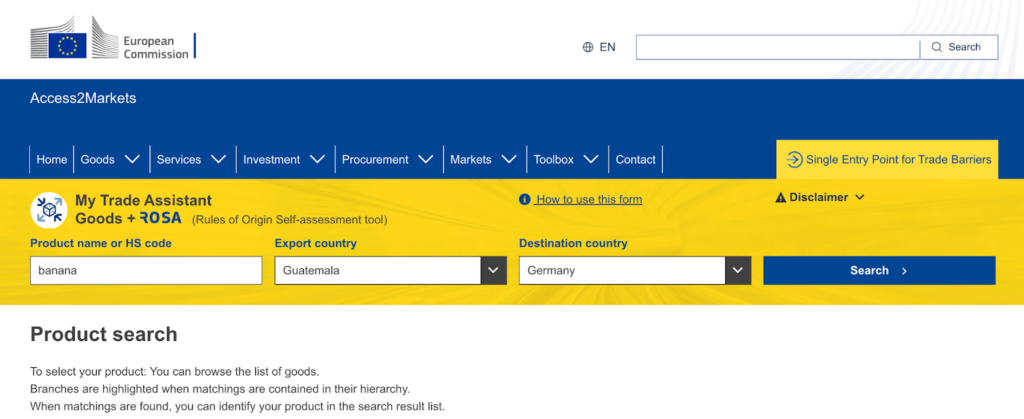
- Step 1: Open the Access2Market website by accessing trade.ec.europa.eu. Then, choose the product’s name and the export country, and the destination country, which must be an EU member country.
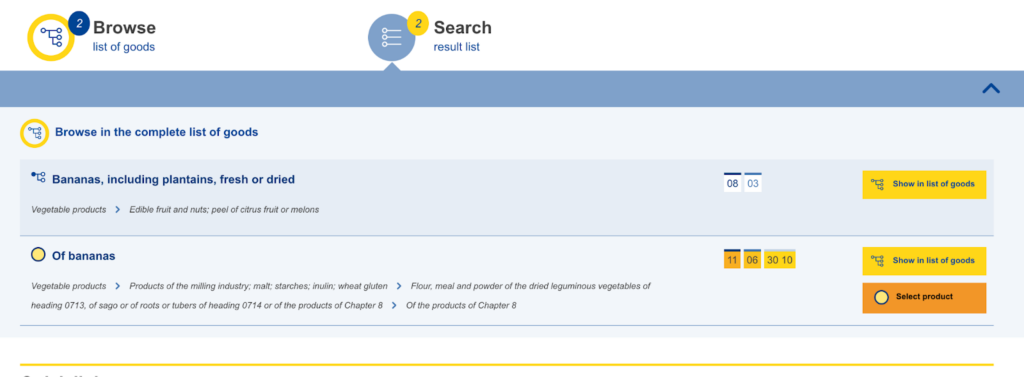
- Step 2: The Access2Markets website will provide the list of the HS code and CN code for bananas in Germany. You can click the most relevant bananas related to your product classification, whether they are dried or fresh bananas.
- Step 3: After clicking the most relevant HS code, you will be redirected to the hierarchy of the national standard code with the 8-digit code. For instance, we can choose the fresh bananas and classified more on Platano de Canarias under the code 08039011.
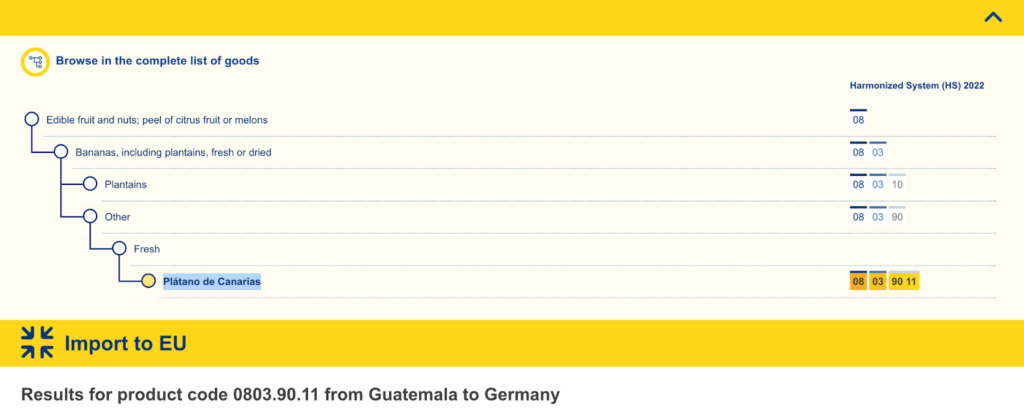
- Step 4: Move to the lower section of the page, where you can find the applicable tariff rate for exporting fresh bananas under HS code 08039011 from Guatemala to Germany. From the Access2Markets page, we can see the tariff is €114/tonnes under the ERGA OMNES or Most Favoured Nation (MFN) regime.
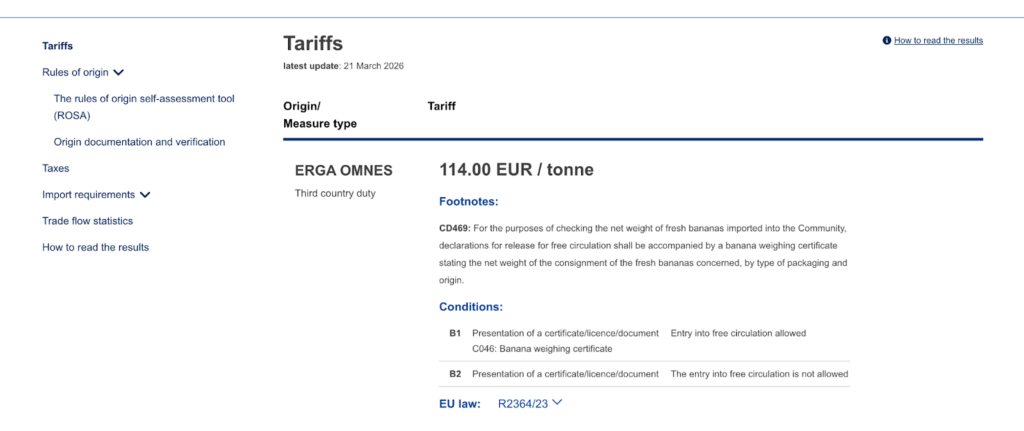
The Access2Markets website is easy to use, even for beginners. However, this application is only for EU countries and cannot be used in other regions. Therefore, it is still hard to find the national standard HS code for other countries, such as the United States, China, India, Japan, or other big market countries.
How to Find HS Codes of Products on HSCodeMatch
Other than Access2Markets, there is another way and step on how to find HS codes. You can use a third-party application, such as HSCodeMatch, to easily and quickly find the HS code for your products. With the help of HSCodeMatch, you won’t worry anymore about the misclassification of the HS code. Also, HSCodeMatch is applicable and appropriate for finding HS codes from all countries in the world, not limited to the European Union.
For comparison with Access2Markets, we can use a similar example: the export of fresh bananas from Guatemala to Germany. Follow the step-by-step tutorial on how to find the HS code for fresh bananas from Guatemala to Germany with HSCodeMatch below:
- Step 1: Open the HSCodeMatch application on your browser and access the link hscodematch.com. Move to the right side of the page and click Go to App and choose the HS Code Search tool. Set the product’s name, bananas, and the country of origin for Guatemala, and the destination country, Germany.
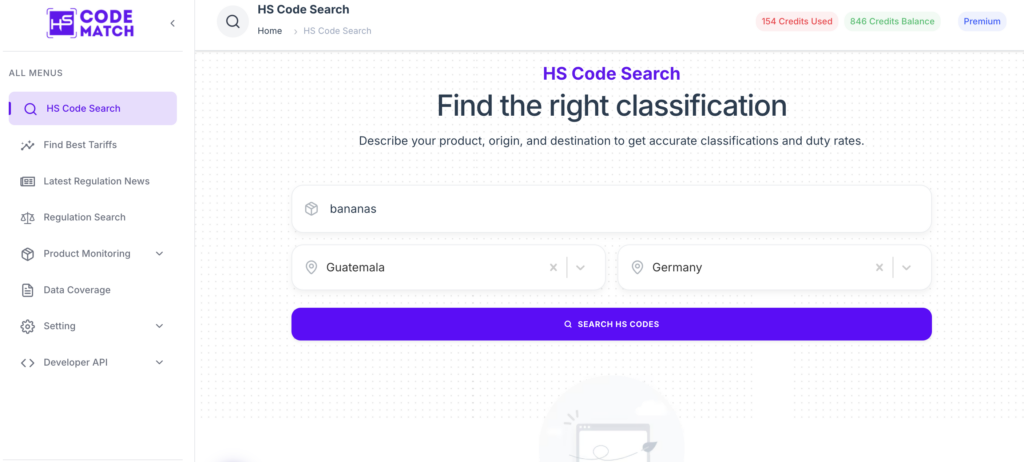
- Step 2: If all product names and countries are set, all you need to do is just click Search HS Code. Then, the HSCodeMatch application automatically finds all of the lists of HS codes for bananas in Germany. For fresh bananas, we can choose the products under the code 08039011.
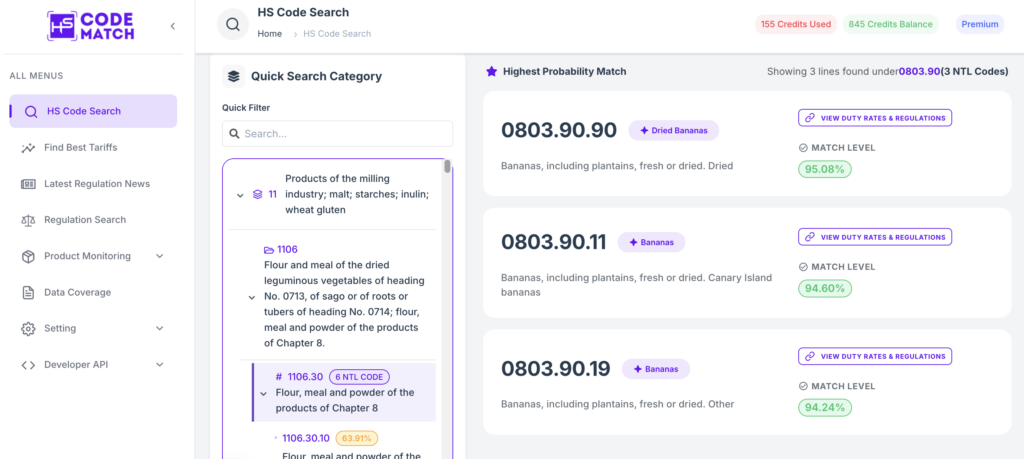
- Step 3: Click the HS code number, 0803901100, or the View Details option. Then, you will be redirected to the HS Code Details page that includes a summary of the HS code for fresh bananas and the import duty rate in Germany and the European Union in general.
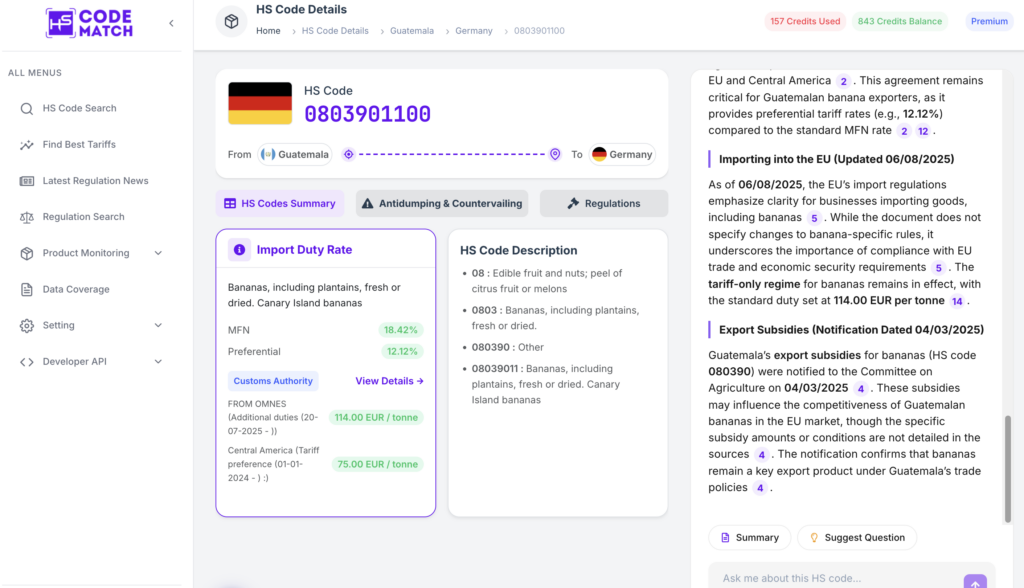
- Step 4: Scroll to the lower section of HS Code Details to check all related regulations for exporting bananas from Guatemala to Germany. If you have any perplexity, please use the AI Assistant on the right part of the HS Code Details page.
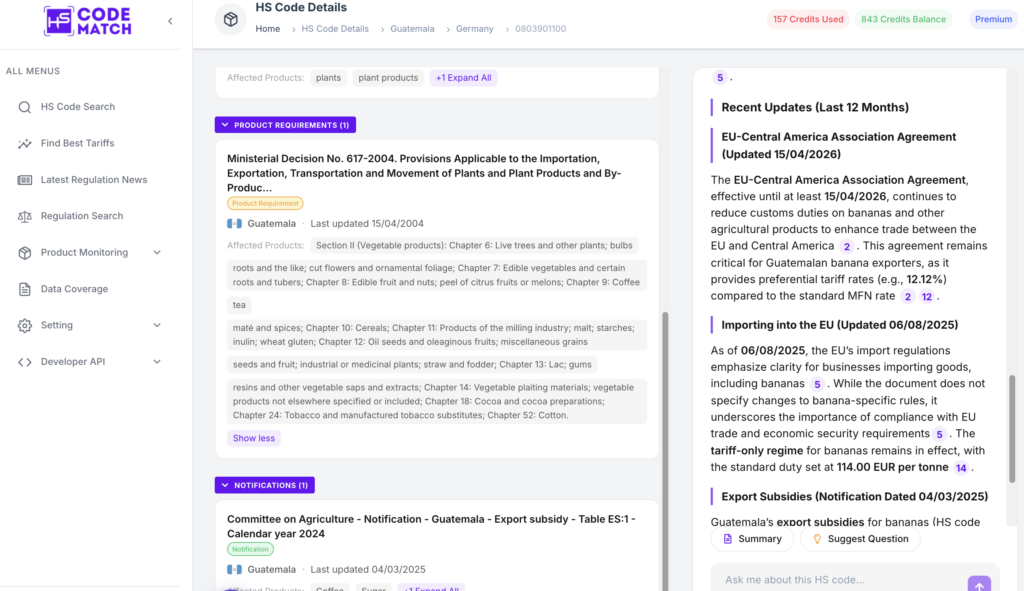
For more understanding of the provided AI Assistant, please follow the several examples of questions and answers below. The answers will solve your confusion regarding exporting bananas from Guatemala to Germany.
What is the tariff rate for exporting bananas under HS code 0803901100 from Guatemala to Germany?
The tariff rate for exporting bananas based on the HS code 0803901100 from Guatemala to Germany is 114 EUR per tonne. This tariff applies based on the ERGA OMNES or non-preferential regime. Unfortunately, Guatemala does not qualify for the Everything but Arms (EBA) scheme, which is a specific program to eliminate tariff rates, because Guatemala is not classified as a least developed nation.
| HS Code | Product | Tariff | Rate | Agreement |
| 0803901100 | Bananas | ERGA OMNES | 114.00 EUR/tonne | Non-preferential |
| 0803901100 | Bananas | MFN | 18.42% | Non-preferential |
| 0803901100 | Bananas | Preferential | 12.12% | CA-EU Association Agreement |
Are there any non-tariff barriers (e.g., phytosanitary regulations) affecting banana exports from Guatemala to Germany?
Yes, there are non-tariff barriers for exporting bananas from Guatemala to Germany. The imposition of non-tariff barriers, especially phytosanitary regulations from the European Union. This regulation includes compulsory pet risk assessments, maximum residue limits (MRLs) for pesticides, and traceability requirements for the products. The importers must comply with the EU food safety standard regulation before exporting bananas from Guatemala, including Regulation(EC) No.396/2005 for pesticide residues and Regulation (EC) No 178/2022 regarding general food law. The table below will explain the list of SPS standards for exporting bananas from Guatemala to Germany.
| Standard | Key Requirement | Applicable Regulation |
| Pesticide residue limits | Compliance with MRLs | Regulation (EC) No 396/2005 |
| Traceability | Complete supply chain documentation | Regulation (EC) No 178/2002 |
| Hygiene | Sanitary handling and processing | Regulation (EC) No 852/2004 |
Are there any EU import quotas or seasonal restrictions on Guatemalan bananas?
No, the European Union (EU) does not impose any import quotas on bananas imported from Guatemala based on the Committee of Agriculture 2021-2024. Nevertheless, the EU might apply seasonal restrictions on fresh fruits or other fresh products related to health regulations. The seasonal restriction can affect the agricultural products, reducing the availability for a certain period of time, which can impact the price instability, supply scarcity, and other problems. Besides, Guatemala does not solely depend on Germany or the EU in general to export its products. It has an agreement, called the EU-Central America Association Agreement, to exempt from tariffs and reduce tariffs for most of the agricultural products from Central American countries, including Guatemala. This is the table to make your understanding clear
| HS Code | Products Description | EU Trade Agreement |
| 080390 | Fresh and dried bananas | EU-Central America Association Agreement |
.
So, as you can see, the tutorial on how to find HS code above is easy, right? HSCodeMatch facilitates your journey to find all of the conditions before exporting products to all countries. So this application can be an option for navigating the problems in international shipping.
Impact of Misclassifying the HS Code of Products
Some of us might think that misclassifying the HS code of products is not a big deal, but it actually is. Therefore, the key to the success of international shipping is the precision of HS codes. Here are the crucial repercussions of the misclassification of the HS code of products.
- Financial loss: For a business, financial loss is something that must be avoided. During the shipping process, the financial burden is already high due to paying for all the transportation services. However, the misclassification of the HS code is also a threat to financial penalties such as fines, and this leads to huge losses or a smaller profit margin.
- Delays of Importation: Declaring the incorrect HS code of products requires the products to undergo a thorough review process. This review process obviously needs some time to check, and it could interrupt the supply chain process, which poses the risks of damage to goods, particularly for fresh products.
- Need more requirements and audit: By declaring an incorrect HS code, the customs authorities most likely conduct the audit and require more documentation from the importers. They also initiate the reassessment of classifying products, which can cause another financial burden for importers. There is also a risk of legal action due to the misclassification of products.
- Hinder to access preferential tariff: HS tariff classification is a part of the compliance with the trade regulation. Misclassification of products will hinder the products from being able to access preferential tariffs based on Free Trade Agreements (FTAs). It will reduce the potential profit gain for businesses.
Conclusion
How to find HS code for products is indeed a complicated task. It seems easy at first, but the reality is more complex than that. Besides, it is an integral part of international shipping, which makes it crucial to be known by all international trade parties. No wonder, all actors in international business must have knowledge to identify the products and how to find HS code. If you have found a potentially accurate HS code, you need to reassess to ensure that it is the accurate code. In order to avoid the misclassification, you need to get help from another service or application to assist on how to find HS code.
Frequently Asked Questions (FAQs) about How to Find HS Codes
1. How to find the HS code and check the precision of the HS code?
How to find HS code has several challenges, and finding the accurate HS code. However, you need to check on the government website to ensure how precise your declared HS code is. The tutorial on how to find HS codes varies based on each government.
2. How to find the HS code based on the national standard?
You can find the HS code based on the national standard on the government websites. They are providing the national standard HS code as transparently as possible to ensure a seamless international trade. You just check the HS code on the tariff database for each destination country.
3. What is the impact of the missclassification due to failure on how to find HS code of products?
Misclassification of a product based on the HS tariff code will have a huge impact on businesses. The most significant impact is financial loss due to fines, customs delays, and the reassessment process, which requires certification and other documents.
4. Is there any application to simplify how to find the HS code of products?
Yes, you can use the HSCodeMatch application to find and match the HS code of products. Only accessing on hscodematch.com, and you can find all information on HS codes and other import regulations worldwide.
5. Do all countries use the HS code for export and import?
Yes, all countries in the world are using the HS code as an identification of products. HS code is recognized universally to streamline the export and import process. Without the declaration of the HS code, you cannot transfer the products across the border.
Find and Match the Right HS Code for Your Products.
Try Our App