
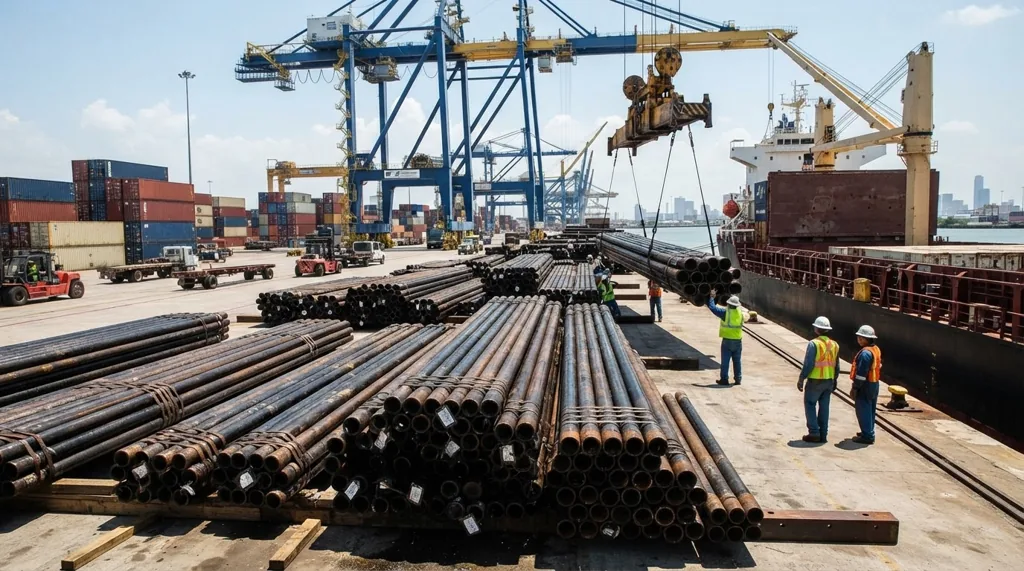
The United States keeps anti-dumping and anti-subsidy duties on steel oil well pipe from five countries, effective Sept. 29, 2026.
The U.S. Department of Commerce has kept its extra duties on steel oil-well pipe from India, Korea, Türkiye, Vietnam and Ukraine, effective Sept. 29, 2026.
Commerce announced the decision in a Federal Register notice published on Oct. 22, 20261. The notice ends the second five-year review of the duty orders, a check known as a "sunset review"1.
In short, nothing changes at the border for these pipes. Importers will keep paying the same cash deposits on every shipment from the five countries, and the orders will stay in place for at least five more years.
What did Commerce decide on oil well pipe?
Commerce ordered the continuation of two kinds of duty orders on oil country tubular goods (OCTG), the steel pipes used to line and operate oil and gas wells1. The first kind is the anti-dumping duty, an extra import tax on goods sold in the United States below their normal price. The second is the countervailing duty, an extra import tax that cancels out subsidies a foreign government gives its makers.
The anti-dumping orders cover pipe from India, Korea, Türkiye, Vietnam and Ukraine1. The countervailing duty orders cover pipe from India and Türkiye only1. In total, the notice lists seven case numbers, five for dumping and two for subsidies1.
The notice says U.S. Customs and Border Protection (CBP), the border agency, will continue to collect cash deposits at the rates in effect at the time of entry1. A cash deposit is money the importer pays when the goods enter, as security for the final duty.
Why did the orders stay in place?
A sunset review asks one question: would dumping, subsidies and harm to American makers come back if the duties were removed? Two agencies must each answer it. Commerce looks at dumping and subsidies, and the U.S. International Trade Commission (ITC), an independent federal agency, looks at harm to the U.S. industry.
Commerce found that removing the orders would likely lead to more dumping and more subsidised sales1. The ITC found that removing them would likely bring back "material injury", meaning serious harm, to an American industry within a reasonably foreseeable time2. Because both agencies found a likely return of the problem, the law required the orders to continue1.
The ITC vote was not fully unanimous. Commissioner Jason E. Kearns voted against keeping the anti-dumping order on pipe from Ukraine2. The majority still decided to keep all of the orders, including the one on Ukraine2.
How large would the dumping be without the duties?
In its review, Commerce estimated how far prices would fall below normal value if the orders ended. It reported these dumping margins, the gap between the normal price and the U.S. sale price, in a notice published on Jan. 9, 20263. The margins likely to prevail were up to:
- India: 11.24%
- Korea: 6.49%
- Türkiye: 35.86%
- Vietnam: 111.47%
- Ukraine: 7.47%
Dumping margins likely without the orders, %
Commerce gave these figures to the ITC as part of the review1. Vietnam’s figure, at 111.47%, is the highest by far. It means pipe from Vietnam could be sold at less than half of its normal price, according to Commerce’s estimate.
These margins are estimates of what would happen without the orders. They are not new duty rates. The rates that importers pay at the border remain the cash deposit rates already in effect1.
Which subsidy rates did Commerce report for India and Türkiye?
Commerce also published the subsidy rates it expects would return if the countervailing duty orders ended. It released them in a separate notice dated Jan. 5, 2026, and published on Jan. 8, 20264. Rates are a percentage of the value of the goods.
For India, Commerce listed three rates4:
- Jindal SAW Ltd: 27.77%
- GVN Fuels Limited, Maharashtra Seamless Limited and Jindal Pipes Limited: 13.87%
- All other Indian makers: 20.82%
For Türkiye, Commerce listed 2.87% for Borusan Mannesmann Boru Sanayi ve Ticaret A.S. and its linked companies4. The same 2.87% rate applies to all other Turkish makers4.
The Indian rates are far higher than the Turkish one. An Indian pipe faces both a subsidy finding and a dumping finding, so the two charges can add up for buyers.
Which pipes are covered and which are not?
The orders cover hollow steel products with a round cross-section1. This includes oil well casing and tubing, made of iron or steel, both carbon and alloy steel1. Seamless and welded pipe are both covered1.
What the orders cover
| Point | What the notice says |
|---|---|
| Covered goods | Oil well casing and tubing, seamless or welded |
| Also covered | Green tubes and OCTG coupling stock |
| Standards | API and non-API pipe alike |
| Excluded | Pipe with 10.5% or more chromium, drill pipe |
| Also excluded | Unattached couplings and thread protectors |
The finish of the pipe ends does not matter. Plain-end, threaded, and threaded-and-coupled pipe are all covered1. The orders apply whether or not the pipe meets American Petroleum Institute (API) specifications, the oil industry’s main technical standards1.
The orders also cover:
- finished pipe, including "limited service" pipe1
- unfinished pipe, including "green tubes", pipe that has not yet been heat-treated1
- pipe with or without thread protectors attached1
- OCTG coupling stock, the material used to make the joints between pipes1
Four items are left out of the orders1:
- casing or tubing with 10.5% or more chromium by weight
- drill pipe
- couplings that are not attached
- thread protectors that are not attached
Which tariff codes do the orders list?
The notice lists the pipes under Harmonized Tariff Schedule of the United States (HTSUS) codes, the U.S. customs numbers for goods1. The main codes fall under headings 7304.29, 7305.20 and 7306.291. Examples include 7304.29.10.10, 7305.20.20.00 and 7306.29.10.301.
The pipes may also enter under other codes, such as those in 7304.39, 7304.59, 7305.31, 7306.30 and 7306.501. Commerce says the codes are only a guide for customs purposes1. The written description of the goods decides what is covered, not the code1.
This matters at the border. A shipment entered under a code outside the list can still owe the duties if the pipe matches the written description.
How did the review reach this point?
The orders are more than a decade old. Commerce first issued the anti-dumping orders on India, Korea, Türkiye and Vietnam, and the subsidy orders on India and Türkiye, on Sept. 10, 20141. The order on Ukraine came later, on July 16, 20191. It followed the end of an earlier agreement that had suspended the Ukraine investigation1.
The review steps were:
- On July 1, 2025, Commerce and the ITC started the second sunset review1.
- On July 16, 2025, two U.S. producers’ groups said they would take part: the U.S. OCTG Manufacturers Association and United States Steel Corporation3.
- No foreign maker sent a full response, and neither did the governments of India or Türkiye3, 4.
- Commerce therefore ran a shorter, 120-day expedited review3.
- A federal government shutdown pushed Commerce’s deadline to Jan. 5, 20263.
- Commerce published its dumping results on Jan. 9, 2026, and its subsidy results on Jan. 8, 20263, 4.
- The ITC held a public hearing on July 23, 20262.
- The ITC filed its decision on Sept. 24, 2026, and published it on Sept. 29, 20262.
- Commerce published the continuation notice on Oct. 22, 20261.
Commerce’s side of the review was quick because foreign makers did not take part. The ITC, by contrast, decided on Nov. 24, 2025, to hold a full review with a hearing2.
Who is affected by the continued duties?
U.S. importers of oil well pipe from the five countries keep paying cash deposits on each shipment1. Their costs do not change because of this notice. They also keep the risk that a later review sets a higher final duty.
Pipe makers in India, Korea, Türkiye, Vietnam and Ukraine keep facing the extra charges when they sell to U.S. buyers. Makers in Vietnam face the steepest estimated dumping margin, and Indian makers face the highest subsidy rates3, 4.
U.S. pipe makers keep the protection they asked for. Their two groups, the U.S. OCTG Manufacturers Association and United States Steel Corporation, took part in the review3.
Customs brokers must keep checking the scope of each pipe shipment. The written description, not only the tariff code, decides whether the duties apply1.
When do the continued orders take effect, and what comes next?
The continuation took effect on Sept. 29, 2026, the date the ITC published its decision1. The Commerce notice was signed on Oct. 16, 2026, by Scot Fullerton, Acting Deputy Assistant Secretary for Antidumping and Countervailing Duty Operations1.
Key dates in the review
The orders now run until the next sunset review. Commerce says it will start the next five-year reviews no later than 30 days before the fifth anniversary of the ITC’s last decision1. Since that decision was published on Sept. 29, 2026, the next review should fall due around 2031.
The ITC’s full reasons are set out in its report, USITC Publication 5790, dated September 20262.
Key points on oil country tubular goods duties
The table below sums up the decision.
| Question | Answer |
|---|---|
| What changed? | Duty orders continued for five more years |
| Who issued it? | U.S. Department of Commerce |
| Which agency found injury? | U.S. International Trade Commission |
| Which goods? | Steel oil well casing, tubing and coupling stock |
| Which countries, anti-dumping? | India, Korea, Türkiye, Vietnam, Ukraine |
| Which countries, subsidy duties? | India and Türkiye |
| Highest dumping margin estimate | 111.47% for Vietnam |
| Highest subsidy rate estimate | 27.77% for Jindal SAW Ltd, India |
| What is excluded? | Pipe with 10.5% or more chromium, drill pipe |
| Who must act? | Importers keep paying cash deposits to CBP |
| Start date | Sept. 29, 2026 |
| Next step | Next sunset review, due around 2031 |
For shipments now on the water, the result is plain: CBP will keep collecting the same cash deposits on these pipes from the five countries1. The orders stay until the next five-year review, which Commerce must start before the fifth anniversary of the ITC’s Sept. 29, 2026 decision1.
Sources
- ↩ Federal Register :: Certain Oil Country Tubular Goods From India, the Republic of Korea, the Republic of Türkiye, the Socialist Republic of Vietnam, and Ukraine: Continuation of Antidumping Duty Orders and Countervailing Duty Orders https://www.federalregister.gov/documents/2026/10/22/2026-21530/certain-oil-country-tubular-goods-from-india-the-republic-of-korea-the-republic-of-trkiye-the
- ↩ Federal Register :: Oil Country Tubular Goods From India, South Korea, Turkey, Ukraine, and Vietnam; Determinations https://www.federalregister.gov/documents/2026/09/29/2026-19879/oil-country-tubular-goods-from-india-south-korea-turkey-ukraine-and-vietnam-determinations
- ↩ Federal Register :: Certain Oil Country Tubular Goods From India, the Republic of Korea, the Republic of Türkiye, the Socialist Republic of Vietnam, and Ukraine: Final Results of the Expedited Second Sunset Reviews of the Antidumping Duty Orders https://www.federalregister.gov/documents/2026/01/09/2026-00207/certain-oil-country-tubular-goods-from-india-the-republic-of-korea-the-republic-of-trkiye-the
- ↩ Federal Register :: Certain Oil Country Tubular Goods From India and the Republic of Türkiye: Final Results of the Expedited Second Sunset Reviews of the Countervailing Duty Orders https://www.federalregister.gov/documents/2026/01/08/2026-00185/certain-oil-country-tubular-goods-from-india-and-the-republic-of-trkiye-final-results-of-the