
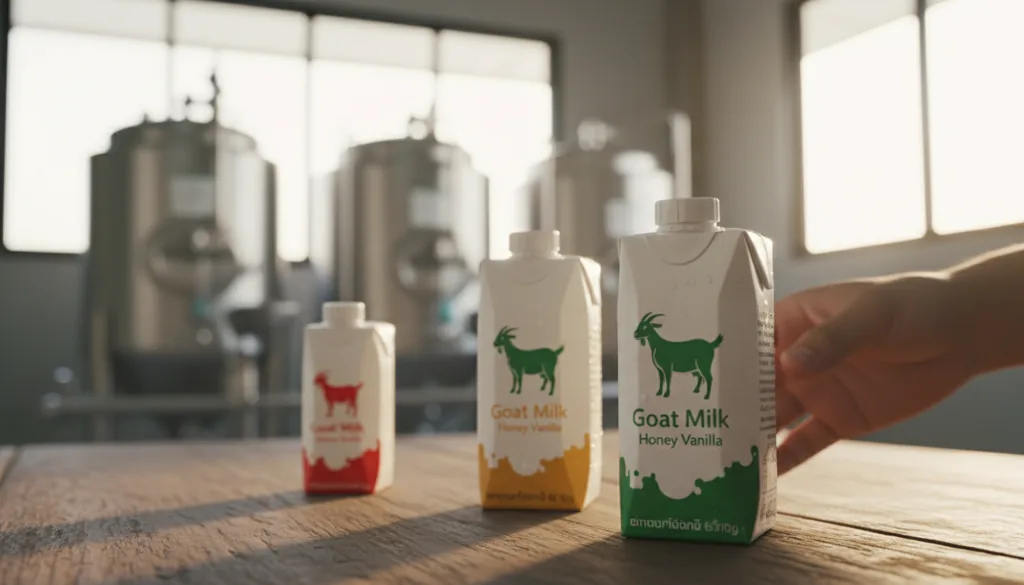
Thailand has introduced comprehensive safety, labeling, and distribution standards for goat milk and flavored goat milk through Ministry of Public Health Notification No. 470.
Thailand has set new safety and labelling rules for goat milk and flavoured goat milk that take effect on 5 August 2026, the Ministry of Public Health said in a notification published on 4 August.
The rules cover everything from pasteurisation to packaging and apply to every litre of goat milk sold in the country. The importer or local processor pays for all testing, certification and any recalls.
It is the first time Thailand has written a single standard for goat milk. Until now, the product was regulated under general dairy rules that did not address the specific risks of goat milk—higher levels of certain bacteria, faster spoilage and a different nutrient profile from cow milk. The new rules bring Thailand into line with international standards set by the Codex Alimentarius, the global food-safety body.
What the new rules require
Every shipment of goat milk must now carry a pre-issued import permit and a health certificate from the country of origin1. The certificate must show that the milk meets Thailand’s microbiological limits: no more than 100,000 colony-forming units of bacteria per millilitre and no detectable pathogens such as Salmonella or Listeria1. Flavoured goat milk must also pass tests for permitted food additives and their maximum levels.
Maximum shelf life by treatment, days
On the label, the words “goat milk” must appear in Thai and English, and the font size must be at least 3 mm high1. If the milk is flavoured, the flavour must be named in the same size and the label must state whether it is natural or artificial. Nutrition information must follow the format set in Ministry of Public Health Notification No. 467, which came into force in December 20252.
The rules also set physical standards. Goat milk must be pasteurised at 72 °C for 15 seconds or sterilised at 135 °C for 2 seconds1. Packaging must be food-grade, tamper-evident and labelled with a production date and a shelf life that does not exceed 14 days for pasteurised milk or 180 days for sterilised milk.
Who the rules apply to
The rules bind every company that sells goat milk in Thailand, whether the milk is imported or produced locally. Importers must register with the Thai Food and Drug Administration (FDA) before they can apply for the import permit1. Local processors must also register and must keep records of every batch for at least two years.
Who has to do what
Small farmers who sell raw goat milk directly to consumers are exempt, provided they sell no more than 50 litres a day and label the milk “not for retail sale”1. The exemption does not extend to raw milk sold to processors or retailers.
What the rules replace
Before 5 August 2026, goat milk was regulated under the general dairy standard, Notification No. 183, which did not distinguish between cow and goat milk. That standard set the same microbiological limits for both, even though goat milk is more prone to contamination by certain bacteria such as Staphylococcus aureus3. It also did not require specific labelling for goat milk, so consumers could not tell whether a product was made from cow or goat milk.
Goat milk rules, old and new
| Requirement | Old rules (No. 183 / No. 468) | New rules (No. 470) |
|---|---|---|
| Microbiological limits | Same limits as cow milk | Goat-specific limits |
| Labelling | No goat-milk-specific labelling | “Goat milk” in Thai and English, ≥3 mm |
| Additives | Any permitted for dairy | Only those listed for goat milk, with maxima |
The new rules also replace parts of Notification No. 468, which set general rules for food additives. Under the old rules, processors could use any additive permitted for dairy products. The new rules limit additives to those explicitly listed for goat milk and set maximum levels for each2.
How the rules fit into Thailand’s food-safety agenda
The goat-milk rules are the latest in a series of food-safety measures Thailand has introduced since 2023. In December 2025, the Ministry of Public Health issued Notification No. 467, which updated nutrition-labelling rules for all packaged foods. In May 2026, it issued Notification No. 469, which set new standards for canned foods2.
The timing is not accidental. Thailand is negotiating a trade agreement with the European Union, and the EU has made food safety a key condition. The goat-milk rules bring Thailand closer to EU standards, which require specific rules for goat milk and set lower microbiological limits than Thailand’s old rules.
The rules also reflect a broader push to reduce foodborne illness. In 2019, Thailand reported more than 110,000 cases of food poisoning, with the highest rates in children under five3. Goat milk was not a major source of outbreaks, but the Ministry of Public Health said in a statement that the new rules would “close a gap in the regulatory framework and protect vulnerable consumers.”
What happens next for goat milk
The rules take effect on 5 August 2026, but importers and processors have until 5 November 2026 to sell existing stock that does not meet the new labelling requirements1. After that date, any product on the shelf must comply.
Deadlines for importers and processors
The Ministry of Public Health will review the rules in 2028, two years after they come into force. The review will look at whether the microbiological limits are strict enough, whether the labelling rules are clear, and whether the rules have reduced foodborne illness linked to goat milk.
For now, the rules are set. The volumes are small—Thailand imports only about 1,200 tonnes of goat milk a year, mostly from Australia and New Zealand4—but the effect on compliance costs is not. Every litre now requires a permit, a certificate and a label that meets the new standards. The cost will fall on the importer or processor, and it will be passed on to consumers. The question is whether the safety gains will be worth the price.
Sources
- ↩ Ministry of Public Health (MOPH) Notification No. 470 entitled "Goat Milk and Flavored Goat Milk" https://docs.wto.org/imrd/directdoc.asp?DDFDocuments/T/G/TBTN26/THA800A1.docx
- ↩ Ministry of Public Health Announcement No. 468 B.E. 2025 on Food Additives https://food.fda.moph.go.th/food-law/category/announcement-of-the-ministry-of-public-health-1/
- ↩ BOE Apps – Ministry of Public Health 2019 https://apps-doe.moph.go.th/boeeng/download/MIX_AESR_2562.pdf
- ↩ Phetchabun District Office: Ministry of Agriculture and Cooperatives https://www.opsmoac.go.th/phetchabun-dwl-files-472991791033