
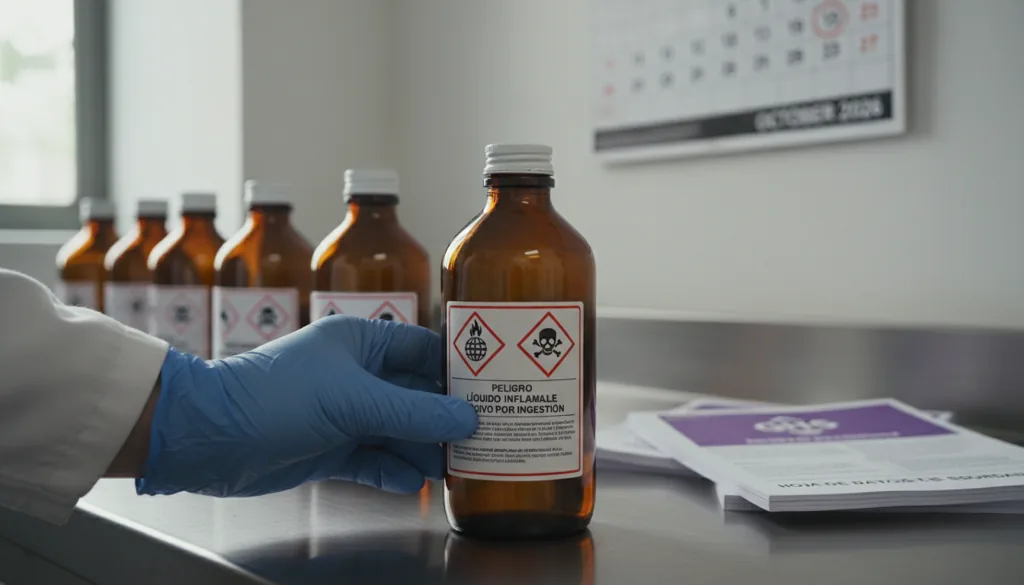
Panama has implemented mandatory chemical hazard classification and communication standards through the Globally Harmonized System for all hazardous chemicals, requiring compliance with label and safety data sheet requirements.
Panama has adopted mandatory chemical hazard classification and labelling rules under the United Nations’ Globally Harmonized System (GHS), requiring all hazardous chemicals sold or used in the country to carry standardised safety data sheets and warning labels by 18 August 2026.
The measure covers every chemical imported, manufactured or handled in Panama—from industrial solvents and fertilisers to household cleaners—except finished medicines, cosmetics and food additives. Importers and manufacturers must now classify each substance, prepare a safety data sheet in Spanish, and redesign labels with GHS pictograms, signal words and hazard statements. The delivered cost of compliance will fall on the company that first places the product on the Panamanian market.
It comes after a two-year joint project between Panama’s health and trade ministries, the University of Panama and the United Nations Institute for Training and Research (UNITAR), funded through the Stockholm and Basel conventions. The new rules replace a patchwork of national and Central American technical regulations that often placed the same chemical in multiple, conflicting categories.
The system Panama is adopting
The GHS is the UN’s “Purple Book”—a 600-page manual that classifies chemicals by physical, health and environmental hazards and prescribes how those hazards must be communicated. Panama is implementing the seventh revised edition, published in 20171. Under it, a flammable liquid is labelled with a flame pictogram, the signal word “Danger” and the statement “Highly flammable liquid and vapour”; a corrosive substance carries a corrosion pictogram, the word “Warning” and the phrase “Causes severe skin burns and eye damage”2.
GHS hazard classes by type
The system covers 28 hazard classes—16 physical, 10 health and 2 environmental—and assigns each a category from 1 (most severe) to 5 (least severe). A single chemical can carry multiple classifications: methanol, for example, is both flammable (Category 2) and acutely toxic if swallowed (Category 3)2. Every classification must be backed by test data or internationally recognised literature and documented in the safety data sheet.
Panama’s technical regulation, DGNTI XX-2026, defines a “substance” as any chemical element or compound in its natural state or obtained by any process, including stabilisers and impurities but excluding solvents that can be separated without altering the product2. The definition sweeps in raw materials, intermediates, formulated products and even some waste streams, although hazardous waste itself is excluded1.
What importers and manufacturers must do
By 18 August 2026, every hazardous chemical entering or produced in Panama must be reclassified, relabelled and accompanied by a safety data sheet that meets GHS format and content requirements1. The sheet must be in Spanish, dated, and include 16 sections: identification, hazard classification, composition, first-aid measures, firefighting measures, accidental-release measures, handling and storage, exposure controls and personal protection, physical and chemical properties, stability and reactivity, toxicological information, ecological information, disposal considerations, transport information, regulatory information and any other relevant data2.
How GHS labels two hazards
| Label element | Flammable liquid | Corrosive substance |
|---|---|---|
| Pictogram | Flame | Corrosion |
| Signal word | Danger | Warning |
| Hazard statement | Highly flammable liquid and vapour | Causes severe skin burns and eye damage |
Labels must display the product identifier, supplier information, GHS pictograms, signal words (“Danger” or “Warning”), hazard statements and precautionary statements1. For small packages, the regulation allows reduced labelling, but the full information must still be available on the safety data sheet1. Importers and manufacturers must also replace the older NFPA “diamond” hazard rating with the GHS pictograms, although the NFPA 704 system will still be required for fixed installations such as storage tanks and production lines1.
Companies must keep the classification data on file and make it available to Panama’s competent authorities on request1. If a chemical is reformulated or new hazard data emerges, the safety data sheet and label must be updated within three months1.
Who enforces the rules and what happens if they are broken
Enforcement is split among nine government agencies, each responsible for a different sector. The Ministry of Agricultural Development (MIDA) inspects agrochemicals; the Ministry of Labour (MITRADEL), the Ministry of Health (MINSA) and the Social Security Fund (CSS) oversee workplaces; the Consumer Protection Authority (ACODECO) monitors retail products; the National Customs Authority (ANA) checks imports; the Transit Authority (ATTT) regulates road transport; the Fire Brigade (BCBRP) inspects storage facilities; and the Ministry of Environment (MiAmbiente) handles environmental hazards1.
Inspections can happen at any point in the supply chain—ports, warehouses, factories, retail stores or work sites. Inspectors will verify that labels and safety data sheets are present, accurate and in Spanish, and that the hazard classification matches the data on file1. If a product is found to be misclassified or mislabelled, the agency can order a recall, suspend sales or impose fines under Panama’s consumer-protection and occupational-safety laws1.
The regulation does not set fixed penalties; instead, each agency applies its own sanctioning regime. ACODECO, for example, can fine companies up to 10 % of their annual turnover for misleading labelling, while MITRADEL can shut down workplaces that fail to provide safety data sheets to employees1.
What is excluded and what the rules leave open
The regulation carves out three broad categories of products. First, finished articles—such as batteries, electronics and furniture—are excluded because their chemical hazards are considered incidental to their primary function1. Second, medicines, cosmetics, food additives and pesticide residues in food are exempt because they are already regulated by separate health and agriculture laws1. Third, radioactive materials and biological hazards are excluded because they fall under international conventions that Panama has ratified1.
The rules also leave two key questions unanswered. The first is how the quota of 3,600 tonnes for agrochemicals will be allocated among importers; the regulation simply states that MIDA will establish the procedure “in due course”1. The second is whether companies will need third-party certification for their safety data sheets. The regulation allows self-declaration but also references ISO/IEC 17020, an international standard for inspection bodies, suggesting that accredited testing may eventually be required1.
What comes next for chemical labeling
The regulation takes effect on 18 August 2026, giving companies 24 months to reclassify their products, redesign labels and train employees1. In the meantime, Panama’s Directorate General of Standards and Industrial Technology (DGNTI) will publish guidance documents and host workshops for industry. A technical subcommittee—made up of government agencies, universities, industry associations and consumer groups—will meet quarterly to monitor implementation and propose amendments3.
Deadlines on the calendar
| Date | Who it catches | What falls due |
|---|---|---|
| 18 Aug 2026 | All hazardous chemicals on the market | Reclassification, GHS labels, Spanish safety data sheet |
| Within 3 months of new data | Reformulated products | Updated safety data sheet and label |
| Aug 2028 | Whole regulation | First review; DGNTI may propose adjustments |
The first review is scheduled for August 2028, two years after the rules come into force. At that point, DGNTI can propose adjustments to hazard classifications, labelling requirements or enforcement procedures based on industry feedback and international updates to the GHS1. Until then, companies that import or manufacture hazardous chemicals in Panama must treat the 2026 deadline as firm: after that date, any product that does not comply with the new labelling and safety data sheet requirements will be barred from the market.
Sources
- ↩ WTO TBT notification 26-03040 — Panama https://members.wto.org/crnattachments/2026/TBT/PAN/26_03040_00_s.pdf
- ↩ Project Technical Regulation DGNTI XX-2026 – MICI on the Implementation of the Global Harmonized System (GHS) https://mici.gob.pa/wp-content/uploads/2026/06/PROYECTO-de-Reglamento-Tecnico-DGNTI-XXX-2026-SGA-CyE.pdf
- ↩ National Assembly Official Gazette No. 30489 https://s3-legispan.asamblea.gob.pa/legispan/GACETAS/2020/2026/30489_2026.pdf