
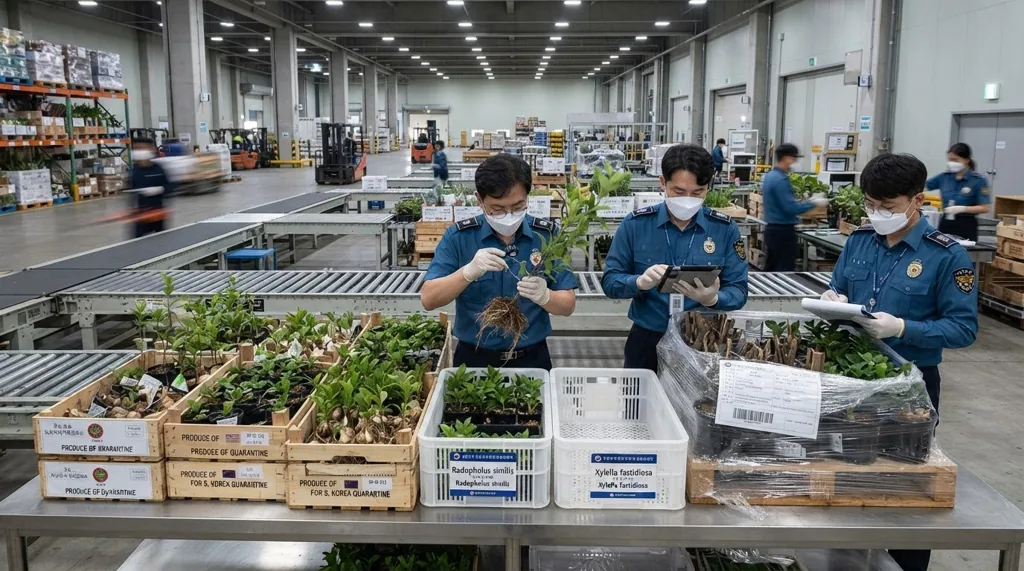
South Korea has expanded its phytosanitary measures to address emerging plant pathogen threats affecting ornamental plants and propagation materials.
South Korea’s plant quarantine agency has banned more nursery plants from Lebanon and other Xylella-affected countries, for shipments sent from 13 July 2026.
The Animal and Plant Quarantine Agency (APQA), part of the Ministry of Agriculture, Food and Rural Affairs (MAFRA), told the World Trade Organization (WTO) on 10 July 20261. It added Lebanon to its list of banned areas and named many new host plants and insects1.
In short, nursery plants, cuttings and grafting wood of the listed plants cannot enter South Korea from the listed countries. A plant-health certificate does not make such a shipment legal if it was sent on or after 13 July 2026.
What is Xylella and why did Korea act?
Xylella fastidiosa is a bacterium that harms plants. Korea lists it as one of its prohibited quarantine pests, a pest so serious that its host plants are banned from the areas where it lives1. Certain insects, called vectors, carry it from plant to plant2.
How the ban has grown
APQA says the new additions follow a pest risk analysis, a formal study of how a pest could enter and spread1. The notice does not publish that study. It states only the result: a longer list of countries, host plants and insects1.
The ban is not new. Korea has used it for years and widens it step by step. In August 2020 it added host plants in the same way, for shipments sent from Aug. 20, 20203. In late 2024 it added Peru to the banned areas4.
What exactly changed on 13 July 2026?
The addendum to WTO notification G/SPS/N/KOR/622, called Addendum 7, lists three changes1:
- Lebanon joins the list of banned areas.
- 18 species of insects that carry the bacterium join the list of carriers.
- 17 genera and 64 species of host plants join the list of banned plants.
What Addendum 7 changed
| Item | Change |
|---|---|
| Banned areas | Lebanon added |
| Insect carriers | 18 species added |
| Host plants | 17 genera and 64 species added |
| Start | Shipments sent on or after 13 July 2026 |
These changes apply to shipments with a plant-health certificate that leave on or after 13 July 20261. A genus is a group of related plant species, such as all oaks or all roses. A listing for a whole genus covers every species in it.
The shipping date decides which rule applies. A shipment sent before 13 July 2026 falls under the earlier list. A shipment sent on or after that date falls under the new one.
Which plants does the Korean ban cover?
The ban covers plants for planting, such as nursery stock, scions and cuttings2. Scions are pieces of a plant cut for grafting onto another plant. Seeds are covered for only one plant, the pecan tree (Carya illinoensis)2.
Listed plant species, total and newly added
The full list now holds 88 genera and 326 species of plants2. Many are common garden, fruit and street trees. Examples from the list include:
- fruit plants such as citrus (Citrus spp.), grapevines (Vitis spp.), olives (Olea spp.), avocado (Persea americana) and plums, cherries and almonds (Prunus spp.)2
- ornamental plants such as roses (Rosa spp.), lavender (Lavandula spp.), oleander (Nerium oleander), hibiscus (Hibiscus spp.) and hydrangea (Hydrangea paniculata)2
- trees such as oaks (Quercus spp.), maples (Acer spp.), plane trees (Platanus spp.), elms (Ulmus spp.) and ginkgo (Ginkgo biloba)2
- crops such as coffee plants (Coffea spp.), blueberries (Vaccinium spp.), tomato (Solanum lycopersicum) and alfalfa (Medicago sativa)2
The list also names many grasses and weeds, such as ryegrass (Lolium spp.) and dandelion (Taraxacum officinale)2. Plant-health rules aim at the plant that could carry the pest, not at its trade value.
Which countries are banned areas?
The attachment to Addendum 7 lists the banned areas by region2:
- Asia: Chinese Taipei, India, Iraq, Iran, Israel, Türkiye and Lebanon.
- North and Central America: Canada, Costa Rica, Honduras, Mexico and the United States.
- South America: Argentina, Brazil, Venezuela, Colombia, Paraguay and Peru.
- Europe: France, Italy, Portugal and Spain.
Lebanon is the only new country in this round1. Plants of the listed kinds from any of these places cannot enter Korea for planting.
How are the insect carriers treated?
The attachment now lists 38 species of insects that carry Xylella2. They include the glassy-winged sharpshooter (Homalodisca vitripennis) and the meadow spittlebug (Philaenus spumarius)2.
These insects count as banned pests only in one case. That is when inspectors find them on host plants from the banned areas2. In all other cases, Korea’s normal pest rules apply to them2.
In practice, an insect found on a banned host plant from a banned country makes the case even more serious. The same insect found on other goods is handled under the usual inspection rules.
Who is affected by the Xylella list?
Nurseries and plant growers in the banned areas lose access to the Korean market for the listed plants2. Growers in Lebanon face this for the first time1. Growers elsewhere face it for the newly listed plants.
Korean importers of young plants, cuttings and grafting wood must check two things for each shipment. They must check the plant’s scientific name against the list and the country of origin against the banned areas. Garden centres, fruit farms and landscapers that buy from these importers also feel the change.
Plant-health officials in exporting countries are affected too. A plant-health certificate is the paper an exporting country’s officials issue to say a shipment meets the buyer’s rules. Under Addendum 7, such a certificate cannot cover a listed plant from a banned area sent on or after 13 July 20261.
Cut flowers, fruit for eating and other plant products are not named in the ban. The ban speaks of plants for planting and, for one tree, its seeds2.
What happens at the Korean border?
The notice says the import of host plants and carrier insects "will be prohibited"1. It does not describe a permit or treatment that would let such plants in. So a listed plant from a banned area has no legal route into Korea under this rule.
The notice does not say what customs will do with a shipment that breaks the rule. It also does not set a comment period. The box for comments is marked "not applicable"1. That fits a measure that is already in force rather than a draft.
Where can traders read the Korean rules?
MAFRA’s WTO desk in Sejong is the contact point for questions and for the full text1. The attachment to Addendum 7 is published on the WTO’s notification site1.
The 2020 addendum used the same channel. It pointed readers back to the first notification, G/SPS/N/KOR/622, for details of host plants, insects and areas3. Each round has added to the same list instead of starting a new one.
Key points on Korea’s Xylella plant ban
The table sums up the change.
| Question | Answer |
|---|---|
| Who issued it? | APQA, part of MAFRA |
| When was the WTO told? | 10 July 2026 |
| What is the pest? | Xylella fastidiosa, a plant bacterium |
| What changed? | Lebanon, 18 insects, 17 genera and 64 species added |
| Which goods? | Plants for planting, and pecan seeds |
| How many plants are listed? | 88 genera and 326 species |
| How many insect carriers? | 38 species |
| Which areas are banned? | Areas in Asia, the Americas and Europe |
| What is the rule? | Import of listed plants is prohibited |
| From when? | Shipments sent on or after 13 July 2026 |
| Is there a comment period? | No, marked not applicable |
The ban applies to every listed plant shipped from a banned area on or after 13 July 2026. For Lebanese nurseries, this closes the Korean market for these plants. For other growers, it closes it for the newly added species.
Sources
- ↩ NOTIFICATION http://www.spsvietnam.gov.vn/Data/File/Notice/12089/NKOR622A7.pdf
- ↩ 26_03603_00_e.pdf https://members.wto.org/crnattachments/2026/SPS/KOR/26_03603_00_e.pdf
- ↩ NKOR622A2.pdf http://www.spsvietnam.gov.vn/Data/File/Notice/5261/NKOR622A2.pdf
- ↩ WTO-SPS-Notifications-Nov.30-Dec.7-2024.pdf https://cahfsa.org/wp-content/uploads/2024/12/WTO-SPS-Notifications-Nov.30-Dec.7-2024.pdf