
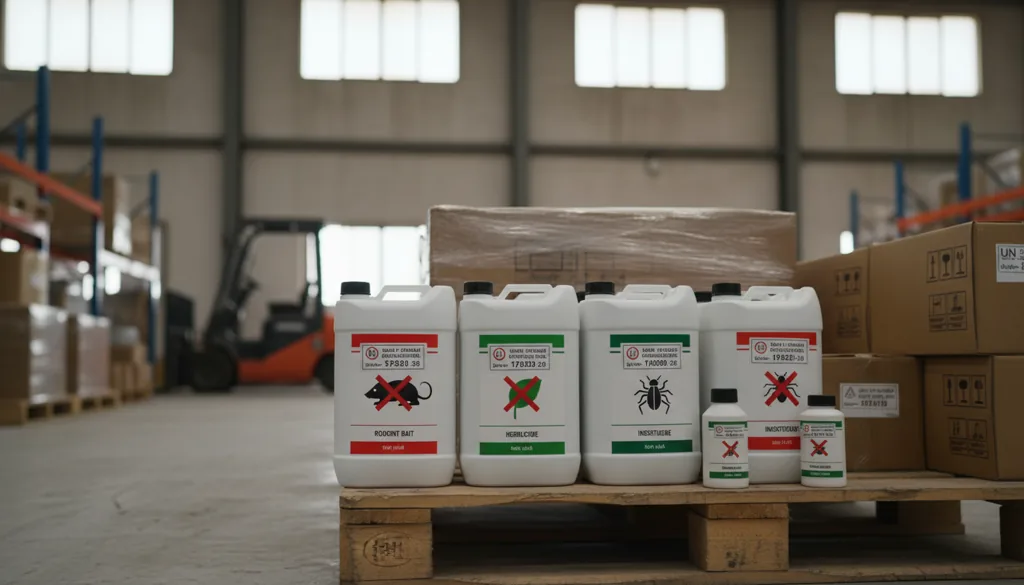
Saudi Arabia has established mandatory registration and safety protocols for pesticides, including public health applications and rodent bait products, to ensure safe use and compliance in domestic markets
Saudi Arabia Enforces Pesticides Registration and Safety Rules
Importers must register products and follow new storage and transport rules.
What changed
Registration required for all conventional and low-risk public health pesticides.
Storage requirements for public health pesticides including insecticides and herbicides.
Transportation protocols for public health pesticides with strict safety measures.
Rodent bait controls with specific safety and handling requirements.
Who it affects
Pesticide importers and manufacturers must register all products before market entry.
Transport companies must follow safety protocols when moving public health pesticides.
Storage facility operators must meet specific safety requirements for pesticides.
Public health pesticide distributors must ensure compliance with all regulations.
Summary
The question addresses mandatory regulatory requirements for the registration, storage, and transportation of public health pesticides in Saudi Arabia, including conventional, low-risk, and rodent bait products.
- Registration & Licensing: Mandatory pre-market registration for conventional and low-risk public health pesticides under GCC Pesticides Law1, 2, 3.
- Storage & Transportation: Technical and procedural controls to prevent contamination, ensure safety, and preserve product integrity4, 5, 6.
- Product-Specific Rules: Additional conditions for rodent bait pesticides, including safety and efficacy standards7, 8.
Jurisdiction(s): Saudi Arabia
**
Subject matters:** Pesticide Registration — mandatory pre-market approval for public health pesticides; Storage & Transport — safety and environmental protection requirements
Regulation Analysis
Saudi Arabia has established a comprehensive regulatory framework for public health pesticides, covering registration, storage, and transportation to ensure safety, efficacy, and environmental protection. The following requirements apply to insecticides, herbicides, rodent baits, and other agrochemicals classified under ICS code 65.1001, 2, 7.
1. Registration Requirements for Public Health Pesticides
All conventional and low-risk public health pesticides must undergo mandatory registration with the Saudi Food and Drug Authority (SFDA) before importation, distribution, or use in Saudi Arabia. The registration process aligns with the GCC Pesticides Law and includes the following key obligations:
- Product Classification:
- Conventional pesticides (e.g., insecticides, herbicides) and low-risk pesticides (e.g., biological or reduced-risk formulations) are subject to distinct registration pathways1, 2.
- Rodent baits must meet additional technical and safety conditions, including efficacy, toxicity limits, and tamper-resistant packaging7, 8.
- Documentation & Data Submission:
- Timeline & Enforcement:
Authority: Saudi Food and Drug Authority (SFDA)1, 2, 7.
2. Storage Requirements for Public Health Pesticides
The draft technical regulation on storage4, 6 imposes technical and procedural controls to prevent contamination, preserve product quality, and protect human health and the environment. Key requirements include:
- Facility Standards:
- Safety Measures:
- Record-Keeping:
Objective: Minimize risks of leakage, contamination, or unauthorized access4, 6. Authority: Saudi Food and Drug Authority (SFDA)4, 6.
3. Transportation Requirements for Public Health Pesticides
The draft technical regulation on transportation3, 5 establishes safety and environmental controls for the movement of pesticides within Saudi Arabia. Key provisions include:
- Packaging & Labeling:
- Vehicle & Handling Standards:
- Documentation:
Objective: Protect human health, environmental safety, and product integrity during transit3, 5. Authority: Saudi Food and Drug Authority (SFDA)3, 5.
4. Product-Specific Rules for Rodent Baits
Rodent baits are subject to additional technical and safety conditions under a separate draft regulation7, 8. Key requirements include:
- Efficacy & Safety:
- Packaging & Formulation:
- Usage Restrictions:
Objective: Prevent territorial damage from pests while protecting human health7, 8. Authority: Saudi Food and Drug Authority (SFDA)7, 8.
Compliance Timeline & Enforcement
Note: All draft regulations are subject to public comment (60-day window) before final adoption1, 2, 7. Final dates for adoption and enforcement are not yet specified in the sources.
Summary Answer
Saudi Arabia mandates pre-market registration for all public health pesticides, including conventional, low-risk, and rodent bait products, under the GCC Pesticides Law1, 2, 7. Storage and transportation are governed by technical regulations requiring secure facilities, spill containment, dedicated transport, and hazard labeling to protect human health and the environment4, 3, 5. Rodent baits face additional safety and efficacy conditions, such as tamper-resistant packaging and toxicity limits7, 8. Compliance deadlines are 6 months from publication for registration and rodent bait rules, while storage and transport timelines remain to be determined1, 8, 4. The Saudi Food and Drug Authority (SFDA) is the primary regulatory body overseeing these requirements1, 2, 7.
Sources
- ↩ Requirements of Registration for Conventional and Low-Risk Public Health Pesticides https://docs.wto.org/imrd/directdoc.asp?DDFDocuments/T/G/SPS/NSAU620.docx
- ↩ Requirements of Registration for Conventional and Low-Risk Public Health Pesticides. https://docs.wto.org/imrd/directdoc.asp?DDFDocuments/T/G/TBTN26/SAU1441.docx
- ↩ Committee on Sanitary and Phytosanitary Measures – Notification – Kingdom of Saudi Arabia – Pesticides and other agrochemicals — SS / directdoc https://docs.wto.org/dol2fe/Pages/SS/directdoc.aspx?filename=Q:/G/SPS/NSAU598.pdf&Open=True
- ↩ Committee on Sanitary and Phytosanitary Measures – Notification – Kingdom of Saudi Arabia – Pesticides and other agrochemicals — SS / directdoc https://docs.wto.org/dol2fe/Pages/SS/directdoc.aspx?filename=Q:/G/SPS/NSAU599.pdf&Open=True
- ↩ Committee on Technical Barriers to Trade – Notification – Kingdom of Saudi Arabia – Pesticides and other agrochemicals — SS / directdoc https://docs.wto.org/dol2fe/Pages/SS/directdoc.aspx?filename=Q:/G/TBTN25/SAU1413.pdf&Open=True
- ↩ Committee on Technical Barriers to Trade – Notification – Kingdom of Saudi Arabia – Pesticides and other agrochemicals — SS / directdoc https://docs.wto.org/dol2fe/Pages/SS/directdoc.aspx?filename=Q:/G/TBTN25/SAU1412.pdf&Open=True
- ↩ Pesticides used as baits for domestic rodents — SS / directdoc https://docs.wto.org/dol2fe/Pages/SS/directdoc.aspx?filename=Q:/G/TBTN26/SAU1431.pdf&Open=True
- ↩ Pesticides used as baits for domestic rodents — SS / directdoc https://docs.wto.org/dol2fe/Pages/SS/directdoc.aspx?filename=Q:/G/SPS/NSAU612.pdf&Open=True