
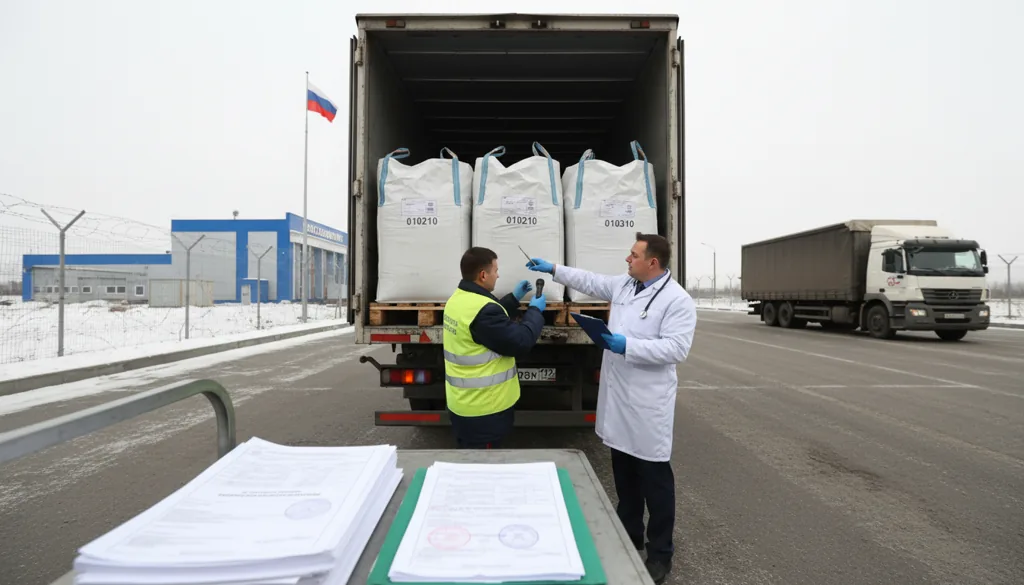
Russian Federation is proposing amendments to common veterinary (sanitary and veterinary) requirements and updating veterinary certificate forms for regulated goods, including meat, dairy, and poultry products, affecting imports from third countries.
The Eurasian Economic Commission has published draft decisions that will rewrite the rules for meat, dairy and poultry imports into Russia, Belarus, Kazakhstan, Armenia and Kyrgyzstan, with new veterinary certificates and stricter health checks taking effect on 1 January 20271.
The changes cover every shipment of beef, pork, chicken, milk powder and cheese from outside the bloc, adding new testing and paperwork that will raise the delivered cost of each tonne. Importers will pay for the extra checks; the five governments will enforce them1.
It comes after a year of rising border rejections. In August 2026, Russian inspectors stopped a tonne of Chinese beeswax at Vladivostok port because the paperwork did not match the new veterinary templates2. The same week, the Federal Service for Veterinary and Plant-health Surveillance (Rosselkhoznadzor) published 28 open datasets on its website, giving traders the first public look at rejection rates, disease alerts and approved suppliers3.
What the new rules require
The draft decisions amend two existing regulations: the common veterinary requirements and the standard veterinary certificates that must accompany every shipment1. The main changes are legal and technical: new definitions, updated disease names, and a single set of rules for all five countries instead of separate national lists1.
What every veterinary certificate must now show
Every shipment must now carry a revised veterinary certificate that matches the new template exactly1. The certificate must list the exact disease tests performed, the laboratory that did them, and the date of sampling1. If the form is missing any of these details, the shipment will be held at the border until the importer provides the missing information or pays for new tests2.
The rules also tighten the list of approved diseases. Foot-and-mouth, African swine fever and avian influenza remain on the list, but the names have been harmonised with the World Organisation for Animal Health (OIE) standards1. This means that a test certificate issued in Brazil or Thailand will now be accepted in Moscow if it uses the same disease codes1.
Who pays and when
The new requirements start on 1 January 20271. Importers have until then to update their contracts, train staff and negotiate with foreign suppliers1. After that date, any shipment that arrives with the old certificate will be rejected, and the importer will have to pay for storage, re-testing and possible re-export2.
Extra cost per tonne from 1 January 2027
The cost falls entirely on the importer. The Eurasian Economic Commission estimates that the extra paperwork and testing will add between $50 and $200 to the delivered cost of each tonne, depending on the product1. For a 20-tonne container of frozen boneless beef (0202.30), that means an extra $1,000 to $4,000 per shipment1.
Rosselkhoznadzor has already started publishing open data on its website, including a list of approved foreign laboratories and a monthly report on border rejections3. Importers can use this information to check whether their suppliers are on the approved list and whether their shipments are likely to be stopped3.
What the old rules left unclear
The old veterinary certificates were often ambiguous. A single product could appear in several different categories, and the disease names were not standardised1. This led to frequent disputes at the border, where inspectors would reject a shipment because the certificate used the wrong disease code or the wrong laboratory name2.
Old rules vs new rules
| Question | Old rules | From 1 Jan 2027 |
|---|---|---|
| Disease names | Not standardised | Single OIE-harmonised name |
| Certificate validity | Unspecified; inspectors differed | Max 30 days before arrival |
| Laboratories | No pre-approval rule | Rosselkhoznadzor pre-approval |
| Certificate template | Ambiguous categories | Fixed template, no interpretation |
The new rules remove this ambiguity. Every disease now has a single, standard name, and every laboratory must be pre-approved by Rosselkhoznadzor1. The certificate template is also simpler: it lists the tests performed, the results, and the laboratory that did them, with no room for interpretation1.
The old rules also did not specify how long a certificate remained valid. Some inspectors accepted certificates that were six months old; others demanded fresh ones2. The new rules set a clear limit: the certificate must be issued no more than 30 days before the shipment arrives at the border1.
How the new rules fit with other Russian trade measures
The veterinary changes are part of a broader push to digitise and standardise trade paperwork. In July 2026, the Russian government launched an experiment to reduce redundant reporting by state agencies4. The goal is to create a single database of government data that all agencies can access, eliminating the need for companies to submit the same information multiple times4.
At the same time, Russia is expanding its national traceability system. Since 2021, importers of refrigerators and freezers have had to register every shipment in the system, and the list of tracked products is set to grow5. The veterinary certificates will eventually be linked to this system, allowing inspectors to verify a shipment’s history with a single click5.
Rosselkhoznadzor has also introduced new rules for paid veterinary services. Starting in 2027, importers will be able to pay for expedited testing and certification, reducing the time a shipment spends at the border6. The fees are set by the government and published in advance, so importers can budget for them6.
What happens next for goods subject to veterinary control
The Eurasian Economic Commission is accepting comments on the draft decisions until 15 October 20261. After that, the final text will be published in the official gazette, giving importers two and a half months to prepare1.
Dates importers must watch
| Date | Who it catches | What falls due |
|---|---|---|
| 15 Oct 2026 | All traders | Deadline for comments on the drafts |
| 1 Jan 2027 | Importers of meat, dairy, poultry | New certificates required; old ones rejected |
| 2027 | Importers needing faster clearance | Paid expedited testing begins |
The changes are unlikely to disrupt trade flows in the long term. The new rules align with international standards, so most foreign suppliers already meet them1. The main effect will be on small importers who lack the resources to update their paperwork and testing procedures1.
For the five Eurasian governments, the goal is clearer: fewer border disputes, faster clearance, and better disease control. For importers, the message is simpler: update your certificates, check the open data, and budget for the extra costs3.
Sources
- ↩ 1) Draft Decision of the Collegium of the Eurasian Economic Commission on Amendments to the Regulation on Common veterinary (sanitary and veterinary) requirements for goods subject to veterinary control (surveillance); and 2) Draft Decision of the Collegium of the Eurasian Economic Commission on Amendments to the Forms of the Common Veterinary Certificates for Regulated Goods Imported into the Customs Territory of the Eurasian Economic Union from Third Countries https://docs.wto.org/imrd/directdoc.asp?DDFDocuments/T/G/SPS/NRUS361.docx
- ↩ Rosselkhoznadzor Identifies Violations in Import of Bee Wax from China in Primorye https://125.fsvps.gov.ru/news/v-primore-rosselhoznadzorom-ustanovleny-narusheniya-pri-vvoze-tonny-pchelinogo-voska-iz-kitaya/
- ↩ Open Data from Rosselkhoznadzor https://fsvps.gov.ru/otkrytaya-sluzhba/otkrytye-dannye/
- ↩ Government of Russia Documents: Decree on Optimizing State Reporting Quality http://government.ru/docs/all/164952/
- ↩ National Traceability System for Imported Goods https://www.nalog.gov.ru/rn77/related_activities/spt/
- ↩ Approval of Rules for Paid Veterinary Services and Invalidating a Government Decree http://government.ru/docs/all/158849/