
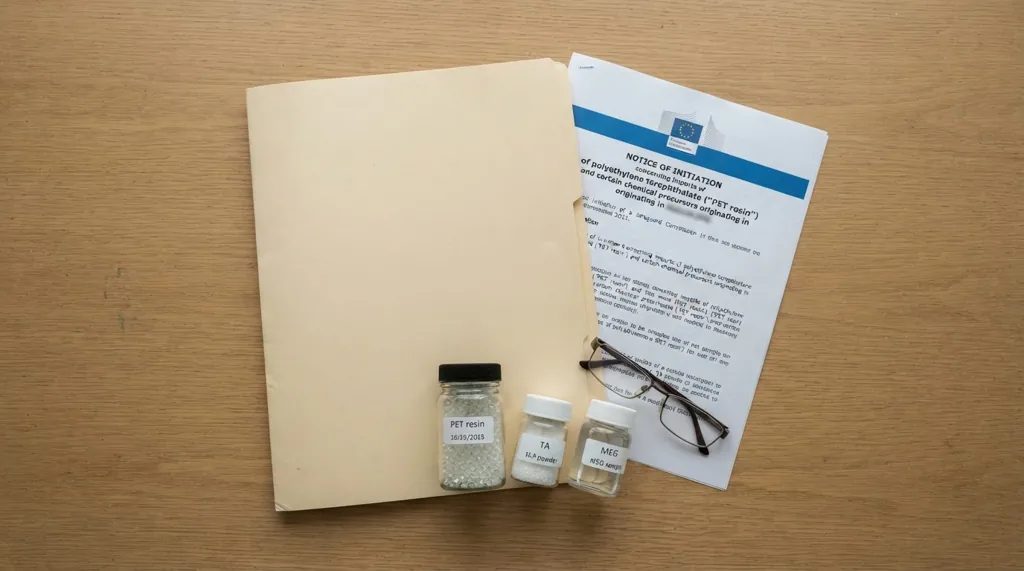
European Union opened a safeguard investigation on Nov. 6, 2026, into PET plastic resin imports, which could bring import limits.
The European Commission opened an investigation on Nov. 6, 2026, into rising imports of PET plastic resin and three chemicals used to make it.
The investigation is a safeguard case, which can lead to temporary limits on imports from all countries1. It covers plastic for bottles and packaging and the raw materials behind it2.
In short, nothing changes at the border today. No new duty or quota applies yet, but the Commission may later limit these imports, for example with a quota, if it finds that EU producers are seriously harmed.
What is the EU investigating in PET resin?
The Commission published a notice of initiation, the formal document that opens the case, in the Official Journal of the European Union on Nov. 6, 20261. The case covers four groups of goods, which the notice calls "segments"1.
Goods covered by the investigation
| Goods | Customs code |
|---|---|
| PET resin, incl. recycled PET and PET-G | CN 3907 61 00 |
| Terephthalic acid (TA) and its salts | CN 2917 36 00 |
| Mono-ethylene glycol (MEG) | CN 2905 31 00 |
| Purified isophthalic acid (PIA) | TARIC 2917 39 85 70 |
The goods under investigation are:
- PET plastic resin (polyethylene terephthalate) with a viscosity number of 78 ml/g or higher, under Combined Nomenclature (CN) code 3907 61 00. The CN is the EU’s list of customs codes.
- Terephthalic acid (TA) and its salts, under CN code 2917 36 00.
- Mono-ethylene glycol (MEG), also called ethylene glycol or ethanediol, under CN code 2905 31 00.
- Purified isophthalic acid (PIA), under CN code ex 2917 39 85 and TARIC code 2917 39 85 70. TARIC is the EU’s detailed customs tariff.
This list follows the Official Journal notice1. The PET group follows the description of CN code 3907 61 001.
Does recycled PET fall under the case?
Yes. The notice says the PET group includes virgin PET, recycled PET and PET glycol (PET-G)1. Virgin PET is new plastic. Recycled PET (rPET) is made from used plastic, and PET-G is a modified form of the resin.
The three chemicals are mostly used to make PET, the notice says1. PET itself is mostly used to make packaging, especially bottles1. The Commission’s news release adds that these chemicals serve packaging, textiles, construction and advanced materials2.
Imports from every origin are covered. A safeguard case differs from an anti-dumping case, which targets unfair prices from named countries. The WTO explains that a safeguard investigation asks whether more imports are causing, or threaten to cause, serious injury to a home industry3.
Why did the Commission open the PET case?
The Commission acted after a request from EU member states1. It found sufficient evidence that imports had increased sharply1.
EU imports of PET resin chemicals, million tonnes
The notice gives these figures for all four groups combined1:
- Total imports rose from 2.12 million tonnes in 2021 to 2.70 million tonnes in 2025, an increase of 27%.
- Imports as a share of EU consumption rose from 27% to 40% over the same years.
- Imports compared with EU production rose from 30% to 62%.
These figures come from the request, and the investigation will test them.
The Commission links the rise to "unforeseen developments", mainly new production capacity outside the EU1. It estimates spare capacity worldwide at about 67.84 million tonnes1. That is 917% more than total EU consumption, the notice says1.
The notice also points to other markets closing their doors. Several countries have adopted their own trade defence measures in recent years, and goods blocked there may turn to Europe1.
How are EU producers of PET chemicals affected?
The request showed that imports have cut the market share of EU producers1. This has put pressure on their sales and left them with losses or low profits, the notice says1.
The Commission’s news release describes "unprecedented difficulties" for EU makers of these chemicals2. It blames high import pressure fuelled by growing global overcapacity2.
The investigation will also look at recent events1. One example is trade diversion, when goods shut out of one market are shipped to another.
How does the safeguard investigation work?
The case follows two EU laws. These are Regulation (EU) 2015/478 on common rules for imports and Regulation (EU) 2015/755 on imports from certain third countries1. The first law says an investigation must come before any safeguard measure is applied4.
The steps run in this order:
- The Commission publishes questionnaires on the website of its Directorate-General for Trade and Economic Security on the day of the notice1.
- EU producers, their associations, importers and users fill in the questionnaires and send them back1.
- Any interested party, including foreign exporters, may send written views and evidence1.
- The Commission studies whether more imports cause or threaten serious injury to EU producers1.
- If it finds injury and measures serve the EU’s interest, the Commission may propose safeguard measures2.
Any measure needs the support of a qualified majority of EU member states2. That is a set voting threshold among EU governments.
Parties should file through TRON.tdi, the Commission’s online system for trade defence cases1. Confidential papers must be marked "Sensitive", with a public summary sent at the same time1.
What could the measures be for PET imports?
A safeguard measure restricts imports of a product for a limited time, the WTO says3. In the EU, such a measure can take the form of a quota, a cap on the quantity allowed in.
The EU import law sets a floor for any quota4. In principle, it should be no lower than the average level of imports over a representative period of at least 3 years4. A quota may also be split among supplier countries4.
The Commission may also impose provisional measures, temporary measures taken before the final decision2. It can do this if the investigation shows the conditions are met2. The import law allows them in urgent cases, when delay would cause damage that is hard to repair4.
Which companies need to act, and by when?
The deadlines run from the notice’s publication date of Nov. 6, 20261. Late views and information may be ignored1.
Deadlines in the PET safeguard case
The main dates are:
- Within 15 days, by Nov. 21, 2026: interested parties should make themselves known to the Commission, preferably by email1.
- Within 21 days, by Nov. 27, 2026: completed questionnaires must reach the Commission1.
- Within 21 days: written views and evidence must arrive, and parties may ask for a hearing1.
The European Union told the WTO Committee on Safeguards about the case on the same day3. Its notification, G/SG/N/6/EU/5, repeats the 15-day and 21-day deadlines3.
If a party refuses to give information or blocks the case, the Commission may decide on the facts it has1. It may also disregard false or misleading information1.
Who is affected by the PET safeguard case?
EU importers and users of PET, TA, MEG and PIA face possible quotas or other import limits later. These include bottle makers and packaging firms that buy the resin.
Makers abroad that export these goods to the EU may face limits too. Unlike an anti-dumping case, a safeguard covers imports from all countries.
EU producers of the four groups of goods are the companies the case aims to protect2. Parties who take part may, on written request, see the non-confidential information in the file1.
A Hearing Officer handles disputes about access to the file, confidentiality and requests for more time1.
What other EU duties already apply to PET?
Some of these goods already face EU trade measures2. The EU applies anti-dumping duties, an extra import tax on goods sold below their normal price, on PET from China2. It applies anti-subsidy duties on PET from India2.
There are also anti-dumping duties on terephthalic acid from Korea and Mexico2. Mono-ethylene glycol from Saudi Arabia and the USA faces anti-dumping duties as well2.
The new case is broader. It covers all origins, so suppliers in other countries are now also under review.
When will the EU decide on PET imports?
The Commission must take any decision within nine months of Nov. 6, 20261. In exceptional cases, that limit may be extended by up to two months1. The Commission would publish a notice in the Official Journal to explain an extension1.
If provisional measures are imposed, definitive measures must follow within 200 days2. They must still come no later than nine months, or at most 11 months, after the case opened2.
Key points on the EU PET safeguard investigation
The table below sums up the case.
| Question | Answer |
|---|---|
| What happened? | A safeguard investigation opened |
| Who issued it? | The European Commission |
| When did it start? | Nov. 6, 2026 |
| Which goods? | PET, rPET, PET-G, TA, MEG, PIA |
| Main customs codes | 3907 61 00, 2917 36 00, 2905 31 00 |
| Which origins? | All countries outside the EU |
| Import rise cited | 2.12 to 2.70 million tonnes, 2021-2025 |
| Possible result | Quotas or other import limits |
| Contact deadline | Nov. 21, 2026 |
| Questionnaire deadline | Nov. 27, 2026 |
| Decision deadline | 9 months, extendable by 2 |
For now, PET shipments enter the EU on the same terms as before. The next dates are Nov. 21 and Nov. 27, 2026, when contact requests, questionnaires and written views are due1.
Sources
- ↩ C_202605775EN.000101.fmx.xml https://eur-lex.europa.eu/legal-content/EN/TXT/HTML/?uri=OJ:C_202605775
- ↩ Commission initiates safeguard investigation into imports of PET resin chemicals – Trade and Economic Security https://policy.trade.ec.europa.eu/news/commission-initiates-safeguard-investigation-imports-pet-resin-chemicals-2026-11-06_en
- ↩ WTO | 2026 News items – EU launches safeguard investigation on certain PET resin chemicals https://www.wto.org/english/news_e/news26_e/safe_eec_06nov26_542_e.htm
- ↩ Regulation – 2015/478 – EN – EUR-Lex https://eur-lex.europa.eu/eli/reg/2015/478/oj/eng