
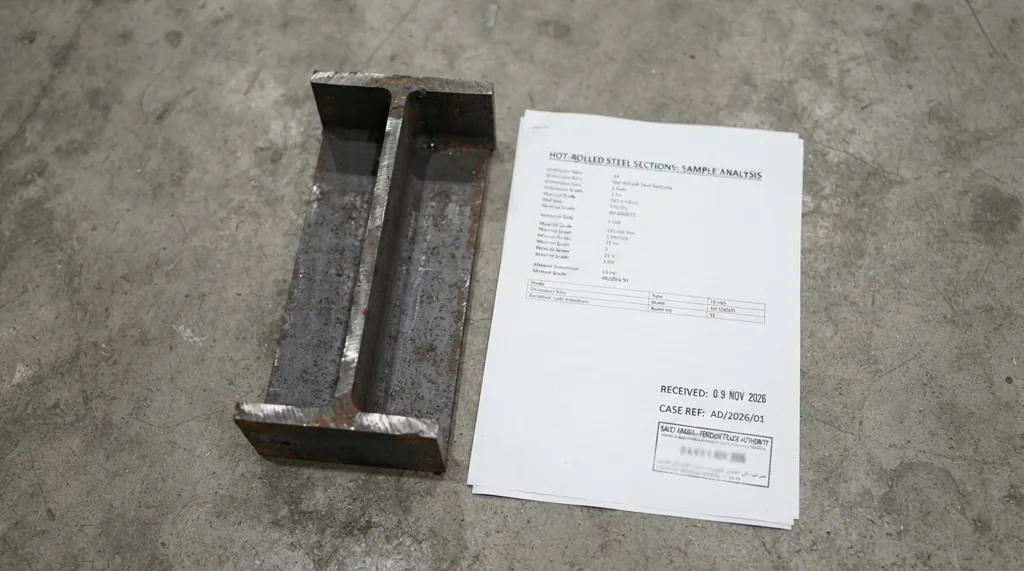
Saudi Arabia opened an investigation on Nov. 9, 2026, into whether Chinese and Turkish steel sections are sold below normal price.
Saudi Arabia’s General Authority of Foreign Trade (GAFT) opened an anti-dumping investigation on Nov. 9, 2026, into hot-rolled steel sections from China and Türkiye.
The case covers "structural sections, angles, and shapes of hot-rolled light and medium grades, made of iron or steel" from the two countries1. GAFT published the formal start as Notice No 15 on its list of trade remedy notices on the same day2.
In short, no new duty applies yet. Steel beams, angles and similar shapes from China and Türkiye still enter Saudi Arabia as before, but the investigation could end with extra import taxes on them.
What has GAFT started for steel sections?
GAFT has started an anti-dumping investigation, a formal inquiry into whether foreign goods are sold in a country below their normal price. If dumping is found and it harms local makers, the authority can add an extra import tax called an anti-dumping duty.
The investigation covers goods "originating in or exported from" China and Türkiye1. This wording matters for traders. It means the case can reach goods made in either country and goods shipped from either country.
The announcement does not set any duty rate. It only opens the case. GAFT points readers to two pages on its website for the details: its notices and circulars on trade remedies, and its page on ongoing investigations and reviews1.
Which steel goods are in the case?
The goods are hot-rolled steel shapes used in buildings and other structures. They include sections, angles and shapes made of iron or steel. Hot-rolled means the steel is shaped while it is very hot, not pressed cold.
The case is limited to light and medium grades of these products1. Heavy sections are not named in the title of the case. The announcement itself gives no tariff codes, sizes or other limits.
Buyers and sellers will need the full text of Notice No 15 to check whether a given product is covered. The notice is listed for download on GAFT’s notices page3.
Why did Saudi Arabia act on Chinese and Turkish steel?
GAFT says it acted under the Law of Trade Remedies in International Trade, issued on Nov. 23, 20221. Article 4.1 of that law makes GAFT responsible for investigations, reviews and the imposition of trade remedy measures.
The law says GAFT must act in line with Saudi Arabia’s international commitments. It names three World Trade Organization (WTO) agreements: the Anti-Dumping Agreement, the agreement on subsidies and countervailing measures, and the Agreement on Safeguards1.
According to GAFT, the law aims to protect local industry from harm caused by dumped or subsidized imports. It also aims to guard against sudden increases in imports. A third aim is to defend Saudi exports that face trade cases abroad1.
The announcement does not name the Saudi company that complained. It also gives no import volumes, prices or dumping margins.
How does a GAFT anti-dumping case start?
GAFT’s implementing regulations for the trade remedies law describe how a case begins. The draft text was posted for public comment on the government’s consultation portal, Istitlaa4.
How a GAFT case starts
Under these rules, GAFT’s trade remedies department has up to 45 days to study a complaint after it is accepted and registered4. It checks whether the evidence of dumping and of harm is accurate and enough to justify a case.
If the evidence is enough, the department sends a report to GAFT’s governor recommending an investigation4. The governor then has up to 15 days to decide whether to open the case. GAFT must tell the governments of the exporting countries about the complaint before that decision4.
No public announcement is made before the governor decides to open the case4. The Nov. 9 notice is therefore the first public step in this steel case.
When can a country be dropped from the case?
The regulations set minimum levels for a case to go on against a country. GAFT must reject the complaint, or end the case, for a country whose imports are less than 3% of Saudi Arabia’s total imports of the product4.
When a country leaves the case
| Test | Level |
|---|---|
| Share of imports | Less than 3% of total imports |
| Small suppliers together | Stay in if above 7% combined |
| Dumping margin | Under 2% |
There is an exception. Small suppliers stay in the case if, together, they make up more than 7% of total imports4.
A country is also dropped when its dumping margin is under 2%. The dumping margin is the gap between the normal price and the export price. A country is dropped as well if the harm from its goods is too small to matter4.
These tests will apply to both China and Türkiye. Either country could leave the case if its share or its margin falls below these levels.
What must importers and steel exporters do, and by when?
The regulations give firms with an interest in the case 15 days from the announcement to register4. From the Nov. 9 announcement, that period ends on Nov. 24, 2026. This applies to foreign makers, exporters, importers and other interested parties.
Time limits for parties in the case, days
GAFT then sends questionnaires, which are long sets of questions on prices, costs and sales. Parties have at least 37 days to answer from the date the questionnaire is sent or made available4.
A party can ask in writing for more time. GAFT may grant up to 10 extra days. The request must reach GAFT before the last 5 days of the original period4.
Other rules shape how firms take part:
- Signed authority: GAFT accepts information only with an authenticated document naming who represents the party4.
- Public file: answers go into a public file, and other parties get at least 3 days to comment on them4.
- Hearings: parties that ask within the set period can join a hearing, and must send their spoken points in writing within 7 days4.
What could happen to steel shipments next?
During the case, GAFT may reach early findings and apply provisional measures, which are temporary duties before a final decision4. If it does, parties get at least 7 days to comment on the early findings4.
The regulations say these steps do not stop GAFT from moving ahead with the case. It can reach early or final findings and apply temporary or final duties within the time limits of the law4.
For now, importers of these steel shapes face no new charge at Saudi customs. A duty would come only after GAFT finds dumping and harm.
How have earlier GAFT cases ended?
GAFT’s recent cases show the path a case can take. Its notices list shows a case on aluminium lids for beverage cans from China3. GAFT imposed anti-dumping duties on those lids in a notice dated Oct. 12, 20263.
The same list shows duties on ductile iron pipes after a case that began earlier. The final report on that case is dated Aug. 3, 20263. Other recent cases cover epoxy resins and grey-back duplex cardboard3.
Each of these earlier cases began with an initiation notice like Notice No 15. Several ended with duties. The outcome of the steel case is not decided.
Key points on the Saudi steel sections case
The table sums up the main facts of the case.
| Question | Answer |
|---|---|
| What changed? | An anti-dumping investigation opened |
| Who issued it? | General Authority of Foreign Trade (GAFT) |
| Which notice? | Notice No 15 |
| When? | Nov. 9, 2026 |
| Which goods? | Hot-rolled light and medium steel sections, angles and shapes |
| Which countries? | China and Türkiye |
| Legal basis | Law of Trade Remedies, Nov. 23, 2022 |
| Duty now? | None yet |
| Registration period | 15 days from the announcement |
| Questionnaire answers | At least 37 days |
| Minimum dumping margin | 2% |
The next date in the rules is the end of the 15-day registration period, on Nov. 24, 2026. Firms that do not register by then risk losing their voice in a case that could bring new duties on these steel shapes.
Sources
- ↩ The General Authority of Foreign Trade announces the initiation of an … / GAFT https://gaft.gov.sa/en/lists/news/the-general-authority-of-foreign-trade-announces-the-initiation-of-an-anti-dumping-investigation-concerning-the-kingdom-s-imports-of-structural-sections-angels-and-shapes-of-hot-rolled-light-and-medium-grades-made-of-iron-or-steel-from-the-
- ↩ Initiation of an anti-dumping investigation against the imports of Str… / GAFT https://gaft.gov.sa/en/lists/notices-and-circulars-for-trade-remedies-investigations/initiation-of-an-anti-dumping-investigation-against-the-imports-of-structural-sections-angels-and-shapes-of-hot-rolled-light-and-medium-grades-made-of-iron-or-steel/
- ↩ Notices and Circulars for Trade Remedies Investigations / GAFT https://gaft.gov.sa/en/trade-remedies/notices-and-circulars-for-trade-remedies-investigations
- ↩ اللائحة التنفيذية لنظام المعالجات التجارية في التجارة الدولية https://istitlaa.scbc.gov.sa/ar/Trade/gaft/TRREQULATION/Pages/default.aspx