
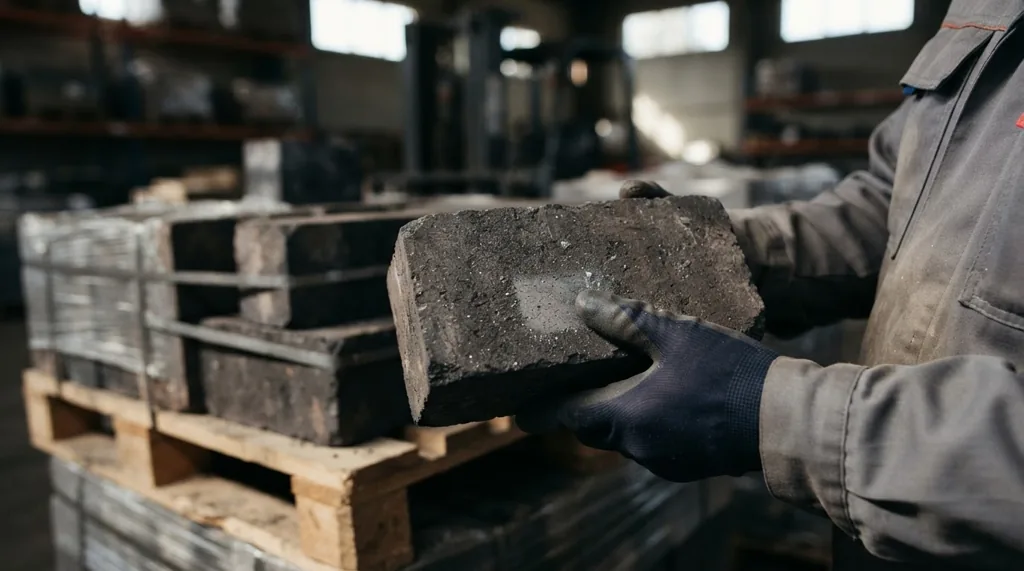
United States opened an inquiry on Nov. 10, 2026, into whether Chinese bricks with trace alumina avoid existing brick duties.
The U.S. Department of Commerce on Nov. 10, 2026, opened an inquiry into whether Chinese bricks with a little alumina avoid existing brick duties.
The inquiry asks whether these heat-resistant bricks are a small change made to escape the anti-dumping and anti-subsidy duties on Chinese magnesia carbon bricks1. An anti-dumping duty is an extra import tax on goods sold abroad below their normal price.
In short, a Chinese brick with a trace of alumina may now be treated like a brick already under duty. Customs can ask for a cash deposit on it while Commerce decides.
What is Commerce checking in the brick inquiry?
Commerce calls this step a circumvention inquiry. It is a check on whether goods have been changed only slightly so that they fall outside a duty order. The notice was published in the Federal Register on Nov. 10, 2026, and applies from that date1.
The question is narrow. Commerce will decide whether Chinese bricks containing alumina above zero but below 5% by weight are covered by the orders on magnesia carbon bricks1. Alumina is aluminium oxide, a common mineral used in heat-resistant materials.
The inquiry is country-wide1. It covers bricks of this kind from every producer in China, not just one company. Commerce said the information it received justified this wider approach, as in earlier inquiries of the same kind1.
The notice was dated Nov. 5, 2026, and signed by Scot Fullerton, Acting Deputy Assistant Secretary for Antidumping and Countervailing Duty Operations1.
Which Chinese bricks are under review?
The inquiry covers chemically bonded refractory bricks, meaning bricks held together with resin or pitch that resist very high heat1. To fall within the inquiry, a brick must meet all of these conditions1:
- At least 70% magnesia by weight, magnesia being a mineral form of magnesium oxide
- Carbon from trace amounts to 30% by weight
- Alumina above zero but below 5% by weight when the brick is imported
- Produced in China and exported to the United States
Bricks covered by the inquiry
| Condition | Limit |
|---|---|
| Magnesia | At least 70% by weight |
| Carbon | Trace amounts to 30% by weight |
| Alumina | Above zero, below 5% by weight |
| Origin | Produced in China, exported to the United States |
| Test method | X-ray diffraction |
The notice also sets a testing method. The alumina content should be measured by X-ray diffraction, a laboratory test that reads a material’s crystal structure1. The test must be run so that metallic aluminium in the brick is not turned into aluminium oxide during the analysis1.
That condition matters. The orders already allow metal antioxidants in the bricks, and aluminium can be one of them. The testing rule keeps such metal from being counted as alumina.
What do the existing brick duty orders cover?
The orders date from 2010. Commerce issued the anti-dumping duty orders on bricks from Mexico and China on Sept. 20, 20102. It issued a separate countervailing duty order on Chinese bricks on Sept. 21, 20103. A countervailing duty is an extra import tax that offsets subsidies paid by a foreign government.
All three orders describe the same goods. They cover magnesia carbon bricks with at least 70% magnesia by weight, whatever the source of the magnesia1. Carbon can range from trace amounts to 30% by weight1.
The orders also cover bricks with extra treatments. The examples given are coating, grinding, tar impregnation or coking, high-temperature heat treatment, anti-slip treatment and metal casing1. Bricks with antioxidants of up to 15% by weight, in the form of metals, metal alloys or metal carbides, are also covered1.
The orders list five import codes in the Harmonized Tariff Schedule of the United States (HTSUS), the U.S. list of tariff codes2:
- 6902.10.1000
- 6902.10.5000
- 6815.91.0000
- 6815.99.2000
- 6815.99.4000
The codes are a guide only. The written description decides what is covered2. The law on minor changes also applies to goods whether or not they fall under the same tariff code1.
Why did U.S. brick makers ask for the inquiry?
The request came from the Magnesia Carbon Bricks Fair Trade Committee1. This is a group formed for the case by three U.S. brick makers1:
- Magnesita Refractories Company
- HarbisonWalker International, Inc.
- Resco Products, Inc.
The committee filed its request on Sept. 21, 20261. It claimed that Chinese bricks with trace alumina are bricks altered in form or appearance in minor respects1. In plain words, it says adding a little alumina does not make them a different product.
The committee asked Commerce to treat these bricks as covered by the orders1. The claim rests on section 781(c) of the Tariff Act of 1930, the U.S. law on duty circumvention1.
Who argued against the brick inquiry?
One company objected before Commerce decided. FRC Global, Inc. filed comments opposing the start of the inquiry on Oct. 1, 20261. The committee answered those comments on Oct. 6, 20261.
From request to inquiry
Commerce then gathered more information. Its officials met the committee’s lawyers on Oct. 8, 20261. Commerce sent the committee extra questions on Oct. 9, and the committee answered on Oct. 151.
On Oct. 19, 2026, Commerce gave itself 15 more days to decide whether to begin1. It concluded that the request met the legal requirements and started the inquiry1.
How will Commerce decide on trace-alumina bricks?
The law lets Commerce weigh several factors when it judges a minor change. The notice lists five of them1:
- The overall physical features of the bricks.
- What the final users expect from them.
- How the bricks are used.
- How they are marketed and sold.
- The cost of the change compared with the total value of the imported goods.
The list is not closed, and Commerce may consider other points too1. The law also has an exception. Commerce need not bring the changed goods under the orders if it finds that this is unnecessary1.
Commerce plans to ask certain companies in China for information1. It will ask about their production of bricks with trace alumina and their shipments to the United States1.
Commerce will run one inquiry for both orders. It will hold it on the record of the anti-dumping case, then copy its final decision to the subsidy case1.
What changes at the border for brick shipments?
The change at the border starts now. Commerce will tell U.S. Customs and Border Protection (CBP), the border agency, about the inquiry1. CBP will keep holding open the final duty bill on entries already held open under the orders. This is called suspension of liquidation, meaning customs does not close the final account on an entry1.
CBP will also apply the cash deposit rates that would apply if the bricks were covered by the orders1. A cash deposit is an advance payment of the expected duty, paid when the goods enter.
If Commerce finds circumvention, more entries will be caught. CBP will start holding open and taking deposits on unsettled entries made on or after Nov. 10, 2026, the date the inquiry began1.
Commerce may go further back. It may tell CBP to act on unsettled entries made before Nov. 10, 2026, but not on entries before Nov. 4, 20211. That is the date the current circumvention rules took effect1. CBP also keeps its own power to take other steps on these entries1.
How large are the deposits on Chinese bricks?
The rates are those of the existing orders. In 2010, Commerce set anti-dumping rates of 128.10% for RHI Refractories Liaoning Co., Ltd. and 13 other named Chinese firms2. All other Chinese exporters received 236.00%2.
2010 duty rates on Chinese bricks, %
The 2010 subsidy order added more. It set a rate of 24.24% for RHI and for all other Chinese exporters3. Liaoning Mayerton Refractories and Dalian Mayerton Refractories Co. Ltd. received 253.87%3.
For some Chinese firms, Commerce lowered the anti-dumping deposit by the part linked to export subsidies2. This stopped the same subsidy from being charged twice.
The orders remain in force. On Nov. 4, 2026, Commerce found that ending the anti-dumping orders would likely bring back dumping by Chinese makers at margins of up to 236.00%4. That finding came from the third five-year review of the orders4.
Who is affected by the brick inquiry?
U.S. importers carry the cost. The importer pays the cash deposit at entry, at the same time as normal customs duties2. A buyer of Chinese bricks with less than 5% alumina may now face deposits that did not apply before.
Chinese makers and exporters face questions from Commerce. Those that ship trace-alumina bricks may be asked to explain their production and their U.S. sales1.
Customs brokers who file entries of Chinese refractory bricks will need to know the alumina content of each shipment.
When will Commerce rule on the bricks?
Commerce has set two deadlines in the notice. It plans a preliminary decision within 150 days of Nov. 10, 20261. That points to early April 2027.
The final decision is due within 300 days of Nov. 10, 20261. That points to early September 2027. Both dates can move if Commerce extends or ends the inquiry, in whole or in part1.
Two outcomes are possible. If Commerce finds circumvention, the trace-alumina bricks fall under the orders and deposits continue. If it does not, the bricks stay outside the orders.
Key points on the Chinese brick circumvention inquiry
The table gives the main facts of the inquiry.
| Question | Answer |
|---|---|
| What happened? | Commerce opened a circumvention inquiry |
| Who issued it? | U.S. Department of Commerce |
| Which goods? | Chinese magnesia carbon bricks with trace alumina |
| Alumina content | Above zero, below 5% by weight |
| Other limits | At least 70% magnesia, up to 30% carbon |
| How wide? | Country-wide, all Chinese producers |
| Who asked? | Magnesia Carbon Bricks Fair Trade Committee |
| Start date | Nov. 10, 2026 |
| Border effect | Cash deposits at the orders’ rates |
| Earliest back date | Nov. 4, 2021 |
| Preliminary decision | Within 150 days |
| Final decision | Within 300 days |
The next step is Commerce’s preliminary decision, due within 150 days of Nov. 10, 2026. Until then, Chinese bricks with trace alumina can face the same deposits as bricks already under duty.
Sources
- ↩ Federal Register :: Certain Magnesia Carbon Bricks From the People’s Republic of China: Initiation of Circumvention Inquiry on the Antidumping and Countervailing Duty Orders https://www.federalregister.gov/documents/2026/11/10/2026-22943/certain-magnesia-carbon-bricks-from-the-peoples-republic-of-china-initiation-of-circumvention
- ↩ Federal Register :: Certain Magnesia Carbon Bricks From Mexico and the People’s Republic of China: Antidumping Duty Orders https://www.federalregister.gov/documents/2010/09/20/2010-23427/certain-magnesia-carbon-bricks-from-mexico-and-the-peoples-republic-of-china-antidumping-duty-orders
- ↩ Federal Register :: Certain Magnesia Carbon Bricks from the People’s Republic of China: Countervailing Duty Order https://www.federalregister.gov/documents/2010/09/21/2010-23550/certain-magnesia-carbon-bricks-from-the-peoples-republic-of-china-countervailing-duty-order
- ↩ Federal Register :: Magnesia Carbon Bricks From Mexico and the People’s Republic of China: Final Results of the Expedited Third Sunset Reviews of the Antidumping Duty Orders https://www.federalregister.gov/documents/2026/11/04/2026-22523/magnesia-carbon-bricks-from-mexico-and-the-peoples-republic-of-china-final-results-of-the-expedited