
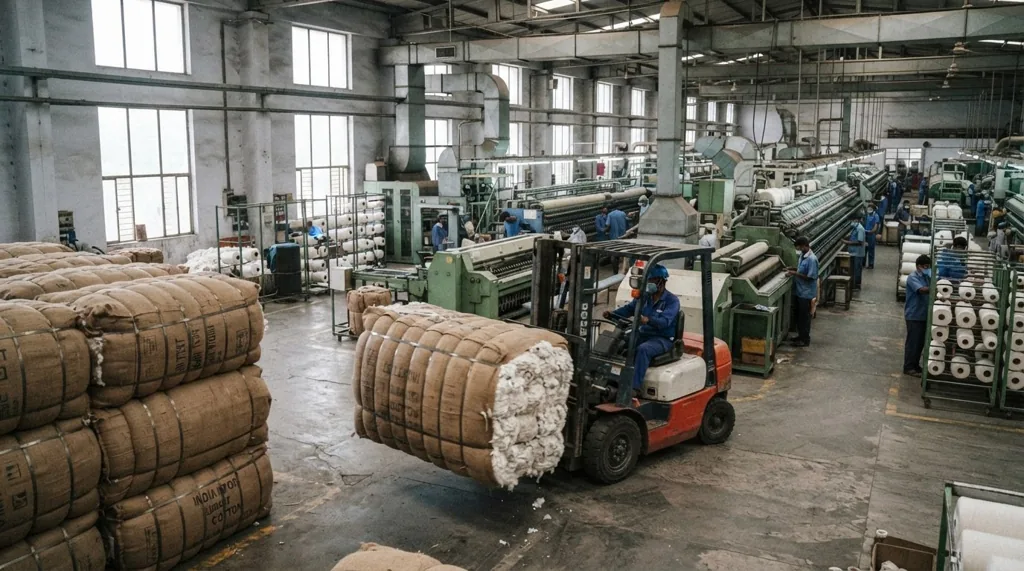
India has extended its exemption from all customs duties on imported cotton by two months, until Dec. 31, 2026.
India’s Ministry of Finance has extended its exemption from all customs duties on imported cotton by two months, to Dec. 31, 2026.
The Department of Revenue in the Ministry of Finance made the change through Notification No. 35/2026-Customs, dated Oct. 30, 20261. The exemption had been due to end on Oct. 31, 20261.
In short, cotton shipments that reach India in November and December 2026 can still enter without customs duty. Without the extension, the duty-free window would have closed at the end of October.
What is changing for cotton imports?
The change is a single new end date. The exemption that ran until Oct. 31, 2026 now runs until Dec. 31, 20261. The Ministry of Textiles described this as an extension of two months1.
Cotton duty exemption, before and after
| Question | Before Oct. 30, 2026 | After Notification No. 35/2026 |
|---|---|---|
| Duties exempted | All customs duties | All customs duties |
| Exemption start | June 1, 2026 | June 1, 2026 |
| Exemption end | Oct. 31, 2026 | Dec. 31, 2026 |
Nothing else about the exemption changes in the announcement. It still covers all customs duties on cotton imports, as the original measure did in May2. The Ministry of Textiles called the new notification an amendment to the existing exemption1.
For an importer, this means the same treatment continues at the border. A cotton shipment cleared on Nov. 15 or Dec. 20 is treated like one cleared in September. The duty that would normally be charged on imported cotton is not collected while the exemption lasts.
How did the cotton duty exemption start?
The Central Government first announced the exemption on May 30, 20262. It temporarily exempted all customs duties on cotton imports from June 1, 2026, until Oct. 31, 20262. The Ministry of Finance said the aim was to increase the supply of cotton for the Indian textile sector2.
Length of the duty-free period, months
The ministry expected the measure to cut input costs, the cost of raw materials, across the textile and clothing sector2. It said this would give targeted relief to manufacturers and consumers2. It also said the government had the interests of Indian cotton farmers in mind2.
The May announcement said the measure would help the Indian textile industry as a whole. It singled out small and medium enterprises as the businesses expected to gain most, through better supply of cotton in the market2.
Why did India extend the cotton exemption?
The Ministry of Textiles linked the extension to the raw material needs of India’s textile industry1. It listed several aims for the decision1:
- more cotton for Indian mills, the textile sector at home
- cotton at competitive prices for buyers in India
- support for manufacturing in India
- meeting needs for specialised types of cotton
- support for adding value along the textile and clothing chain
The ministry expects the extension to give textile and clothing makers more choice in how they buy raw materials1. It also expects it to ease cost pressure on inputs and to support micro, small and medium enterprises (MSMEs)1. A further aim is to make Indian textiles more competitive at home and abroad1.
The ministry said the extension should keep raw materials flowing without a break1. It also expects more value to be added across the cotton-based textile and clothing sector1.
How does the Finance Ministry notification work?
The Department of Revenue, part of the Ministry of Finance, made the change in a legal notice. Its name is Notification No. 35/2026-Customs1.
The new notification does not create a fresh exemption. It amends the existing one so that its end date moves from Oct. 31 to Dec. 31, 20261. Customs at the port therefore applies the same relief for two more months.
The Ministry of Textiles did not issue the notification itself. It welcomed the decision of the Ministry of Finance in its own statement on Oct. 31, 20261. The ministry said it remains committed to a competitive and resilient textile sector that is linked to world markets1.
Who gains from duty-free cotton until December?
The main gainers are the businesses that buy raw cotton from abroad. These are mostly spinning mills and textile makers that turn cotton into yarn, fabric and clothing. The government named textile and clothing manufacturers and MSMEs as the groups it wants to help1.
Cotton sellers abroad also gain, because their cotton can reach Indian buyers without an added duty for two more months. Exporters that had planned shipments for late 2026 can now sell into India on the same terms as in the summer.
Buyers of finished goods are also part of the government’s case. In May, the Ministry of Finance said lower input costs would give relief to consumers as well as manufacturers2.
What about Indian cotton farmers?
Duty-free imports compete with cotton grown in India. The government says it has weighed this. The Ministry of Textiles said it remains aware of the need to balance the textile industry’s needs with the interests of Indian cotton farmers1.
The ministry also spoke of promoting the long-term growth of the whole cotton and textile chain1. The May announcement made the same point, saying the exemption was set with farmers’ interests in mind2.
The time limit is part of this balance. The exemption was presented as temporary from the start2. The extension keeps a fixed end date rather than making duty-free cotton permanent1.
When does the cotton exemption end?
The exemption now has three key dates. The relief began on June 1, 20262. The first end date was Oct. 31, 20262. The new end date is Dec. 31, 20261.
Cotton duty exemption dates
Counted from June 1, the duty-free period now lasts seven months instead of five. The extension was announced the day before the old end date. The notification is dated Oct. 30, 2026, and the Ministry of Textiles announced it on Oct. 311.
Under the current notification, cotton imports again face the normal customs duty from Jan. 1, 2027. Any further extension would need a new notification from the Ministry of Finance.
Key points on the cotton import duty exemption
The table sums up the extension and its dates.
| Question | Answer |
|---|---|
| What changed? | Duty exemption extended by two months |
| Which goods? | Imported cotton |
| Which duties? | All customs duties |
| Who issued it? | Department of Revenue, Ministry of Finance |
| Legal instrument | Notification No. 35/2026-Customs |
| Notification date | Oct. 30, 2026 |
| Exemption began | June 1, 2026 |
| Old end date | Oct. 31, 2026 |
| New end date | Dec. 31, 2026 |
| Main aim | More cotton for the textile industry |
| Who gains? | Textile makers and MSMEs |
Cotton shipments cleared through Indian customs up to Dec. 31, 2026, pay no customs duty. From Jan. 1, 2027, the normal duty returns unless the Ministry of Finance issues another notification.
Sources
- ↩ Press Release: Press Information Bureau https://pib.gov.in/PressReleseDetailm.aspx?PRID=2330823
- ↩ Press Release Page | Press Information Bureau https://www.pib.gov.in/PressReleasePage.aspx?PRID=2267049®=3&lang=1