
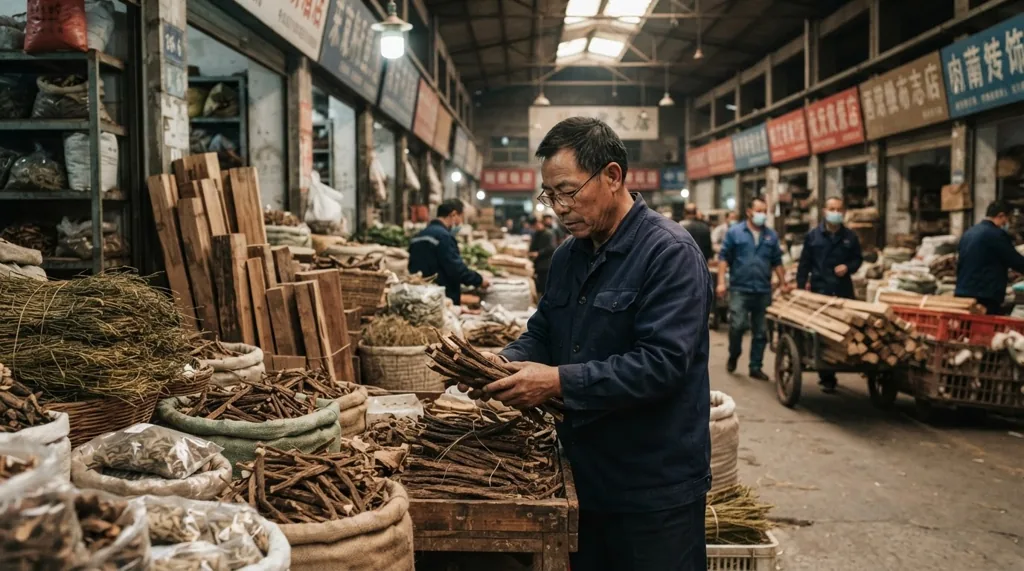
China set 2027 export quotas, raising ephedra and cutting rush products, with quotas given out before Dec. 15, 2026.
China’s Ministry of Commerce (MOFCOM) has set 2027 export quotas for licorice, ephedra, live pigs, cattle, chickens, sawn timber and rush products.
The ministry signed Announcement No. 53 of 2026 on Oct. 25, 2026, and posted it on Oct. 291. It covers the full 2027 calendar year.
In short, a Chinese company that wants to ship these goods in 2027 needs a share of the quota first. With that share it gets an export licence, and customs will clear the shipment only against that licence.
What does Announcement No. 53 set for 2027?
The announcement fixes one total for each product group for 20271. An export quota is a yearly cap on how much of a product may leave the country. Once the quota is shared out, no more can be exported that year.
2027 live animal quotas, head
The 2027 totals are:
- Licorice and licorice products: 5.2 million kilograms.
- Ephedra grown on farms for medicine: 1.0804 million kilograms.
- Live pigs to Hong Kong and Macao: 1.6054 million head.
- Live cattle to Hong Kong and Macao: 22,000 head.
- Live chickens to Hong Kong: 3 million birds.
- Sawn timber: 150,000 cubic meters.
- Rush and rush products: 14 million kilograms.
These figures come from the first point of the announcement1. The ephedra quota covers only ephedra grown on farms for use in medicine.
How do the 2027 quotas compare with 2026?
Most totals did not change. A year earlier, Announcement No. 69 of 2025 set the 2026 quotas2. Licorice, live pigs, live cattle, live chickens and sawn timber have the same totals in both years.
Export quotas, 2026 and 2027
| Product | 2026 | 2027 |
|---|---|---|
| Ephedra for medicine | 1.0289 million kg | 1.0804 million kg |
| Rush products | 16 million kg | 14 million kg |
| Licorice products | 5.2 million kg | 5.2 million kg |
| Sawn timber | 150,000 cubic meters | 150,000 cubic meters |
Two products did change:
- Ephedra rises to 1.0804 million kilograms, from 1.0289 million kilograms in 2026. That is 51,500 kilograms more, an increase of about 5%.
- Rush products fall to 14 million kilograms, from 16 million kilograms in 2026. That is 2 million kilograms less, a cut of 12.5%.
The 2026 figures are in the first point of last year’s announcement2. Neither announcement gives a reason for the totals or for the changes.
For exporters of rush products, the smaller quota means less volume to share among bidders in 2027. For ephedra growers, there is slightly more room to export.
Which law does the ministry use?
The announcement rests on China’s Foreign Trade Law and its regulation on the import and export of goods1. It also cites two ministry rules: one on managing export quotas and one on quota tenders.
The ministry issues the same kind of notice every year. The 2026 notice used the same laws and nearly the same wording2.
How does an exporter get a share of the quota?
Each exporter must apply to the ministry for a quota share. The share can be global or limited to one region, such as Hong Kong1.
The process works in this order:
- The exporter sends its application to the commerce department of its own province.
- The provincial department checks the papers and passes them to the ministry.
- The ministry reviews the applications and gives quotas to those who qualify.
- The exporter uses its quota papers to apply for a People’s Republic of China export licence.
- The exporter shows the export licence to customs to clear each shipment.
These steps are set out in points two to four of the announcement1. A "provincial department" also covers large cities with their own planning status and the Xinjiang Production and Construction Corps.
Provincial offices can set their own earlier cut-off inside the national window. For the 2026 round, the Beijing commerce bureau asked firms to hand in papers by Nov. 12, 2025, three days before the national close3.
When must applications be filed for 2027?
The application window runs from Nov. 1 to Nov. 15, 20261. The ministry will hand out the quotas before Dec. 15, 2026.
2027 quota timetable
This timetable covers the quotas the ministry hands out directly. It does not cover licorice and rush, which go through tenders.
The dates follow last year’s pattern. For 2026, applications also ran from Nov. 1 to Nov. 15, with quotas given out before Dec. 152.
Why do licorice and rush go to tender?
The ministry does not hand out licorice and rush quotas on request. Instead it shares them out by tender, a bidding round run by a committee1. The conditions and steps for those tenders will be published separately.
A tender can run more than once a year. In June 2026 the ministry published the results of its second 2026 tender for licorice and licorice products4. The winners split their amounts across three product groups: dried or fresh licorice root, licorice juice and extract, and glycyrrhizic acid salts made from licorice.
The rush tender follows the same path. In December 2025 the ministry issued the winners of the first 2026 rush tender5. Each winner used its awarded amount and a certificate from the tender committee to apply for an export licence.
The 2027 tenders have not yet been announced. With the rush total cut to 14 million kilograms, the amount open for bids will be smaller.
What extra rules apply to ephedra?
Ephedra has tighter rules than the other goods. China banned its export until the end of 2018. From Jan. 1, 2019, it moved ephedra to quota control instead of a ban6.
Five agencies made that decision, including the police ministry, customs and the drug regulator. They said they acted to protect the environment and wild ephedra, to support farm-grown ephedra, and to meet anti-drug needs6. Only farm-grown ephedra for medicine may be exported.
The ministry’s 2018 rules on ephedra quotas set conditions for applicants7. A company must:
- own its own ephedra farm in a main growing area, and export only ephedra from that farm;
- be an exporter of traditional Chinese medicine materials, with export sales in each of the last three years;
- hold a signed letter of intent with a foreign buyer stating the ephedra is for medicine only;
- sign a pledge and confirm it has broken no laws in the last three years.
These conditions come from the ministry’s 2018 notice7. The farm must also be confirmed in writing by the local county government.
Ephedra uses tariff code 12115000197. All ephedra shipments must clear through Tianjin Customs, the only port named for it6. The ministry’s special office in Tianjin issues ephedra export licences.
The police ministry checks applicants before the commerce ministry gives out the ephedra quota7. Officials can visit farms. A company that gives false papers or breaks its pledge loses its unused quota and cannot apply the next year.
What happens to phosphate rock and silver?
The announcement keeps the quota suspended for phosphate rock and silver in 20271. These goods still need an export licence, but no quota cap applies.
A qualified exporter can apply for the licence with a valid export contract. Silver exported under processing trade follows its own rules. The exporter then shows the licence to customs to clear the goods.
The same suspension applied in 20262. For exporters of these two goods, nothing changes in 2027.
Who is affected by the 2027 quotas?
Chinese exporters of the listed goods are affected first. Without a quota share and a licence, customs will not clear their shipments1.
Buyers abroad are affected too. Importers of Chinese licorice, ephedra, sawn timber and rush products depend on Chinese sellers who hold quota. Buyers in Hong Kong and Macao rely on quota holders for live pigs and cattle, and Hong Kong for live chickens.
Buyers of rush products may find less supply on offer in 2027, since the total is 2 million kilograms lower. Buyers of ephedra for medicine may find slightly more.
Key points on China’s 2027 export quotas
The table sums up the main facts of the announcement.
| Question | Answer |
|---|---|
| Who issued it? | Ministry of Commerce (MOFCOM) |
| Which document? | Announcement No. 53 of 2026 |
| When was it signed? | Oct. 25, 2026 |
| Which year does it cover? | 2027 |
| Which goods? | Licorice, ephedra, live pigs, cattle, chickens, sawn timber, rush |
| What went up? | Ephedra, to 1.0804 million kg |
| What went down? | Rush products, to 14 million kg |
| What stayed the same? | Licorice, livestock, sawn timber |
| What must exporters hold? | Quota share and export licence |
| When are applications due? | Nov. 1 to Nov. 15, 2026 |
| When are quotas given out? | Before Dec. 15, 2026 |
| How are licorice and rush shared? | By tender, rules to follow |
The next date is Nov. 1, 2026, when the application window opens. By Dec. 15, 2026, exporters will know their 2027 quota shares, except for licorice and rush, which wait for the tenders.
Sources
- ↩ 商务部公告2026年第53号 公布2027年货物出口配额总量 https://www.mofcom.gov.cn/zwgk/zcfb/art/2026/art_45feaf534cb7410c880c1b4ca04a90b9.html
- ↩ 商务部公告2025年第69号 公布2026年货物出口配额总量 https://www.mofcom.gov.cn/zcfb/dwmygl/art/2025/art_d939f5e193604b1aaf76aacc441a16f4.html
- ↩ 北京市商务局关于做好本市2026年货物出口配额申请工作的通知_政策文件_北京市商务局 https://sw.beijing.gov.cn/zwxx/2024zcwj/202511/t20251104_4258667.html
- ↩ Content from www.mofcom.gov.cn https://www.mofcom.gov.cn/cms_files/filemanager/policySummary/art_795bc9c267eb4100b1d9aed41fd00fe2.html
- ↩ 商务部关于印发《2026年蔺草及蔺草制品出口配额第一次招标中标企业名单及其额度表》的通知 http://www.mofcom.gov.cn/zcfb/zc/art/2025/art_e12f203b310d4f13a6ea8951b7c3b977.html
- ↩ chn190320.pdf https://faolex.fao.org/docs/pdf/chn190320.pdf
- ↩ 商务部公告2018年第88号 关于药料用人工种植麻黄草出口配额申请等事项的公告 https://swt.yn.gov.cn/gzdt/zwwj/swbwj/201811/t20181108_1871290.html