
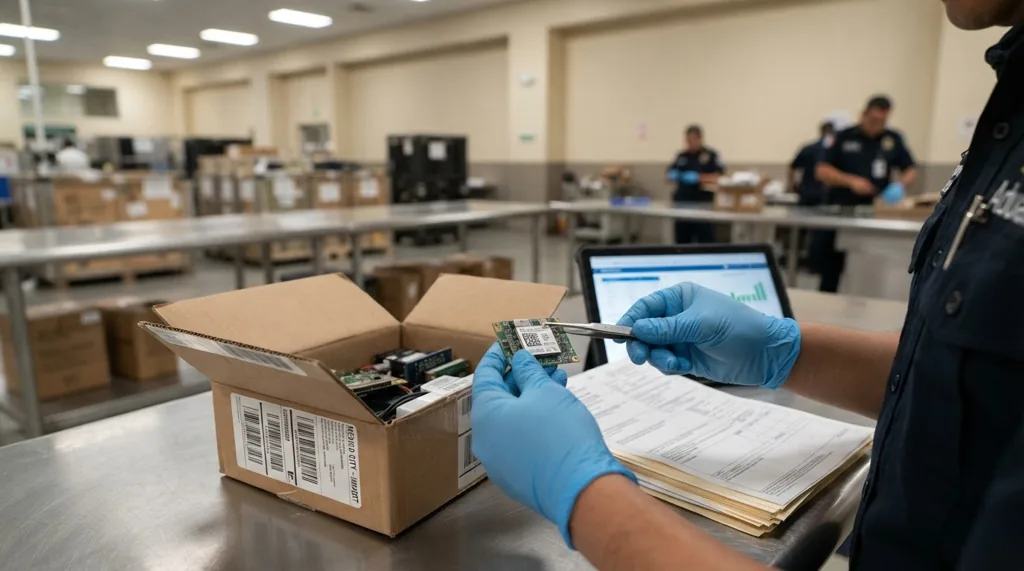
Mexico will audit and may seize imports declared below the value of identical or similar goods from 1 January 2027.
From 1 January 2027, Mexico’s amended Customs Law lets customs audit and hold imports declared below the value of similar goods.
The decree amending the Customs Law (Ley Aduanera) appeared in the evening edition of the Diario Oficial de la Federación, Mexico’s official gazette, on Oct. 23, 20261. It changes articles 144, 151, 153, 154, 177 and 185 of the law2.
In short, a shipment whose declared price is lower than the price of the same or similar goods will now trigger a customs check. Customs can hold the goods while it checks. The importer can get them back with documents proving the price, or by paying a cash deposit that covers the missing duties.
What does the Customs Law decree change?
The decree has one main target: undervaluation. That means declaring goods at a lower price than they really cost, so that less duty is paid. The Chamber of Deputies described the reform as a tool to fight undervaluation and protect tax revenue3.
The decree makes four main changes for goods entering Mexico2:
- Automatic audits. When the declared value is below the value of identical or similar goods, customs must start a check on its own initiative.
- A new ground for seizure. The same price gap becomes a legal reason for customs to hold the goods during a case.
- A cash deposit to release goods. Importers can ask to swap the hold for a deposit equal to the duties on the price gap.
- A lower trigger for a customs offence. For goods entered under a regime where duties are calculated but not paid, a gap of 20% or more is treated as an offence.
The decree also adds heavy fines for fuels. These are covered below.
How will customs compare declared prices?
The key comparison is between two figures. The first is the value written on the pedimento, Mexico’s customs import declaration. The second is the transaction value of identical or similar goods, meaning the price actually paid in other sales of the same or comparable goods2.
That second value is worked out under articles 72 and 73 of the Customs Law2. These are the law’s existing valuation rules for identical and similar goods. The decree does not create a new price list.
Under the new second paragraph of article 144, customs "will start" its checking powers when the declared value is lower than that benchmark2. The legislative summary calls this gap an objective risk signal that triggers a review of the operation4. In plain terms, a low price is no longer just a reason for suspicion. It becomes an automatic trigger for an audit.
When can customs seize undervalued goods?
Article 151 lists the cases in which customs may hold goods while a case runs. This is called a precautionary seizure (embargo precautorio), a temporary hold, not a final confiscation. The decree rewrites part VII of that article. It now covers any case in which the declared value is below the value of identical or similar goods2.
The legislative summary explains the reasoning. It says customs will act on objective risk signals, the facts of each operation, and the law’s valuation methods4. It also says the reform removes an exception to seizure that was linked to posting a guarantee based on prices set in advance4.
The new seizure rule does not apply to every product at once. A transitional article says part VII will apply to the goods, and under the procedure, that customs authorities set in separate rules2. For other goods, those rules may set the percentage gap between declared and benchmark value that will justify a seizure2.
How can an importer get seized goods back?
The decree gives importers two ways to recover goods. The first is to prove the price. Under article 153, the importer can present documents showing the declared value was set under the law’s valuation rules2. Customs must then issue a decision at once, with no penalties imposed2.
From low price to decision
In that case, customs must return any seized goods. It must also release the guarantee or refund the cash deposit2. The legislative summary says this clarifies what happens when the case ends in the importer’s favour4.
If the importer gives no proof, or the proof fails, customs must issue a final decision. It has four months to do so, counted from the day after the case file is complete2. The file is complete when all deadlines for evidence and arguments have passed, or when customs has examined the evidence offered2. If customs misses the four-month limit, its actions that started the case lose their effect2.
How does the cash deposit work?
The second way is to replace the seizure with money. Article 154 sets the rules for goods held under the new price-gap ground2. These rules apply only when the goods are not subject to official estimated prices2.
Releasing seized goods with a deposit
| Question | Gap under 20% | Gap of 20% or more |
|---|---|---|
| Form of deposit | Cash or customs guarantee account | Cash only |
| Amount | Duties on the price gap | Duties on the price gap |
| Deadline to ask | 10 working days after notice | 10 working days after notice |
The importer must ask within 10 working days after being notified that the case has started2. The deposit must equal the duties and countervailing duties that would be due on the gap between the declared value and the benchmark2. Countervailing duties (cuotas compensatorias) are extra import charges Mexico applies against unfair pricing.
The form of the deposit depends on the size of the gap2:
- Gap under 20%: a cash deposit, or a deposit in a customs guarantee account.
- Gap of 20% or more: a cash deposit only.
The legislative summary says the reform keeps this option to swap the seizure for a deposit4. For an importer, the practical effect is clear. Goods can leave customs, but only after the importer pays money roughly equal to the extra duties on the price gap.
What changes for temporary and duty-deferred imports?
Article 177 deals with goods entered under customs regimes that let importers calculate duties without paying them at entry2. The decree sets a new trigger. If an audit finds that the declared value is 20% or more below the benchmark, the case falls under this article2. It applies only if the goods would have underpaid import duties, or countervailing duties, had they been imported for good2.
Price gap that counts as an offence, %
The legislative summary says this cuts the threshold from 50% to 20%4. It says the rule now reaches smaller price gaps, while all other legal conditions stay the same4. An opposition deputy, Héctor Saúl Téllez Hernández, criticised the cut from 50% to 20% in the Chamber debate3. He said it puts importers under suspicion3.
What fines apply to fuel imports?
The decree adds a second paragraph to three parts of article 185, which sets fines2. Each says that for hydrocarbons and petroleum products, the fine will be 50% to 100% of the goods’ commercial value2.
Deputies of several parties linked these fines to "huachicol fiscal"3. That is the Mexican term for fuel smuggling that avoids taxes. A Labour Party deputy said the reform includes measures against this practice3. A Citizens’ Movement deputy backed the fines but questioned whether they would be enough3.
Why did Mexico pass the reform?
President Claudia Sheinbaum Pardo sent the bill to Congress on Sept. 8, 20263. The Chamber of Deputies passed it on Oct. 7, 2026, with 334 votes for and 119 against in the general vote3. In the vote on its details, it passed 338 to 1143.
Supporters argued that undervaluation hurts more than tax revenue. A Labour Party deputy said it puts producers and traders who follow the rules at a disadvantage3. A Morena deputy said the reform widens the state’s ability to detect and punish conduct that harms public finances3.
Congress signed the final text on Oct. 13, 20262. The President ordered its publication on Oct. 23, 20262.
When do the new Customs Law rules start?
The decree takes effect on 1 January 20272. Before then, customs authorities must publish the rules that say which goods the new seizure ground covers and how it works2. These rules must appear in the official gazette by Dec. 31, 20262.
Key dates for the Customs Law decree
This means the full reach of the seizure power is not yet known. The coming rules will name the goods and may set the price gap for others2.
The change affects several groups. Importers carry the risk of holds and deposits. Customs brokers prepare the pedimento with the declared value. Foreign suppliers whose invoices show low prices may see their buyers’ goods held at the border.
Key points on Mexico’s undervalued imports rules
The table below sums up the main facts of the Customs Law decree.
| Question | Answer |
|---|---|
| What changed? | Customs Law articles 144, 151, 153, 154, 177, 185 |
| Who issued it? | Mexico’s Congress, published by the President |
| When was it published? | Oct. 23, 2026, official gazette |
| What triggers an audit? | Declared value below identical or similar goods |
| Can customs hold goods? | Yes, a temporary seizure during the case |
| How to free goods? | Proof of value, or a deposit |
| Deposit deadline | 10 working days after notice |
| Deposit amount | Duties on the price gap |
| Offence threshold for duty-deferred goods | 20% gap, down from 50% |
| Fuel fines | 50% to 100% of commercial value |
| Customs decision deadline | 4 months after file is complete |
| Start date | 1 January 2027 |
The next date is Dec. 31, 2026, the deadline for customs to publish the rules naming the goods the seizure power covers2. From 1 January 2027, a low declared price on any covered shipment can lead to an audit and a hold at the Mexican border2.
Sources
- ↩ Diario Oficial de la Federación || Bienvenido al Sistema de Información del Diario Oficial de la Federación https://sidofqa.segob.gob.mx/notas/5802077
- ↩ DOF – Diario Oficial de la Federación https://www.dof.gob.mx/nota_detalle.php?codigo=5802077&fecha=23/10/2026
- ↩ Noticias | Canal del Congreso https://www.canaldelcongreso.gob.mx/noticias/10307
- ↩ SIL – Sistema de Información Legislativa-PopUp Contenido Asuntos http://sil.gobernacion.gob.mx/Librerias/pp_ContenidoAsuntos.php?SID=dc108eaff2c202874732b2f0dd7d99a6&Clave=5153795