
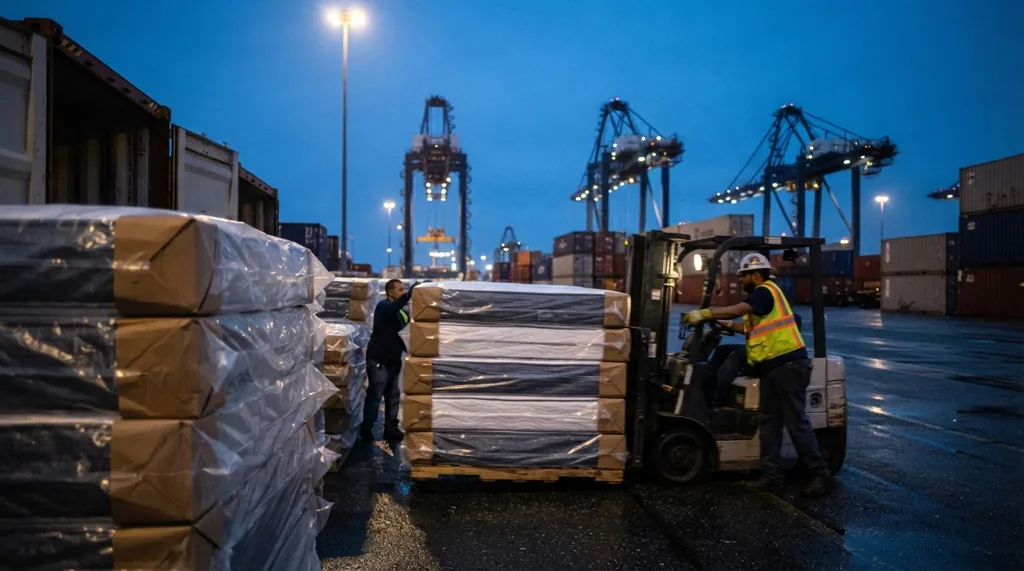
United States trade commission ruled on Oct. 22, 2026 that extra duties on mattresses from seven countries stay in place.
The U.S. International Trade Commission ruled on Oct. 22, 2026, that extra duties on mattresses from seven countries should stay in place1.
The decision covers mattresses from Cambodia, China, Malaysia, Serbia, Thailand, Turkey and Vietnam. It was published in the Federal Register on Oct. 27, 20261.
In short, nothing gets cheaper at the border. Mattresses from these seven countries will keep paying the extra duties that have applied since May 2021, on top of normal customs duty.
What did the Trade Commission decide about mattresses?
The U.S. International Trade Commission (USITC) is the federal agency that judges whether imports harm American producers. It looked again at duty orders on mattresses in what is called a five-year review, or "sunset review". This is a check, held every five years, on whether a duty is still needed.
The commission found that removing the duties would likely lead to continuation or recurrence of material injury, meaning serious harm, to the U.S. mattress industry "within a reasonably foreseeable time"1. That finding keeps the duties alive.
The ruling covers two kinds of duty:
- An anti-dumping duty, an extra import tax on goods sold abroad below their normal price. It applies to mattresses from Cambodia, Malaysia, Serbia, Thailand, Turkey and Vietnam.
- A countervailing duty, an extra import tax that cancels out subsidies a foreign government gives its makers. It applies to mattresses from China.
The commission completed and filed its decision on Oct. 22, 20261. One commissioner, Samuel T. Negatu, did not take part1. The commission’s full reasons are in USITC Publication 5803, dated October 20261.
Why do the mattress duties exist?
The Department of Commerce, which sets the size of these duties, issued the original orders on May 14, 20212. Two agencies share the work. Commerce decides whether goods are dumped or subsidized, and by how much. The trade commission decides whether those imports hurt U.S. makers.
The mattress duty orders
Both agencies must agree before a duty order can continue after five years. In 2026, each reviewed its own part.
The U.S. side of the case was brought by eight mattress and foam makers and a union3. The trade commission found their answers adequate3. They are:
- Brooklyn Bedding LLC
- Carpenter Company
- Future Foam, Inc.
- FXI, Inc.
- Kolcraft Enterprises Inc.
- Leggett & Platt, Incorporated
- Serta Simmons Bedding, LLC
- Tempur Sealy International, Inc.
- United Steel, Paper and Forestry, Rubber, Manufacturing, Energy, Allied Industrial and Service Workers International Union, AFL-CIO
These firms and the union filed papers with both agencies asking that the duties continue4.
What did Commerce find in its own review?
Commerce ran its part of the review first. It also found that removing the orders would let the unfair pricing or subsidies return.
Likely dumping margin if the orders ended, %
For the anti-dumping orders, Commerce published its results on July 31, 20264. It found that without the orders, dumping would likely continue at margins of up to 763.28% for Thailand4. A dumping margin is the gap between a fair price and the export price, shown as a share of the price.
The likely margins Commerce reported for each country were4:
- Cambodia: up to 103.79%
- Malaysia: up to 42.92%
- Serbia: up to 112.11%
- Thailand: up to 763.28%
- Turkey: up to 20.03%
- Vietnam: up to 668.38%
For China, Commerce published its results on July 24, 20265. It found subsidies would likely continue at a rate of 97.78% for every Chinese maker listed, and for all others5.
No foreign maker or government sent Commerce a full reply in either review4. Commerce therefore ran a shorter, 120-day "expedited" review5.
How did the review work, step by step?
The process took about seven months. Each step was published in the Federal Register.
- April 1, 2026: Commerce and the trade commission both opened the five-year reviews2.
- April 15, 2026: The U.S. makers and union told Commerce they would take part4.
- May 1, 2026: Answers to the trade commission’s questions were due2. The U.S. side filed full replies to Commerce the same day4.
- May 20, 2026: Commerce told the trade commission that no foreign maker had replied4.
- July 6, 2026: The trade commission chose a shorter, expedited review3.
- July 24, 2026: Commerce published its final results for China5.
- July 31, 2026: Commerce published its final results for the other six countries4.
- Sept. 29, 2026: Written comments to the trade commission were due3.
- Oct. 22, 2026: The trade commission made its decision1.
The trade commission chose the short review because the U.S. side answered well and the foreign side did not3. It found no other reason to hold a full review with hearings3. It still called the case "extraordinarily complicated" and gave itself up to 90 extra days3.
Which mattresses do the duties cover?
The orders cover all adult and youth mattresses, of any size6. Adult mattresses include twin, extra-long twin, full, queen, king and California king sizes6. Youth mattresses include crib, toddler and youth sizes6.
What the mattress orders cover
| Point | Rule |
|---|---|
| Sizes | All adult and youth mattresses, any size |
| Types | Innerspring, foam and hybrid mattresses |
| Inside furniture | Covered, such as sofa bed and trundle bed mattresses |
| Sets with a base | Only the mattress is covered |
| Left out | Futons, airbeds, waterbeds, toppers 4 inches or less |
All three main kinds of mattress are covered6:
- Innerspring mattresses, built around a set of metal springs.
- Non-innerspring mattresses, made of foam, latex, gel foam or other soft filling.
- Hybrid mattresses, which combine two support layers, such as memory foam and springs.
A mattress is still covered when it arrives inside furniture. Examples are sofa bed mattresses, day-bed mattresses, trundle bed mattresses and crib mattresses6. When a mattress comes in a set with a base or box spring, only the mattress is covered6.
The China order lists the main customs codes as Harmonized Tariff Schedule subheadings 9404.21.0010, 9404.21.0013, 9404.29.1005, 9404.29.1013, 9404.29.9085 and 9404.29.90876. Mattresses may also enter under 9404.21.0095, 9404.29.1095, 9404.29.9095, 9401.40.0000 and 9401.90.50816. The written product description decides coverage, not the code6.
Which products are left out?
Several bedding goods are outside the orders, according to the China order6:
- Futon mattresses, tufted mattresses without springs or foam that serve as both seat and bed.
- Airbeds and waterbeds, including blow-up mattresses.
- Sofa beds and similar furniture, where the padding is built into the frame and cannot be separated.
- Bassinet pads shorter than 39 inches, narrower than 25 inches and thinner than 2 inches.
- Mattress toppers 4 inches high or less.
- Spring units already covered by older duty orders on uncovered innerspring units from China or Vietnam.
The trade commission treats all mattresses in Commerce’s description as one single product2. It counts all U.S. mattress makers as the home industry, except some firms it excluded because of links to importers2.
What do importers pay today?
The sunset rulings do not set new duty rates. The figures above are the margins Commerce expects if the orders ended. The actual deposit an importer pays depends on the maker and on later yearly reviews.
For China, the 2021 order set a cash deposit of 97.78% of the value for every listed maker and for all others6. U.S. Customs and Border Protection (CBP) collects this deposit when the importer pays normal customs duty6.
For Malaysia, Commerce finished a yearly review on Aug. 11, 20267. It set a dumping rate of 42.92% for six Malaysian makers and for others reviewed7. The companies named are CS Vision Supply, Orient GIC Global, Pinnacle Salute, Premier High Ventures, Lion YTT World and Weld Tack Industries7. The rate for all other Malaysian makers stays at 42.92%7.
Importers of Malaysian mattresses must also file a certificate before the final duty is settled. It must say whether the foreign seller paid back any anti-dumping duty7. Without it, Commerce may assume repayment happened and charge double anti-dumping duties7.
Who is affected by the ruling?
U.S. importers carry the cost. They must keep paying cash deposits at the border on mattresses from the seven countries. Retailers and furniture firms buying these mattresses from abroad will keep facing the higher landed cost.
Makers in Cambodia, China, Malaysia, Serbia, Thailand, Turkey and Vietnam lose the chance to have the duties removed. None of them sent Commerce a full reply in the reviews5. Their mattresses remain far more costly to ship to the United States than before 2021.
U.S. makers and the steelworkers’ union keep the protection they asked for. Customs brokers must keep flagging these goods for the extra duty at entry. This includes mattresses packed inside sofa beds or other furniture that is not excluded.
Key points on the mattress duty ruling
The main facts of the decision are below.
| Question | Answer |
|---|---|
| What changed? | Mattress duty orders stay in place |
| Who decided? | U.S. International Trade Commission |
| Decision date | Oct. 22, 2026 |
| Published | Oct. 27, 2026, Federal Register |
| Countries with anti-dumping duty | Cambodia, Malaysia, Serbia, Thailand, Turkey, Vietnam |
| Country with subsidy duty | China |
| Goods covered | All adult and youth mattresses |
| Main exclusions | Futons, airbeds, waterbeds, thin toppers |
| China deposit rate | 97.78% |
| Highest likely dumping margin | 763.28%, Thailand |
| Original orders issued | May 14, 2021 |
| Who pays | U.S. importers, at entry |
The ruling ends this round of review, so the duties on mattresses from all seven countries continue. Shipments entering the United States keep paying the cash deposits set by Commerce, such as 42.92% for most Malaysian makers7.
Sources
- ↩ Federal Register :: Mattresses From Cambodia, China, Malaysia, Serbia, Thailand, Turkey, and Vietnam; Determinations https://www.federalregister.gov/documents/2026/10/27/2026-21824/mattresses-from-cambodia-china-malaysia-serbia-thailand-turkey-and-vietnam-determinations
- ↩ Federal Register :: Mattresses From Cambodia, China, Malaysia, Serbia, Thailand, Turkey, and Vietnam; Institution of Five-Year Reviews https://www.federalregister.gov/documents/2026/04/01/2026-06290/mattresses-from-cambodia-china-malaysia-serbia-thailand-turkey-and-vietnam-institution-of-five-year
- ↩ Federal Register :: Mattresses From Cambodia, China, Malaysia, Serbia, Thailand, Turkey, and Vietnam; Scheduling of Expedited Five-Year Reviews https://www.federalregister.gov/documents/2026/08/11/2026-16301/mattresses-from-cambodia-china-malaysia-serbia-thailand-turkey-and-vietnam-scheduling-of-expedited
- ↩ Federal Register :: Mattresses From Cambodia, Malaysia, Serbia, Thailand, the Republic of Türkiye, and the Socialist Republic of Vietnam: Final Results of the Expedited First Sunset Reviews of the Antidumping Duty Orders https://www.federalregister.gov/documents/2026/07/31/2026-15471/mattresses-from-cambodia-malaysia-serbia-thailand-the-republic-of-trkiye-and-the-socialist-republic
- ↩ Federal Register :: Mattresses From the People’s Republic of China: Final Results of the Expedited First Sunset Review of the Countervailing Duty Order https://www.federalregister.gov/documents/2026/07/24/2026-15034/mattresses-from-the-peoples-republic-of-china-final-results-of-the-expedited-first-sunset-review-of
- ↩ Federal Register :: Mattresses From the People’s Republic of China: Countervailing Duty Order https://www.federalregister.gov/documents/2021/05/14/2021-10237/mattresses-from-the-peoples-republic-of-china-countervailing-duty-order
- ↩ Federal Register :: Mattresses From Malaysia: Final Results of Antidumping Duty Administrative Review; 2024-2025 https://www.federalregister.gov/documents/2026/08/11/2026-16361/mattresses-from-malaysia-final-results-of-antidumping-duty-administrative-review-2024-2025