
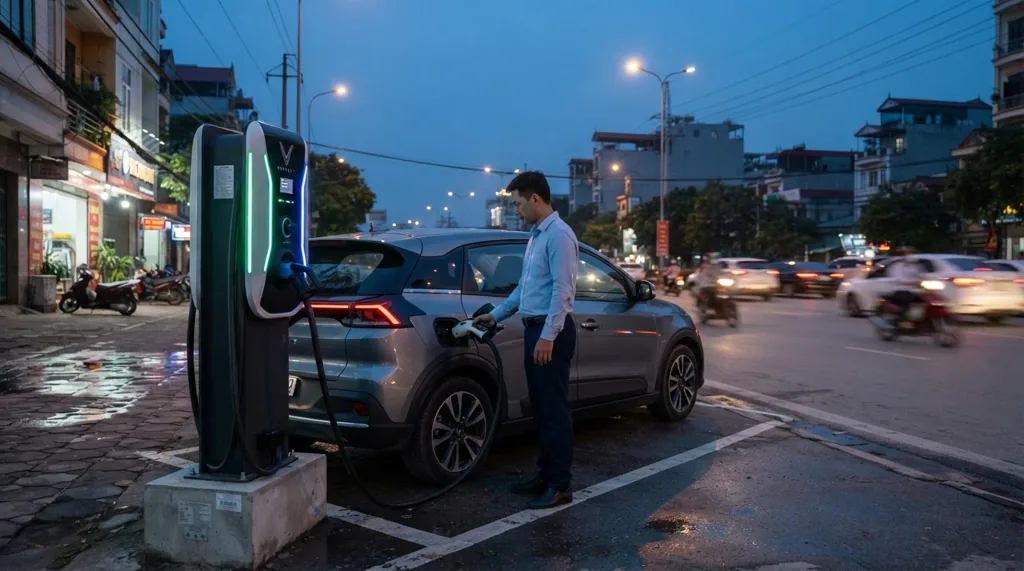
Viet Nam has established national technical regulations for electric vehicle charging equipment to ensure safety, compatibility, and reliable power supply systems nationwide.
Viet Nam’s Ministry of Industry and Trade has set national safety rules for electric vehicle chargers and charging stations, starting 1 July 2027.
The rules come in Circular No. 61/2026/TT-BCT, dated 29 September 2026, which issues the national technical regulation QCVN 32:2026/BCT1. The regulation covers chargers that are made, assembled, imported, sold or installed in Viet Nam1.
In short, a charger shipped to Viet Nam from mid-2027 must pass tests, carry a Vietnamese conformity mark and come with Vietnamese instructions before it can be sold. Charging stations must also meet new safety and layout rules, with a phase-in period for those already running.
What is the new Viet Nam charger regulation?
The Ministry of Industry and Trade (MOIT) issued the circular together with a national technical regulation, a mandatory rulebook that products must meet2. Its code is QCVN 32:2026/BCT, and its full title is the national technical regulation on electric vehicle charging equipment and charging stations1.
The ministry’s Industry Department prepared and submitted the regulation, and the Ministry of Science and Technology gave its view in a letter of 23 September 20261. Deputy Minister Truong Thanh Hoai signed the circular3.
The regulation sets technical and management rules in several areas1. These include the charging equipment itself, the power supply and grid connection, layout and installation, electrical safety, control systems, and day-to-day operation1.
Why did the ministry set charger rules?
A research institute of the ministry described the regulation as an important legal document4. It said the aim is to raise safety, make sure equipment works together, and standardise charging networks, which are growing fast in Viet Nam4.
The regulation states its own basic principles1. Chargers and stations must be safe to use, technically compatible, measure electricity accurately, and run in a safe, stable and transparent way1.
Choices of technology, protocols, hardware and software must meet the regulation’s tests1. They also must not switch off any safety protection built into the equipment1.
Which chargers does QCVN 32:2026/BCT cover?
The rules apply to chargers for road vehicles that run on electricity1. These include fully electric cars, known as battery electric vehicles (BEV), and cars that combine an engine with a battery charged from a plug, known as plug-in hybrid electric vehicles (PHEV)1. Other electric road vehicles with a rechargeable battery on board are also covered1.
Highest rated voltage covered, volts
The regulation covers equipment with a rated input of up to 1,000 V alternating current (AC) or 1,500 V direct current (DC)1. The same limits apply to the rated output1.
It sorts chargers into three types by the current they deliver1:
- AC chargers, which send alternating current to the car, where the car’s own equipment converts it to charge the battery.
- DC chargers, which convert the power inside the unit and send direct current to the car.
- Combined AC and DC chargers, which offer both.
The coverage also reaches stations in public places, central parking areas, highway rest stops and similar sites4.
Which chargers and stations are left out?
The regulation lists several exclusions1. These products and sites do not need to meet the new rules:
- Wireless chargers, which charge without a cable.
- In-cable control boxes used for slow "mode 2" charging from a normal socket (IC-CPD).
- Chargers built into the vehicle.
- Power supply equipment for rail vehicles, special off-road vehicles and industrial vehicles that do not use public roads.
- Chargers used only for testing, research, display or training, under internal control and not offering public charging.
- Stations that serve only the internal needs of a company or person and do not sell charging.
- The power grid on the supply side of the station’s connection point.
Stations placed inside buildings are also excluded1. This covers basements, semi-basements, upper floors, garages and other spaces partly or fully enclosed by structures1. However, an outdoor station, or one under a standalone roof that only gives shelter from rain and sun, is covered1.
What tests must imported chargers pass?
Every charger must transfer power safely under the conditions of use, environment and set-up that its maker declares1. The safety tests come from the Vietnamese standard TCVN 13078-1:2020, which matches the international standard IEC 61851-1:20171. The International Electrotechnical Commission (IEC) writes these global standards for electrical goods.
Tests a charger must pass
| Requirement | Standard |
|---|---|
| Safety, shock, overload, short circuit | TCVN 13078-1:2020 (IEC 61851-1:2017) |
| Electromagnetic compatibility | TCVN 13078-21-2:2020 (IEC 61851-21-2:2018) |
| Charger-to-car communication | Article 7 of TCVN 13078-1:2020 |
| Extra rules for DC chargers | TCVN 13078-23:2020 (IEC 61851-23:2014) |
The safety part covers protection against electric shock, adapters, charging cables, the construction of the unit, and protection against overload and short circuit1. Each topic points to a separate article of that standard1.
Chargers must also pass tests for electromagnetic compatibility (EMC), meaning they must not disturb other electronics and must resist interference1. These tests follow TCVN 13078-21-2:2020, which matches IEC 61851-21-2:2018, for both emissions and immunity1.
Communication between charger and car must meet article 7 of TCVN 13078-1:20201. DC chargers must meet extra rules in TCVN 13078-23:2020, which matches IEC 61851-23:20141.
What must the charger label and manual show?
Each charger must be labelled under Viet Nam’s law on goods labels1. The label must be clear and last for the product’s working life1. It must show:
- the maker;
- the model and type;
- input voltage and input current;
- output voltage, output current and output power;
- the IP rating, a code for protection against dust and water;
- the working temperature;
- the year of manufacture.
The charger’s screen or user interface must be in Vietnamese, though other languages may be added1. Makers, assemblers and importers must supply installation and user instructions in Vietnamese1.
At the station, the charger must also show key details before charging begins1. These are the power, the voltage and current range, the connector type, instructions and safety warnings1. This can be on the unit or by electronic means1.
How does the conformity mark work for imports?
Chargers made or assembled in Viet Nam and chargers brought in from abroad must go through product certification4. The maker or importer must then file a declaration of conformity, a formal statement that the product meets the regulation4. Finally, the product must carry the CR conformity mark before it is sold4.
Before a charger can be sold
The testing and certification for this declaration must be done by bodies that are designated or recognised under Vietnamese law4. The regulation refers to the international standards for testing laboratories (ISO/IEC 17025:2017) and for product certification bodies (ISO/IEC 17065:2012)1.
In practice, a foreign maker selling into Viet Nam will need test results from an approved laboratory. The importer will need the certificate and the mark in place before the goods reach shops or installers.
What changes for charging station operators?
Station rules cover electrical safety, fire prevention, layout, safe distances, power supply, electricity metering, load control, monitoring and data2. A station’s total power use must not exceed the capacity of its connection point and internal distribution system2.
Stations must be able to serve any electric road vehicle whose charging port fits the station’s connectors, charging modes and set-up1. Control functions must not limit this declared compatibility while technical, login and safety conditions stay the same1.
Each charger in a station must at least protect against over-current, over-voltage and under-voltage, short circuits and leaking current1. It must also cut power automatically when a fault occurs1.
Stations need an emergency switch that cuts power quickly1. After an emergency cut, power can only return once the site has been checked, and the check must be recorded1.
Station sites must suit the land use and traffic plan2. Chargers must not block walkways, escape routes or internal traffic, and charging areas need signs, safety warnings and instructions2.
The monitoring system must collect and show operating status, fault alarms and electrical readings2. Data on operation, faults, metering, payment and user complaints must be stored, retrieved and protected under the law2.
When do the charger rules take effect?
The circular takes effect on 1 July 20271. The ministry’s portal listed it as not yet in force3.
Deadlines under Circular 61/2026/TT-BCT
| When | Who | What falls due |
|---|---|---|
| 1 July 2027 | All covered chargers and stations | Regulation takes effect |
| Within 6 months of start | Stations already running | Review against safety rules |
| Within 24 months of start | Stations already running | Fix any safety gaps |
Chargers installed legally before that date may stay in use1. Their owners and operators must keep them safe, inspect and maintain them, and fix defects1.
Stations already running before 1 July 2027 have two deadlines1:
- Review whether they meet the safety rules within 6 months of the start date.
- Fix any safety gaps within 24 months of the start date.
Any repair, upgrade, extension or change of set-up after the start date must meet the regulation for the part that changes1.
Stations that started construction before the start date but are not yet approved must update the design of unfinished work1. They may only be approved and opened once they meet the regulation1.
A direct risk, such as danger of electric shock, fire, explosion or structural failure, must be handled at once1. The operator must warn users, stop or isolate the affected part, and repair it1. If the part cannot be isolated safely, the whole station must stop until it is fixed and checked1.
Key points on Viet Nam’s EV charger regulation
The table sums up the main facts of the new rules.
| Question | Answer |
|---|---|
| What changed? | National rules for EV chargers and stations |
| Who issued it? | Ministry of Industry and Trade |
| Legal instrument | Circular 61/2026/TT-BCT, QCVN 32:2026/BCT |
| Date of circular | 29 September 2026 |
| Goods covered | AC, DC and combined chargers for road EVs |
| Voltage limit | Up to 1,000 V AC or 1,500 V DC |
| Main exclusions | Wireless, on-board and in-cable chargers |
| What imports need | Certification, conformity declaration, CR mark |
| Language rule | Vietnamese interface and instructions |
| Start date | 1 July 2027 |
| Existing stations | Review in 6 months, fix in 24 months |
From 1 July 2027, chargers without the CR mark and Vietnamese instructions cannot be sold in Viet Nam4. Makers abroad have until then to get their products tested and certified.
Sources
- ↩ TT_61_tru___sa__c_die____n_b5124.pdf https://moit.gov.vn/upload/2005517/20261005/TT_61_tru___sa__c_die____n_b5124.pdf
- ↩ Ban hành quy chuẩn kỹ thuật quốc gia về trụ sạc, trạm sạc xe điện https://baochinhphu.vn/ban-hanh-quy-chuan-ky-thuat-quoc-gia-ve-tru-sac-tram-sac-xe-dien-102261005155514536.htm
- ↩ Thông tư số 61/2026/TT-BCT Ban hành Quy chuẩn kỹ thuật quốc gia về trụ sạc, trạm sạc xe điện https://moit.gov.vn/van-ban-phap-luat/thong-tu-so-61-2026-tt-bct-ban-hanh-quy-chuan-ky-thuat-quoc-gia-ve-tru-sac-tram-sac-xe-dien.html
- ↩ Bộ Công Thương chính thức ban hành Quy chuẩn kỹ thuật quốc gia về trụ sạc, trạm sạc xe điện (QCVN 32:2026/BCT) https://vioit.moit.gov.vn/vn/tin-hoat-dong-nganh/bo-cong-thuong-chinh-thuc-ban-hanh-quy-chuan-ky-thuat-quoc-gia-ve-tru-sac–tram-sac-xe-dien–qcvn-32-2026-bct–7161.4056.html