
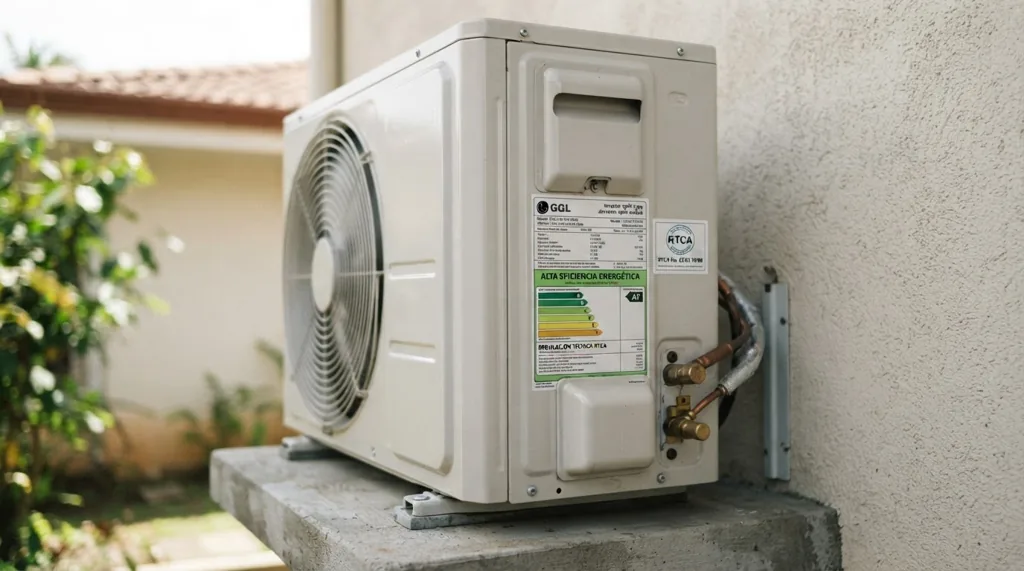
Costa Rica has implemented Central American Technical Regulation (RTCA) No. 23.01.78:00 establishing energy efficiency specifications for inverter split-type air conditioners with variable refrigerant flow to enhance performance and reduce energy consumption.
Costa Rica’s Ministry of Environment and Energy accepted a foreign efficiency test standard for one Daikin inverter air conditioner on Sept. 22, 20261.
The decision is Resolution 0032-2026-DE of the ministry’s Energy Directorate. It says the foreign standard AHRI 210/240-2024 is equivalent to the Central American energy rule for inverter split air conditioners1.
In short, this Daikin model can enter and be sold in Costa Rica on the strength of its AHRI efficiency certificate. Once the ruling is published, any other seller of the same model may rely on it too1.
What did Costa Rica decide on Sept. 22, 2026?
The Energy Directorate of the Ministry of Environment and Energy (MINAE) granted what it calls a "standard equivalence". This is a formal finding that a foreign standard checks the same things as a local technical rule1. Director of Energy Randall Zúñiga Madrigal signed the resolution in San José1.
What the resolution grants
| Item | Detail |
|---|---|
| Instrument | Resolution 0032-2026-DE, Sept. 22, 2026 |
| Foreign standard | AHRI Standard 210/240-2024 |
| Certificate | AHRI 216021576 |
| Local rule | RTCA 23.01.78:20, inverter split air conditioners |
| Goods | Daikin outdoor unit DPSC03BAPB4**E310* |
| Duration | No end date, unless the certificate or standards change |
The foreign standard is AHRI Standard 210/240-2024, "Performance Rating of Unitary Air-Conditioning & Air-Source Heat Pump Equipment"1. It is a method for rating the performance of air conditioners and heat pumps. The equivalence covers the standard together with the values in AHRI certificate 2160215761.
The local rule is Central American Technical Regulation (RTCA) 23.01.78:20. It sets energy efficiency rules for inverter split air conditioners with variable refrigerant flow, free air discharge and no air ducts1.
Which air conditioners does the ruling cover?
The ruling names one outdoor unit. Its brand is Daikin, and its model number is DPSC03BAPB4**E310*1. The asterisks stand for characters that can vary within the model number.
The equivalence is tied to the products in the scope set by an earlier opinion from the national standards body1. The Energy Directorate’s technical report also links validity to the certificates and the model numbers of both units. These are the indoor unit (evaporator) and the outdoor unit (condenser)1.
The ruling does not open the door to every Daikin product or every AHRI-certified unit. It covers the certificate and the equipment listed in the resolution1. Other models still need their own proof of compliance with the Central American rule.
What does the Central American air conditioner rule require?
RTCA 23.01.78:20 sets a minimum energy efficiency, a test method, a testing and approval procedure and a label1. These apply to inverter split air conditioners that are made, imported or sold in the member states1.
When the inverter rule took effect
The Central American governments approved the rule in regional Resolution 451-2021 of Dec. 17, 20211. Costa Rica published it through Executive Decree 43616-COMEX-MEIC-MINAE1. The rule took effect in Costa Rica on Dec. 17, 20221.
The same resolution set other start dates for the region:
- El Salvador: Aug. 17, 20221.
- Honduras, Nicaragua and Panama: Dec. 17, 2022, the same day as Costa Rica1.
- Guatemala: June 17, 20231.
These dates show that the rule is already in force across the bloc. The new resolution does not change the rule itself. It gives one product another route to show it meets the rule.
Why can a foreign standard replace the local test?
The Central American rule leaves equivalence to each member state. Section 9 of the rule says the competent authorities of each state decide whether another standard is equivalent1. It adds that the scope of such an equivalence is national1.
Costa Rica filled in the details with Executive Decree 44037-MINAE, the supplementary rule for applying the regulation. It has been in force since July 17, 20231. Article 5 of that decree sets out how a foreign standard is studied and how the ministry decides1.
A second decree, 44395-MEIC, sets the general procedure for proving equivalence with a Costa Rican or Central American technical rule1. In this case MINAE found the Daikin unit’s efficiency was above the limit set by the Central American rule1.
How did Ecoaire get the equivalence?
The applicant was Constructora, Consultora y Desarrolladora Ecoaire S.A.1. It filed its request with MINAE on Aug. 27, 20261. The decision came less than four weeks later.
From request to decision
The procedure has two stages before two different bodies. The steps in this case ran in this order:
- Standards body opinion: The Institute of Technical Standards of Costa Rica (INTECO), the national standards body, checks the requirements and test methods. Its standards directorate issued opinion EQ-065-2026 on July 23, 20261.
- Energy Directorate report: MINAE checks how the product’s testing and approval works. Its technical report DE-0203-2026 of Sept. 14, 2026 recommended approval1.
- Tax and social security checks: On Sept. 11, 2026, the ministry confirmed the company was up to date with the social security fund and the Finance Ministry1.
- Ministry decision: MINAE granted the equivalence on Sept. 22, 20261.
INTECO’s opinion said the AHRI standard with the certificate values "is equivalent" to the Central American rule1. That opinion only becomes valid once the national authority endorses it1.
What did the Energy Directorate check?
The technical report looked at the papers filed and at INTECO’s opinion1. It found the equipment linked to the certificate meets the required energy efficiency standards1.
It also looked at how the maker proves its products are tested. The manufacturer, named as Daikin-SAEG, uses testing scheme type 51. That scheme is one of the options in Executive Decree 37662-MEIC-H-MICIT, Costa Rica’s procedure for proving products meet technical rules1.
The resolution does not describe what scheme type 5 involves. It records that the scheme was accepted for this equivalence1.
Who can use the ruling, and what must sellers do?
The ruling is not limited to Ecoaire once it is public. After publication, any other interested party may use the equivalence for its declaration of conformity1. That declaration is the seller’s statement that the product meets the rule, under section 5.5 of Decree 44037-MINAE. No permission is needed from the parties behind the original request1.
Sellers who rely on it take on several duties:
- Match the documents: Goods sold under the equivalence must meet the standards that gave rise to it1.
- Keep the standard unchanged: The seller must make sure the technical terms of the standard have not been changed. A repealed or cancelled standard voids the equivalence1.
- Use the national label: Energy efficiency labels must follow the Costa Rican rule1.
For importers of this Daikin unit, the change is practical. They can show compliance with the AHRI certificate instead of a separate local test route. For buyers in Costa Rica, the unit must still carry the national energy label.
How long does the equivalence last?
The equivalence has no end date. It runs from notice to the applicant and from publication of a notice in La Gaceta, the official gazette1.
It ends automatically in three cases1:
- The certificate values are updated, expire or change in any way.
- The Central American rule or AHRI Standard 210/240-2024 is updated.
- The products turn out to be certified under a different standard.
MINAE, the national authority and any other legally authorised market inspector may check the equivalence. They may act on their own or at someone’s request1. If market checks find misuse, the seller loses the equivalence. It must then prove compliance under the normal procedure and may face other penalties1.
If the ministry withdraws the equivalence, it must issue a reasoned resolution. A summary must appear in La Gaceta. The withdrawal applies to everyone, but only for the future1. The holder would then need to start a new equivalence request1.
Is this part of a wider pattern for air conditioners?
Costa Rica has used the same route for other air conditioners. In December 2024, it told the World Trade Organization (WTO) that an equivalence between the 2017 edition of AHRI 210/240 and the same Central American rule was under way2. That notice listed four AHRI certificate numbers, including 202680601 and 2098322692.
The route also covers fixed-speed units under a different Central American rule, RTCA 23.01.80:21. In Resolution 0023-2026-DE of June 8, 2026, MINAE accepted the Mexican standard NOM-023-ENER-2018 for fixed-speed split units3. That case covered three Mexican certificates for Refrigeración Industrial Beirute S.A.3.
In each case, the ministry ties the decision to specific certificates and models. The pattern lets importers bring in units tested abroad, one approved product line at a time.
What happens next for the Daikin ruling?
The resolution must be posted on MINAE’s energy website1. It must also be sent to the applicant, the Costa Rican Accreditation Body (ECA), INTECO and the Centre for Information on Technical Barriers to Trade (CIOT)1. The CIOT then makes it public on its own website1.
Appeals against the resolution must be filed within three days, counted from the day after notice1. The equivalence takes effect for the public once its notice appears in La Gaceta1.
Key points on the Daikin air conditioner equivalence
The table sums up the main facts of the ruling.
| Question | Answer |
|---|---|
| What changed? | Foreign test standard accepted for one air conditioner |
| Who issued it? | MINAE Energy Directorate, Costa Rica |
| Which instrument? | Resolution 0032-2026-DE |
| When was it signed? | Sept. 22, 2026 |
| Which standard? | AHRI Standard 210/240-2024 |
| Which certificate? | AHRI 216021576 |
| Which goods? | Daikin outdoor unit DPSC03BAPB4**E310* |
| Which local rule? | RTCA 23.01.78:20 for inverter split units |
| Who applied? | Ecoaire S.A., on Aug. 27, 2026 |
| Who else can use it? | Any interested party, once published |
| How long does it last? | No end date, unless the certificate or standards change |
| What label is needed? | The Costa Rican energy label |
The equivalence starts for the public when its notice appears in La Gaceta. From then on, importers of this Daikin unit can rely on certificate AHRI 216021576 to show it meets the Central American efficiency rule1.
Sources
- ↩ Resolución de equivalencia – ECOAIRE S.A. https://members.wto.org/crnattachments/2026/TBT/CRI/final_measure/26_04959_00_s.pdf
- ↩ GetDocument https://eping.wto.org/en/DOL/GetDocument?dolLink=G/TBTN20/CRI189A24¬ificationId=97010
- ↩ 26_03109_00_s.pdf https://members.wto.org/crnattachments/2026/TBT/CRI/26_03109_00_s.pdf