
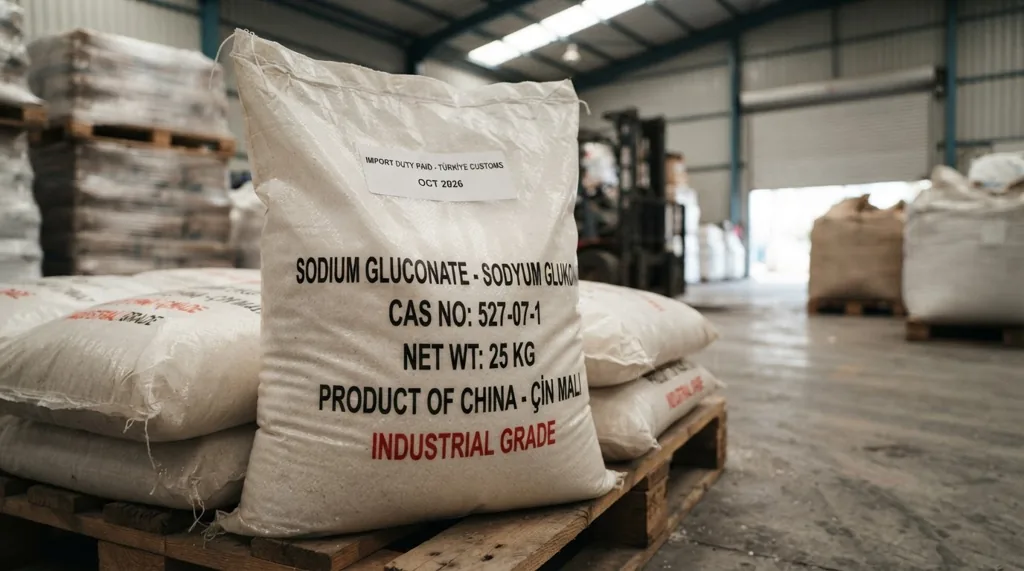
Türkiye charges extra import duties of 22.56% to 32.96% on Chinese sodium gluconate from Oct. 14, 2026.
Türkiye’s Ministry of Trade imposed anti-dumping duties of up to 32.96% on sodium gluconate from China, starting Oct. 14, 2026.
The decision appears in Communiqué No. 2026/31, published in Türkiye’s Official Gazette on Oct. 14, 20261. It ends an investigation that the ministry opened in May 20252.
In short, every shipment of Chinese sodium gluconate entering Türkiye now pays an extra charge at customs. The charge is a share of the shipment’s landed value, and it depends on which Chinese company made the goods.
What is changing for sodium gluconate imports?
The ministry has put a definitive anti-dumping duty on the product. An anti-dumping duty is an extra import tax on goods sold abroad below their normal price. "Definitive" means it is the final duty, not a temporary one1.
The communiqué says the investigation found that imports from China were dumped. It also found that these imports caused material injury, meaning real harm, to Turkish producers1. On that basis, the Board for the Evaluation of Unfair Competition in Imports decided to act, and the Minister of Trade approved the decision1.
Customs offices will collect the duty when the goods are released for free circulation, which means cleared for sale inside Türkiye1. The duty applies on top of any other rules for these goods1.
Which product does the duty cover?
The duty covers sodium gluconate under customs code 2918.16.00.00.13, made in China1. The ministry’s final report describes the product as the sodium salt of gluconic acid3.
It is usually a white, granular, crystal-like powder. It dissolves well in water and breaks down naturally3. Its main use is to bind metals such as calcium, iron, copper and aluminium in alkaline liquids3.
Factories use it as an input for concrete, cleaning products, food and farm products, and metal processing3. The report says it is made mainly from glucose, caustic soda and enzymes3.
The communiqué adds a rule about the code. If the customs code or the product name in the Turkish tariff changes later, the duty still applies1. The description in the investigation report is general. What counts at the border is the code and the product name in the communiqué’s table1.
How much will importers pay on Chinese sodium gluconate?
The duty is set as a percentage of the CIF value. CIF means the price of the goods plus insurance and freight to the Turkish border1. The rates are:
- Shandong Fuyang Bio-Tech. Co., Ltd.: 24.43%1.
- Weifang Jianbao Biotechnology Co., Ltd.: 22.56%1.
- All other Chinese producers: 32.96%1.
Anti-dumping duty by Chinese maker
| Maker | Duty |
|---|---|
| Shandong Fuyang Bio-Tech | 24.43% |
| Weifang Jianbao Biotechnology | 22.56% |
| All other Chinese makers | 32.96% |
The two named companies answered the ministry’s questionnaires on time and took part in the case3. Other Chinese makers get the highest rate, 32.96%1.
As an example of the arithmetic, a shipment with a CIF value of $10,000 from an unnamed Chinese maker would pay $3,296 in anti-dumping duty. The same shipment from Weifang Jianbao would pay $2,256.
What did the investigation find about Chinese prices?
The ministry’s final disclosure report, dated August 2026, set out the dumping margins3. A dumping margin is how far the export price falls below the product’s normal value. The report calculated these margins as a share of the CIF value3:
- Shandong Fuyang Bio-Tech: 53.42%3.
- Weifang Jianbao Biotechnology: 52.13%3.
- All other companies: 74.96%3.
The final duties in the communiqué are lower than these margins1. The communiqué does not explain the difference.
China did not get market-economy treatment in the case. The cooperating companies did not claim it in their questionnaire answers3. So the ministry built the normal value from Türkiye’s own costs. It used the average cost of making the product in Türkiye, plus overheads and a reasonable profit3. It then made adjustments in favour of the Chinese exporters for conditions in China3.
Why did Türkiye act against Chinese sodium gluconate?
The case began with a complaint from a Turkish producer, Sunar Mısır Entegre Tesisleri2. The ministry accepted that it represents Turkish production of the product3.
Sodium gluconate imports from China, tonnes
Imports from China grew strongly over three years, according to the final report3:
- 6,312 tonnes in 2022.
- 8,077 tonnes in 2023.
- 9,282 tonnes in 2024.
At the same time, the average Chinese price fell. It was $912 per tonne in 2022, $652 in 2023 and $646 per tonne in 20243. China’s share of all sodium gluconate imports rose from 93.6% in 2022 to 97% in 20243.
Imports from other countries fell over the same years. They dropped from 432 tonnes in 2022 to 292 tonnes in 20243. Their average price stayed much higher, at $1,032 per tonne in 20243.
Total imports of the product reached 9,574 tonnes in 2024, worth $6.3 million3. Almost all of that came from China.
When the ministry opened the case, it said Chinese prices undercut Turkish selling prices in 2023 and 20242. It also said Chinese prices held Turkish prices down across the whole period2. The opening notice listed harm to the Turkish producer’s stocks, cash flow, productivity and profits2.
How did the sodium gluconate case unfold?
The ministry opened the investigation with Communiqué No. 2025/9, published in the Official Gazette on May 25, 20252. The ministry announced it on May 27, 2025, together with three other trade communiqués4.
From complaint to final duty
The investigation looked at dumping during calendar year 20243. For harm to Turkish industry, it looked at data from Jan. 1, 2022 to Dec. 31, 20243.
The case followed these steps:
- The ministry notified known Chinese producers, Turkish importers and China’s embassy in Ankara3.
- Parties had 37 days, including postal time, to send views and answer questionnaires3.
- Four importing companies answered the questionnaires on time3.
- Two Chinese producers and two Chinese trading firms that sell Weifang Jianbao’s goods to Türkiye also answered3.
- Ministry staff checked the Turkish producer’s data on site in April 20263.
- The ministry shared its final disclosure report with the parties in August 20263.
- The final duties took effect with publication on Oct. 14, 20261.
The two trading firms were Qingdao Reayou Chemical and Qingdao Abel Technology3. They did not get their own rate. The report says they are not related to Weifang Jianbao3.
Did importers dispute that Turkish and Chinese products are alike?
Some importers argued that Chinese and Turkish sodium gluconate differ3. They said the Turkish product has a lower acidity reading (pH) and higher heavy-metal levels3.
The Turkish producer replied that there is no single pH limit for powdered sodium gluconate3. It said test reports from accredited laboratories showed no high heavy-metal levels. The ministry found no evidence of high levels in those reports3.
The producer also submitted a study by the civil engineering department of Middle East Technical University3. That study compared Turkish, European and Chinese sodium gluconate in concrete. It found the Turkish product performed at least as well3.
Some importers that cooperated said there was no technical difference between the products3. The ministry concluded that the two are "like products", meaning they share the same physical features and main uses3.
What other charges already apply to sodium gluconate?
The anti-dumping duty adds to charges that already exist. The ministry’s report lists the regular import duty for this code under Türkiye’s 2026 import rules3. Goods from China fall in the "other countries" column, at 6.5% customs duty3. Value added tax (VAT) on the product is 20%3.
The report also notes a 5% additional customs duty on imports of the product3. This rests on Decision No. 3351 of Dec. 31, 2020, as amended by Decision No. 93923.
There is a further check at the border. Imports valued below $1.5 per kilogram need a surveillance document, a special import record3. This rule applies to goods from all countries3. It comes from a surveillance communiqué published on July 31, 20253.
How long will the duties last?
The duties stay in force for 5 years from Oct. 14, 20261. After that, they end automatically, unless a review is opened1.
If the ministry opens an expiry review before the 5 years end, the duties continue until the review is finished1. The Minister of Trade is responsible for carrying out the communiqué1.
For buyers in Türkiye, the duty raises the cost of the cheapest Chinese supply. Concrete, cleaning-product and food makers that rely on Chinese sodium gluconate will see their input costs rise. Chinese makers other than the two named companies face the steepest charge.
Key points on Türkiye’s sodium gluconate duty
The table below sums up the main facts of the decision.
| Question | Answer |
|---|---|
| What changed? | Final anti-dumping duty on sodium gluconate |
| Who issued it? | Türkiye’s Ministry of Trade |
| Legal instrument | Communiqué No. 2026/31 |
| Which goods? | Sodium gluconate, code 2918.16.00.00.13 |
| Which origin? | China |
| Rate for Shandong Fuyang Bio-Tech | 24.43% of CIF value |
| Rate for Weifang Jianbao Biotechnology | 22.56% of CIF value |
| Rate for all other Chinese makers | 32.96% of CIF value |
| Who collects it? | Turkish customs offices |
| Start date | Oct. 14, 2026 |
| How long? | 5 years, unless a review extends it |
| Other charges | 6.5% customs duty, 5% additional duty |
From Oct. 14, 2026, every shipment of Chinese sodium gluconate cleared in Türkiye pays between 22.56% and 32.96% extra. The duties run for 5 years unless an expiry review keeps them in place1.
Sources
- ↩ 14 Ekim 2026 ÇARŞAMBA https://www.resmigazete.gov.tr/eskiler/2026/10/20261014-4.htm
- ↩ UYAP Mevzuat ve İçtihat Programı https://mevzuat.adalet.gov.tr/mevzuat/343665
- ↩ Sodyum Glukonat Nihai Bildirim Raporu.pdf https://ticaret.gov.tr/data/683416f413b8762dd8da9247/Sodyum%20Glukonat%20Nihai%20Bildirim%20Raporu.pdf
- ↩ T.C. Ticaret Bakanlığı https://ticaret.gov.tr/haberler/ithalatta-haksiz-rekabetin-onlenmesine-iliskin-yeni-damping-tebligleri-yayimlandi