
United States: Commerce found that ending anti-dumping orders on cut-to-length carbon steel plate from China and Russia would likely bring back dumping, in final results applicable from Oct. 5, 2026.
The U.S. Department of Commerce has found that ending its anti-dumping duty orders on cut-to-length carbon steel plate from China and Russia would likely bring back dumping, in final results applicable from Oct. 5, 20261.
The decision closes Commerce’s part of the fifth five-year "sunset" review of the two orders. A sunset review is a check, every five years, of whether an old trade remedy is still needed2.
In short, the extra import taxes on this steel plate from China and Russia do not end now. Commerce says that without them, dumping could return at margins of up to 128.59% for China and 185.00% for Russia1.
What did Commerce decide on steel plate?
Commerce found that revoking the orders "would be likely to lead to continuation or recurrence of dumping"1. Dumping means selling goods abroad below their normal price. An anti-dumping duty is an extra import tax that U.S. customs collects to offset that low price.
The notice covers two separate orders. One applies to plate from China, under case number A-570-849. The other applies to plate from Russia, under case number A-821-8081.
The notice was signed on Sept. 29, 2026, by Scot Fullerton, Commerce’s acting deputy assistant secretary for anti-dumping and countervailing duty operations1. It appeared in the Federal Register, the U.S. government’s daily official journal, on Oct. 5, 20263.
How large are the dumping margins for China and Russia?
Commerce also had to estimate how deep the dumping would be if the orders ended. It calls this "the magnitude of the dumping margins likely to prevail"1.
Likely dumping margin if orders ended, %
Its answer is up to 128.59% for China and 185.00% for Russia1. These are weighted-average margins, which means an average across sales, with larger sales counting more.
A margin of 185.00% means the U.S. price would be far below the normal price in the home market. Commerce reports these figures to the International Trade Commission (ITC), the U.S. agency that judges harm to American industry1. The notice does not say that these figures are new cash deposit rates for importers.
Which steel plate goods are covered?
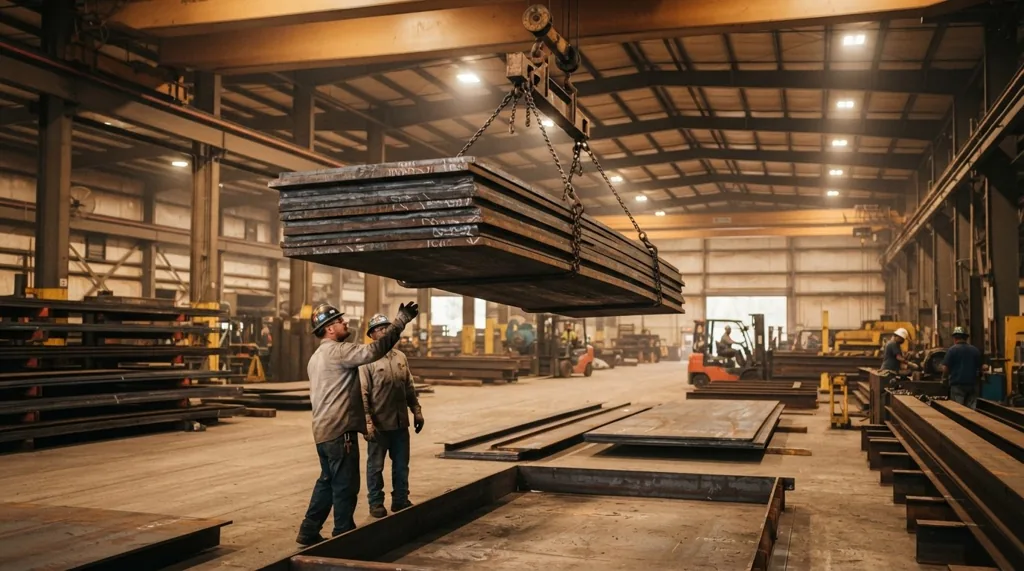
The goods are certain cut-to-length carbon steel plate, which Commerce shortens to "CTL plate"1. This is flat steel plate that has been cut into separate sheets of set length, rather than sold in rolls.
The notice gives only a short scope: "CTL plate from China and Russia." The full product description sits in a separate paper, the Issues and Decision Memorandum, which Commerce adopted with the notice1.
The ITC describes the matching U.S. product as cut-to-length plate made by U.S. mills or cut from coiled plate by service centers. In past reviews it also included plate made from micro-alloy steel4.
Why did Commerce keep the plate orders?
The decision rests on who took part in the review. Three U.S. steelmakers told Commerce they wanted to take part1:
- Cleveland-Cliffs Inc., which filed its notice on June 16, 2026
- Nucor Corporation, which filed on June 16, 2026
- SSAB Enterprises LLC, which filed on June 9, 2026
These companies then filed full written responses on July 1, 2026, one for China and one for Russia1. No foreign producer, exporter or importer filed a full response1.
Under its rules, Commerce then ran an expedited review, a shorter 120-day review based on the papers it already had1. The reasons in detail, including the likelihood of more dumping, are set out in the Issues and Decision Memorandum. Its topics include separate sections for China and for Russia1.
How long have the steel plate orders been in force?
These orders are old. Commerce first suspended its anti-dumping investigations into this plate from China, Russia and Ukraine on Oct. 24, 19974. A suspension means the case is paused under an agreement with the exporting country.
The two plate orders side by side
| Question | China | Russia |
|---|---|---|
| Case number | A-570-849 | A-821-808 |
| Order published | Oct. 21, 2003 | Aug. 14, 2023 |
| Likely margin | Up to 128.59% | 185.00% |
For China, the agreement ended and an anti-dumping order was published on Oct. 21, 20031. The ITC notice says the China order took effect on Nov. 3, 20034. For Russia, the agreement ended and an order was issued on Aug. 14, 20231.
The orders or agreements were kept after earlier sunset reviews. Those continuations took effect on Sept. 17, 2003, Nov. 10, 2009, Dec. 21, 2015 and July 1, 20214. This is the fifth sunset review1.
How did the review run, step by step?
Commerce and the ITC opened the reviews together on June 1, 20262. The process then followed fixed deadlines:
- Commerce started the review automatically, as the Tariff Act of 1930 requires every five years2.
- U.S. producers had 15 days to say they would take part. Without such a notice, Commerce would have ended the order automatically2.
- All parties then had 30 days to file a full written response2.
- Commerce told the ITC on June 22, 2026, that U.S. producers had joined1.
- On July 27, 2026, Commerce told the ITC that no foreign side had filed a response1.
- Commerce issued its final results, applicable on Oct. 5, 20261.
The fifth sunset review in 2026
Step 2 shows why the case went this way. Because only the U.S. side filed full responses, Commerce ran the short review1.
What is the ITC doing on steel plate?
Commerce’s finding is only half of a sunset review. The ITC must also decide whether ending the measures would likely bring back material injury, meaning serious harm to U.S. steel plate makers4.
The ITC’s review covers plate from China, Russia and Ukraine, under investigation numbers 731-TA-753, 754 and 7564. Responses to the ITC were due by July 1, 2026, and comments on whether those responses were enough were due by Aug. 10, 20264.
The ITC asked U.S. producers for data on their 2025 production and capacity4. It also asked for lists of U.S. importers, and of foreign producers that exported this plate after 20194.
On Sept. 4, 2026, the ITC announced its "adequacy determinations" in the case5. These decide whether the ITC runs a full review or a short one. The ITC page reached for this story does not state which it chose.
Who is affected by the plate decision?
U.S. importers of this plate from China or Russia keep facing anti-dumping duties while the orders stay in place. Exporters and makers in China and Russia lose a chance to see the orders end in this round. They did not file a full response to Commerce, so the agency decided without their input1.
U.S. buyers of plate keep paying prices shaped by the duties. U.S. steelmakers such as Nucor, Cleveland-Cliffs and SSAB keep the protection they asked for1.
Customs brokers handling these entries see no change to the rules for now. The orders continue in their current form.
What happens next for China and Russia plate?
The orders now depend on the ITC. If the ITC finds that ending them would likely harm U.S. producers again, the orders stay. If it does not, the orders can end.
Commerce published its final results under sections 751(c) and 752(c) of the Tariff Act1. The notice gives no date for the ITC’s final vote.
Parties who saw secret business data in the case must also return or destroy it under their protective order1. This is the only reminder Commerce will send1.
Key points on the steel plate sunset review
The table below sums up the decision.
| Question | Answer |
|---|---|
| What changed? | Commerce found dumping would likely return |
| Who issued it? | U.S. Department of Commerce |
| Which goods? | Cut-to-length carbon steel plate |
| Which countries? | China and Russia |
| Likely margin, China | Up to 128.59% |
| Likely margin, Russia | 185.00% |
| Type of review | Expedited fifth sunset review |
| Who took part? | Cleveland-Cliffs, Nucor, SSAB |
| Foreign responses filed | None |
| Applicable from | Oct. 5, 2026 |
| Next step | ITC decision on harm to U.S. industry |
The anti-dumping duties on this plate from China and Russia stay in place for now. Their future now rests on the ITC’s fifth review, which also covers plate from Ukraine4.
Sources
- ↩ Federal Register :: Certain Cut-to-Length Carbon Steel Plate From the People’s Republic of China and the Russian Federation: Final Results of the Expedited Fifth Sunset Reviews of the Antidumping Duty Orders https://www.federalregister.gov/documents/2026/10/05/2026-20381/certain-cut-to-length-carbon-steel-plate-from-the-peoples-republic-of-china-and-the-russian
- ↩ Federal Register :: Initiation of Five-Year (Sunset) Reviews https://www.federalregister.gov/documents/2026/06/01/2026-10941/initiation-of-five-year-sunset-reviews
- ↩ 2026-20382.pdf https://www.govinfo.gov/content/pkg/FR-2026-10-05/pdf/2026-20382.pdf
- ↩ Federal Register :: Cut-to-Length Carbon Steel Plate From China, Russia, and Ukraine; Institution of Five-Year Reviews https://www.federalregister.gov/documents/2026/06/01/2026-10914/cut-to-length-carbon-steel-plate-from-china-russia-and-ukraine-institution-of-five-year-reviews
- ↩ Commission Adequacy Determinations: Cut-to-Length Carbon Steel Plate from China, Russia, and Ukraine | United States International Trade Commission https://www.usitc.gov/press_room/news_release/2026/er0904_69189.htm