
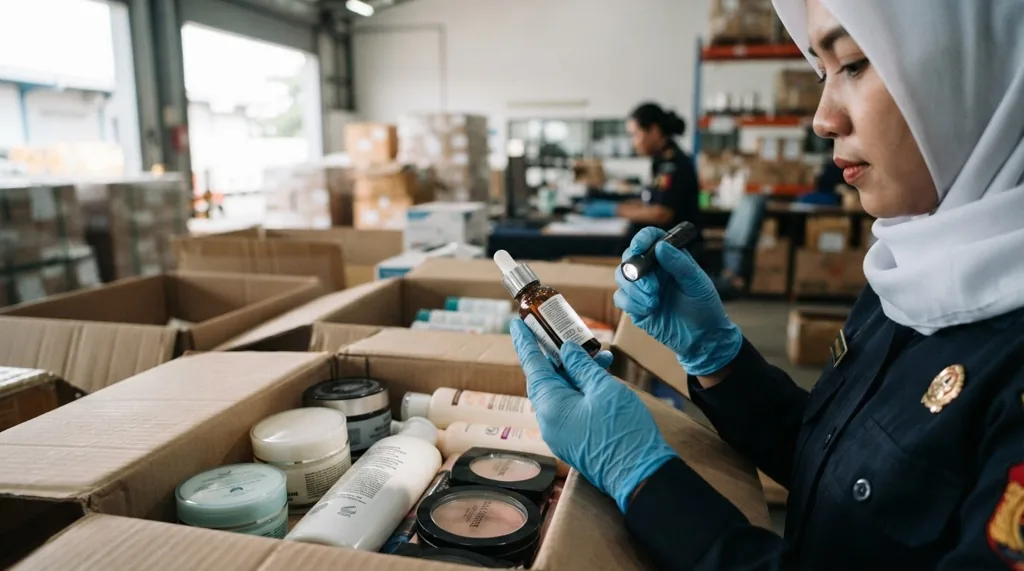
Indonesia will require halal certification for imported food, drinks, cosmetics, herbal medicines, supplements and many consumer goods from Oct. 18, 2026.
Indonesia’s halal agency, BPJPH, has confirmed that from Oct. 18, 2026, imported food, drinks, cosmetics, herbal medicines, supplements and many everyday goods sold in Indonesia must carry halal certification.
The Halal Product Assurance Agency (BPJPH) is the government body that issues halal certificates and halal labels in Indonesia. Its head, Ahmad Haikal Hasan, has said several times that the date will not move1.
In short, Indonesia is ending a long transition period. From Oct. 18, 2026, a shipment of food, cosmetics or one of the other listed goods needs a halal certificate before it can be sold in Indonesia, unless it is labelled as not halal.
What does the Oct. 18 halal rule require?
The rule rests on a basic principle in Indonesian law. Goods that enter, are sold or are traded in Indonesia must be halal-certified2. That principle is written in Article 2 of Government Regulation No. 42 of 2024 on halal product assurance, known as PP 42/20242.
A halal certificate is the official recognition that a product is halal, meaning allowed under Islamic law2. BPJPH issues it, based on a written halal ruling from the Indonesian Ulema Council (MUI) or another approved religious body2. The halal label is the mark on the pack that shows the product is certified2.
The duty has been arriving in steps since 2019. BPJPH says the stage that starts on Oct. 18, 2026 is the second stage, and its coverage is "very wide"3. The first stage started in October 2024 and covered food and drink made by medium-sized and large businesses3.
Which goods need halal certificates from October 2026?
BPJPH lists seven product groups that must carry halal certification from Oct. 18, 2026, under PP 42/20243. The same list was presented to Indonesia’s parliament1:
- Food and drinks.
- Slaughtered animal products and slaughtering services.
- Cosmetics.
- Chemical products and genetically modified products.
- Herbal medicines, quasi-drugs and health supplements.
- Raw materials, food additives and processing aids used to make food and drinks.
- Everyday consumer goods, including clothing and accessories, household health supplies, household equipment, prayer items, stationery, office supplies and class A medical devices, the lowest-risk group.
BPJPH stresses that the October 2026 stage is not only about food and drink3. The agency says the duty now reaches products of micro and small businesses and also foreign products, meaning imports3.
For many importers, the change is in the last three groups. Ingredients for food factories, supplements and simple household goods were not part of the first stage, which covered food and drink3.
What about goods made with non-halal ingredients?
The law does not ban non-halal goods. Products made from ingredients that Islamic law forbids are exempt from the certification duty2. Instead, they must carry a "not halal" statement2.
Indonesia repeated this point at the World Trade Organization (WTO). On March 5, 2026, Haikal Hasan told the WTO committee on technical barriers to trade that such goods can still be imported, sold and traded in Indonesia4. The condition is a clear "not halal" statement and meeting the other rules that apply4.
So a shipment of pork products, for example, does not need a halal certificate. It needs correct labelling instead. The goods most at risk from Oct. 18 are those that could be certified but are not, and that carry neither a halal label nor a not-halal statement.
How does the deadline work for imported goods?
Imports have their own rule in PP 42/2024. BPJPH explained it in October 2024, citing Article 160 of the regulation5.
Halal deadlines for food, drinks and slaughtered products
| Deadline | Who it catches | What happens |
|---|---|---|
| Oct. 17, 2024 | Medium and large businesses | Phase-in ends |
| Oct. 17, 2026 | Micro and small businesses | Phase-in ends |
| Oct. 17, 2026 | Foreign products | Latest date for the minister to set the duty |
Article 160 sets three tracks for food, drinks, slaughtered products and slaughtering services5:
- Medium and large businesses: the phase-in ran from Oct. 17, 2019, to Oct. 17, 20245.
- Micro and small businesses: the phase-in runs from Oct. 17, 2019, to Oct. 17, 20265.
- Foreign products: the duty is set by the Minister of Religious Affairs no later than Oct. 17, 2026, after considering progress on mutual recognition of halal certificates5.
Mutual recognition means that Indonesia accepts halal certificates issued in another country, and that country accepts Indonesia’s. Under Article 160, the minister must also consult the other ministries and agencies concerned before setting the duty for foreign products5.
At the WTO, Indonesia said the earlier extension to Oct. 17, 2026, for imports and other groups was meant to give time to finish these recognition deals4. It also gave businesses time to prepare4.
Who can certify foreign products for Indonesia?
Recognition of foreign halal certificates is done country by country, on the basis of reciprocity, Haikal Hasan told the WTO4. Not every foreign certifier qualifies4.
Only a foreign halal certification body that meets three conditions may certify products for the Indonesian market4:
- It was set up or authorised by the government or the competent Islamic authority in its home country.
- It is recognised by the competent authority there.
- It is accredited by its national accreditation body or by BPJPH’s accreditation team.
Under PP 42/2024, BPJPH also has the power to register halal certificates for foreign products2. In practice, this means a foreign maker needs a certificate from an approved body abroad, and that certificate must be registered with BPJPH.
Indonesia also told the WTO that halal rules for logistics cover only packing, storage and distribution services that are directly linked to food, drinks, medicines and cosmetics4. The aim is to stop non-halal materials mixing with halal goods along the supply chain4.
Why is Indonesia going ahead with halal certification?
BPJPH gives two reasons. The first is consumer protection: the agency says the state must give people certainty, safety and comfort when they eat or use products sold in Indonesia3. The second is economic: it says certification adds value for businesses and helps Indonesian products compete at home and abroad3.
The agency also points to the size of the sector. Haikal Hasan told parliament that the halal value chain contributes 27% of Indonesia’s GDP1.
He also told parliament there will be no delay. Speaking to Commission VIII of the House of Representatives on June 10, 2026, he said: "There is no postponement of Wajib Halal October 2026"1. Wajib Halal means "mandatory halal". He said the start date follows the stages set by PP 42/20241.
Indonesia gave the same message at the WTO in March. It said no further extension or extra transition period is planned, because the timetable had been widely communicated4. The European Union, the United States, India, Australia, Japan, the United Kingdom and Switzerland had raised the policy with Indonesia there4.
What happens to products without halal certificates?
BPJPH has warned that breaking the halal product rules can bring administrative penalties3. These include:
- a written warning;
- an administrative fine;
- withdrawal of the halal certificate;
- removal of the product from the market.
Penalties for breaking the halal rules
The agency did not set out fine amounts in its announcement3. It urged all businesses whose products fall within the mandatory groups to apply for certification before Oct. 18, 20263.
For an importer, the most serious penalty is the last one. A product that must be certified but is not can be taken off shop shelves, and the stock already in Indonesia would then be unsold.
Which Indonesian ministries are preparing for October 2026?
BPJPH held a coordination meeting on imported products on June 11, 20266. The ministries of religious affairs, finance, agriculture, industry and trade attended, with the National Food Agency and BPI Danantara6. The meeting covered supervision, recognition of foreign halal certificates and matching regulations between agencies6.
The road to Oct. 18, 2026
On Sept. 15, 2026, the Presidential Staff Office (KSP) held another meeting on the deadline7. Popy Rufaidah, acting deputy at the KSP, said the start date of Oct. 18, 2026, is a legal duty that must be carried out7.
She said imported products and raw materials need special attention, because they come from many countries7. Information on how halal status is checked should reach businesses in the country of origin, she said7. Indonesia’s quarantine agency and the foreign affairs ministry also attended, with trade and farm attachés from Indonesian embassies in cities such as Washington D.C., Bangkok, Seoul, Tokyo and Brussels7.
BPJPH is also building regional offices. It set up 10 technical units in 10 provinces in 2025 and plans 15 more in 15 other provinces in 20261.
What is new compared with earlier coverage?
This site reported in August 2026 on BPJPH fees for halal supervisors. This story covers the wider product list and the import rules that start on Oct. 18, 2026, under PP 42/20243.
Key points on Indonesia’s October 2026 halal rule
The table sums up the rule for importers and exporters.
| Question | Answer |
|---|---|
| What changes? | Halal certification becomes mandatory for more goods |
| Who confirmed it? | BPJPH, Indonesia’s halal agency |
| Legal basis | Law No. 33 of 2014 and PP 42/2024 |
| Start date | Oct. 18, 2026 |
| Goods covered | Food, drinks, cosmetics, chemicals, herbal medicines, supplements, ingredients, consumer goods |
| Medical devices covered | Class A, the lowest-risk group |
| Imports included? | Yes, foreign products are covered |
| Non-halal goods | Allowed with a "not halal" statement |
| Foreign certifiers | Must be authorised, recognised and accredited |
| Penalties | Warning, fine, certificate withdrawal, product removal |
| Delay planned? | No, says BPJPH |
From Oct. 18, 2026, goods in the seven groups that reach Indonesian shops without a halal certificate or a not-halal statement can face penalties up to removal from the market3.
Sources
- ↩ Raker dengan DPR, Kepala BPJPH Pastikan Implementasi Wajib Halal Oktober 2026 Sesuai Tahapan – Berita – BPJPH https://bpjph.halal.go.id/read/raker-dengan-dpr-kepala-bpjph-pastikan-implementasi-wajib-halal-oktober-2026-sesuai-tahapan
- ↩ Salinan_PP_Nomor_42_Tahun_2024_tentang_Bidang_Penyelenggaraan_Jaminan_Produk_Halal_ce371e0e1e.pdf https://cmsbl.halal.go.id/uploads/Salinan_PP_Nomor_42_Tahun_2024_tentang_Bidang_Penyelenggaraan_Jaminan_Produk_Halal_ce371e0e1e.pdf
- ↩ Tak Hanya Makanan-Minuman, Ini Jenis Produk yang Wajib Bersertifikat Halal Mulai 18 Oktober 2026 – Berita – BPJPH https://bpjph.halal.go.id/read/tak-hanya-makanan-minuman-ini-jenis-produk-yang-wajib-bersertifikat-halal-mulai-18-oktober-2026
- ↩ Di Forum TBT WTO, Indonesia Tegaskan Komitmen Implementasi Wajib Halal Oktober 2026 – Berita – BPJPH https://bpjph.halal.go.id/read/di-forum-stc-wto-indonesia-tegaskan-komitmen-implementasi-wajib-halal-oktober-2026
- ↩ BPJPH: 17 Oktober 2026 Produk Makanan-Minuman UMK Harus Sudah Bersertifikat Halal, Bagaimana dengan Produk Luar Negeri? – Berita – BPJPH https://bpjph.halal.go.id/read/bpjph-17-oktober-2026-produk-makanan-minuman-umk-harus-sudah-bersertifikat-halal-bagaimana-dengan-produk-luar-negeri
- ↩ BPJPH dan K/L Terkait Rakor Perkuat Kebijakan Produk Impor Jelang Implementasi Wajib Halal Oktober 2026 – Berita – BPJPH https://bpjph.halal.go.id/read/bpjph-dan-k-l-terkait-rakor-perkuat-kebijakan-produk-impor-jelang-implementasi-wajib-halal-oktober-2026
- ↩ Wajib Halal Oktober 2026 Dilaksanakan Tepat Waktu sesuai Amanat Undang-undang – Berita – BPJPH https://bpjph.halal.go.id/read/wajib-halal-oktober-2026-dilaksanakan-tepat-waktu-sesuai-amanat-undang-undang