
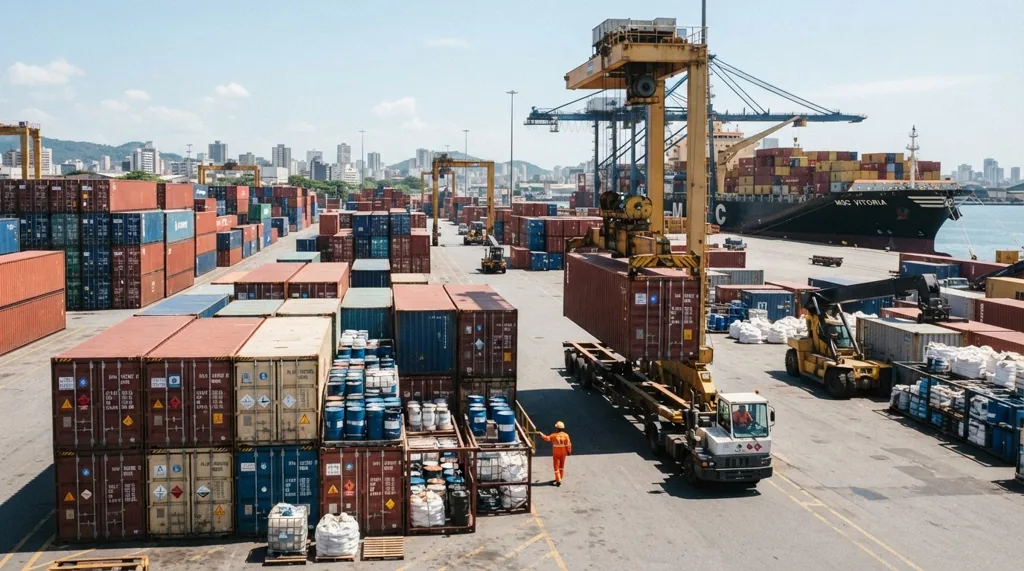
Brazil will charge import duties of 9% to 20% on 24 chemical and plastic tariff codes from Oct. 17, 2026 to Oct. 16, 2027.
Brazil’s foreign trade executive committee, Gecex, has set import duties of 9% to 20% on 24 tariff codes for chemicals and plastics, applying from Oct. 17, 2026 to Oct. 16, 20271.
The measure is Gecex Resolution No. 963 of Oct. 2, 2026. It was published in Brazil’s official gazette, the Diário Oficial da União, on Oct. 5, 20261.
In short, Brazil keeps higher import taxes on common solvents, acids and plastic resins for one more year. A shipment of ethyl acetate or polyethylene that clears customs on or after Oct. 17 will pay 20% instead of Brazil’s normal rate of 10.8% or 12.6%2.
What does Resolution 963 change for chemical imports?
Resolution 963 adds products to Annex IX of Gecex Resolution No. 272 of Nov. 19, 20211. Annex IX is Brazil’s list of temporary tariff increases for trade imbalances caused by the world economy. The trade ministry calls it the Lista DCC, a list of short-term duty rises that Mercosur members may apply above their shared tariff2.
Rates in the Resolution 963 annex, %
Brazil’s normal import duty for each code is set in the Mercosur Common External Tariff (TEC)3. Mercosur Decisions No. 27/15 and No. 09/21 allow temporary rises above it2. Resolution 963 rests on those two decisions1.
Each line in the annex gives a code, a description, the import duty rate and the start and end dates1. Every line runs from Oct. 17, 2026 to Oct. 16, 20271.
Is this a new tariff or a renewal?
It is a renewal. The same products have carried higher duties since 20242. The Brazilian Chemical Industry Association, Abiquim, first asked for higher duties on 65 codes on March 11, 20242. Gecex approved 29 of them at its meeting of Sept. 18, 20242.
From first duty to second renewal
That first decision became Resolution No. 648 of Oct. 14, 2024, valid from Oct. 15, 2024 to Oct. 14, 20252. Sodium chlorite was added later by Resolution No. 672 of Nov. 18, 20242.
A first one-year extension followed in Resolution No. 800 of Oct. 16, 20252. Those duties run from Oct. 17, 2025 until Oct. 16, 20262. The new duties start the next day, so importers face no gap between the two periods.
Abiquim then asked for a second renewal covering 29 products2. Gecex approved 28 requests, in full or in part, at its 240th meeting on Aug. 27, 20264. Resolution 963 puts 24 of those codes into law1.
Which chemicals face the new duties?
The list starts with basic chemicals, acids and solvents. The annex names these products1:
- Phosphoric acid with less than 750 ppm of iron (2809.20.11), at 17.5%
- Sodium chlorite (2828.90.20), at 10.8%
- Baking soda, or sodium bicarbonate (2836.30.00), at 20%
- Isobutyl alcohol (2905.14.10), at 20%
- Phenol and its salts (2907.11.00), at 12.6%
- Butanone, also called methyl ethyl ketone (2914.12.00), at 20%
- Ethyl acetate and n-butyl acetate (2915.31.00 and 2915.33.00), at 20%
- Other acetates under 2915.39.39, at 20%
- Adipic acid, maleic anhydride and fumaric acid (2917.12.10, 2917.14.00, 2917.19.30), at 20%
- Plasticizers made from phthalates, dioctyl, dinonyl or didecyl orthophthalates (2917.32.00 and 2917.33.00), at 20%
- Hexamethylenediamine and monoethanolamine (2921.22.00 and 2922.11.00), at 20%
Most of these lines carry the top rate of 20%1.
Which plastics and soap ingredients are covered?
The list also covers surfactants, the active ingredients in soaps and detergents. Other anionic surfactants under code 3402.39.90 pay 20%1.
Several plastic resins are on the list too1:
- Polyethylene with filler, below 0.94 density (3901.10.20), at 20%
- Other ethylene polymers under 3901.30.90, at 20%
- Ethylene and alpha-olefin copolymers below 0.94 density (3901.40.00), at 20%
- Propylene copolymers (3902.30.00), at 20%
- Polystyrene without filler (3903.11.20), at 18%
- Other styrene polymers under 3903.90.90, at 20%
- Unsaturated polyesters (3907.91.00), at 20%
Most of these resins pay the same 20% that applied in the year now ending2.
Which products keep a lower rate?
Some special grades are carved out. Brazil does this with an "Ex", a tariff note that gives one narrowly described product its own rate inside a wider code2. The annex keeps six such notes1:
- Dialysis-grade sodium bicarbonate, at least 99% pure and packed for hemodialysis, at 9%
- Three surfactants under 3402.39.90: ammonium tristyrylphenol ethoxylate ether sulfate, ammonium polyarylphenyl ether sulfate, and sodium benzene bis-propylene sulfonate in water solution, each at 12.6%
- Alpha-methylstyrene-styrene copolymer, at 12.6%
- Styrene-butadiene block copolymers (SBC) with 18% to 25% butadiene, sold as granules for industry, at 12.6%
Grades with a lower rate
The trade ministry says the notes for the sodium benzene surfactant and the SBC copolymers were set up for products not made in Brazil2. A buyer of these grades must describe the goods exactly as the note does to get the lower rate.
A request from the chemical maker Lanxess asked for a similar note2. It sought a 12.6% rate for one ethylene copolymer used in rubber goods2. The annex of Resolution 963 contains no such note, and code 3901.40.00 appears at 20% for all goods1.
How much higher are the new rates?
Each new rate equals the rate in force in the year now ending2. The rise is measured against Brazil’s normal TEC rate, which the ministry calls the initial rate2.
Normal rate and Lista DCC rate
| Product | Normal TEC rate | From Oct. 17, 2026 |
|---|---|---|
| Phosphoric acid | 9% | 17.5% |
| Baking soda, adipic acid | 9% | 20% |
| Butanone, ethyl acetate | 10.8% | 20% |
| Phenol | 7.2% | 12.6% |
| Polystyrene | 12.6% | 18% |
For several products, the duty roughly doubles. Phosphoric acid goes from a normal 9% to 17.5%2. Baking soda and adipic acid go from 9% to 20%2. Butanone, ethyl acetate and isobutyl alcohol go from 10.8% to 20%2.
Smaller rises apply elsewhere. Phenol moves from 7.2% to 12.6%, and sodium chlorite from 9% to 10.8%2. Most plastics move from 12.6% to 20%, and polystyrene from 12.6% to 18%2.
Abiquim had asked for more. It sought rates up to Brazil’s ceiling at the World Trade Organization for five products: sodium chlorite, baking soda, phenol, the surfactants and polystyrene2. It asked for 35% on baking soda and 22.5% on the surfactants2. Resolution 963 keeps all five at last year’s rates1.
Why did Gecex keep the higher duties?
Resolution 963 gives one reason in its title: trade imbalances caused by the world economy1. The requests came from Abiquim, which asked for the earlier duties to be renewed for 12 months2. Gecex weighed them with a ministry technical note, No. 2104/20262.
A separate ministry note, on a request by the chemical maker Basf for nylon resin, shows how the duties link along the supply chain3. Basf said adipic acid and hexamethylenediamine, the raw materials for its nylon (polyamide-6,6), rose to 20% when they joined the Lista DCC3. It said imports at very aggressive prices, mainly from China, hurt Brazilian makers3. That nylon request is handled under a different list and is not part of Resolution 963.
Who is affected by the chemical tariffs?
Brazilian importers of these chemicals and resins pay the higher duty at customs. Factories in Brazil that use them as inputs will keep paying more for imported supplies for another year. Foreign suppliers, in turn, keep facing a price gap against Brazilian producers.
Customs brokers must check the exact code and any Ex note on each entry. A shipment of hemodialysis bicarbonate pays 9%, while ordinary baking soda under the same code pays 20%1.
Five codes from last year’s extension do not appear in the annex of Resolution 9631. They are polyethylene without filler (3901.10.30), high-density polyethylene (3901.20.29), polypropylene without filler (3902.10.20), suspension PVC (3904.10.10) and PET resin (3907.61.00)2. Their Lista DCC duty is set to end on Oct. 16, 20262.
When do the new rates start?
Resolution 963 took legal effect on its publication date, Oct. 5, 20261. The rates themselves apply only from Oct. 17, 20261. They end on Oct. 16, 20271.
The resolution is signed by Márcio Fernando Elias Rosa, chair of the committee1. Gecex acted under powers set out in Decree No. 11,428 of March 2, 20231.
Key points on Brazil’s chemical import duties
The table sums up Resolution 963.
| Question | Answer |
|---|---|
| What changed? | Higher import duties renewed for one year |
| Who issued it? | Gecex, Brazil’s foreign trade committee |
| Which measure? | Gecex Resolution No. 963 of Oct. 2, 2026 |
| When published? | Oct. 5, 2026 |
| Which goods? | 24 codes of chemicals, surfactants and plastics |
| What rates? | 9% to 20%, mostly 20% |
| Lowest rate? | 9% for dialysis-grade sodium bicarbonate |
| Legal basis? | Mercosur Decisions No. 27/15 and No. 09/21 |
| Start date? | Oct. 17, 2026 |
| End date? | Oct. 16, 2027 |
| Who pays? | Importers of these goods into Brazil |
| Codes left out? | Five, including PVC and PET resin |
From Oct. 17, 2026, a Brazilian importer of ethyl acetate, adipic acid or propylene copolymers pays 20% duty at customs. That rate holds until Oct. 16, 20271.
Sources
- ↩ RESOLUÇÃO GECEX Nº 963, DE 2 DE OUTUBRO DE 2026 – RESOLUÇÃO GECEX Nº 963, DE 2 DE OUTUBRO DE 2026 – DOU – Imprensa Nacional https://static.poder360.com.br/uploads/2026/10/resolucao-gecex-no-963.pdf
- ↩ SEI/MGI – 63850118 – Extrato https://www.gov.br/mdic/pt-br/assuntos/camex/outros-documentos/notas/deferimentos/240a-reuniao-ordinaria-do-comite-executivo-de-gestao-gecex/extrato-publico-da-nota-tecnica-sei-no-2104_2026-mdic.pdf
- ↩ SEI/MGI – 63256662 – Extrato https://www.gov.br/mdic/pt-br/assuntos/camex/outros-documentos/notas/deferimentos/240a-reuniao-ordinaria-do-comite-executivo-de-gestao-gecex/extrato-publico-da-nota-tecnica-sei-no-1465_2026-mdic.pdf
- ↩ Deliberações da 240ª Reunião Ordinária do Comitê-Executivo de Gestão (Gecex) — Ministério do Desenvolvimento, Indústria, Comércio e Serviços https://www.gov.br/mdic/pt-br/assuntos/camex/outros-documentos/deliberacoes/deliberacoes-da-240a-reuniao-ordinaria-do-comite-executivo-de-gestao-gecex