
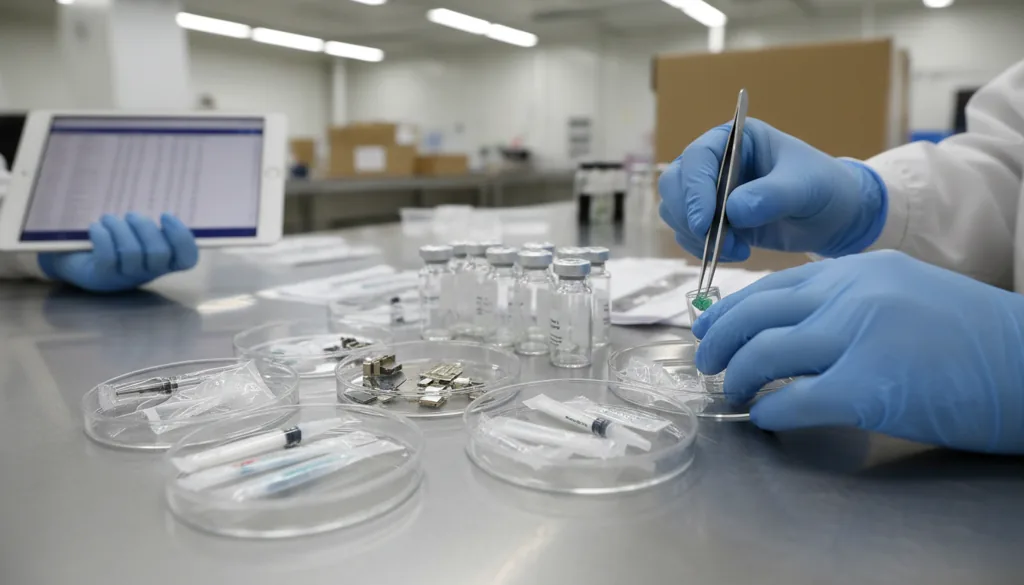
China applied provisional import tariff rates lower than most-favored-nation rates on 935 items beginning January 1, 2026.
China will apply provisional import tariff rates below its most-favoured-nation rates to 935 items from Jan. 1, 2026, in a tariff adjustment announced by the State Council Customs Tariff Commission.1
The change covers a wide range of goods rather than a single industry. It includes key components, advanced materials, resources linked to green development and medical products such as artificial blood vessels.1 For importers, the immediate effect is a lower customs duty on qualifying goods entering China under the listed tariff lines.
The measure is intended to improve the connection between China’s domestic and international markets and increase the supply of higher-quality goods, according to a commission circular.1 The importer pays the duty at the revised rate, so the direct financial effect is a reduction in the customs charge for goods covered by the plan.
The 935-item tariff plan
The tariff adjustment takes effect at the start of 2026 and forms part of a wider annual plan covering import duties, tariff headings and national subheading notes. The State Council Customs Tariff Commission published the announcement on Dec. 26, 2025, under Announcement No. 11 of 2025.2 Its legal basis is China’s Customs Law and related rules.
Announced, then in force
The announcement sets out several attachments rather than a single rate change. They cover provisional import rates, tariff-quota goods, export rates, changes to import and export tariff headings, changes to national subheading notes, and rates under free-trade and preferential trade arrangements.2 That structure means the 935-item reduction sits alongside changes that may affect how goods are classified.
For customs teams, the central question is whether a product falls within one of the adjusted lines on Jan. 1. A lower provisional rate can reduce the duty paid at entry, but only where the imported goods match the relevant tariff description. The practical effect therefore depends on classification, product specifications and the rate assigned to the line.
The plan is temporary in form, with provisional rates applying from the effective date under the annual tariff schedule. Lower provisional import rates will be the key rate change for the covered goods. The announcement’s multiple attachments also make the adjustment broader than a simple across-the-board reduction.
Components, materials and medical goods
The product groups named by the commission point to inputs used in manufacturing and technology. Certain key components and advanced materials will receive lower tariffs to support what the announcement calls high-level technological self-reliance.1 That gives the measure a direct connection to factories importing parts or materials for further production.
Three named product groups
The plan also covers selected resources intended to support green development. The source announcement does not provide a complete product list in its published description, so the exact effect will vary by the tariff lines set out in the attached schedule. Even so, the named categories show that the adjustment reaches beyond finished consumer products.
Medical imports form a third stated group. The commission specifically identified artificial blood vessels among the medical products affected.1 Lower duty on such goods reduces the border charge on the covered items, while the classification of each product remains decisive.
The categories suggest a policy aimed at inputs and goods with a direct link to industrial capacity, environmental goals or public health. That mix could spread the effect across manufacturers, technology suppliers and medical distributors rather than concentrating it in one trade lane. Artificial blood vessels are the clearest named example of a medical product included in the announcement.
New headings for new technology
The tariff plan also changes China’s customs language by adding national subheadings for some products. A national subheading is a more detailed tariff code used within China’s customs system. The stated purpose is to support technological progress and sectors including the circular economy.1
The products named in this part of the plan include intelligent bionic robots and bio-aviation kerosene. These are different kinds of goods, but both illustrate the same administrative move: creating more precise places in the tariff structure for products linked to newer industries. The new codes can give customs authorities a clearer basis for recording and handling those imports.
For exporters and brokers, a new subheading can matter even where the duty rate is not the main issue. Product descriptions, classification databases and declaration systems may need to reflect the revised national structure. The change is therefore relevant to classification work as well as to the calculation of duty.
The announcement groups these changes with adjustments to national subheading notes, which can help define how a product fits within the tariff system.1 That makes the 2026 plan both a rate measure and a classification measure. Intelligent bionic robots and bio-aviation kerosene will have named national subheadings under the revised structure.
Trade partners and zero-duty access
The provisional rates are only one part of China’s import tariff arrangements for 2026. China will continue applying agreed rates to certain goods from 34 trading partners under 24 free-trade agreements and preferential trade arrangements.1 Those rates operate through the relevant agreements and are separate from the general provisional-rate list.
Preference arrangements for 2026, by the numbers
For a shipment, the available rate can therefore depend on more than the product’s tariff line. The origin of the goods and the agreement covering that origin can also determine which preferential treatment applies. Importers handling goods from covered partners will need the agreement-based rate structure considered alongside the 935-item adjustment.
China will also maintain zero-tariff treatment on 100% of tariff lines for 43 least-developed countries that have diplomatic relations with China.1 This is a broad continuation of preferential access, covering every tariff line for the countries included in the announcement. It creates a separate duty treatment from both the provisional rates and ordinary most-favoured-nation rates.
The combination of these measures gives the 2026 plan several layers. A product may be covered by the general provisional schedule, an agreement-based rate or the zero-tariff arrangement for an eligible least-developed country. Zero-tariff treatment on 100% of tariff lines is the widest preference described in the documents.
What the tariff changes signal
The commission presents the adjustment as part of a broader effort to deepen economic and trade cooperation, promote regional integration and use domestic and international resources more effectively.1 The stated objectives connect the tariff decision to supply, technology, green development and access to medical goods. They also place the annual rate changes within China’s wider trade policy.
Three duty regimes in the 2026 plan
| Question | Provisional rates | Agreement rates | LDC zero tariff |
|---|---|---|---|
| Who it covers | 935 listed tariff lines | Goods from 34 partners | 43 least-developed countries |
| Rate applied | Below MFN rate | Agreed rate under 24 agreements | Zero on 100% of lines |
| Legal basis | Annual tariff schedule | Trade agreements | Preferential arrangement |
That policy mix matters because the measure is not limited to finished imports entering for consumption. Key components, advanced materials and resources can enter production chains, while medical goods can move through health-related supply networks. Lower duty on those inputs can reduce the border cost of covered goods, although the documents give no overall estimate for the value of the reduction.
The new headings for emerging products add a longer-term element. They allow the tariff system to identify goods such as bionic robots and bio-aviation kerosene more precisely as those sectors develop. The adjustment therefore combines immediate rate relief with an administrative update to China’s customs classification framework.
The effective date is Jan. 1, 2026, which gives the measure a fixed point for declarations made from the start of the year.2 The key operational dividing line is whether the goods are entered before or after that date and whether their classification matches the amended schedule. Jan. 1, 2026 is when the new tariff rates and related tariff changes begin.
The plan is unlikely to have one uniform effect across all 935 items. Its impact will be strongest where the covered goods are imported in significant quantities or sit early in a production chain, while the effect on individual shipments will depend on the assigned tariff line and applicable origin treatment. The documents identify the policy direction, but the attached schedules determine the rate applied to each product.
For importers, exporters and customs brokers, the principal change is therefore a new tariff framework to be used from the first day of 2026. It brings lower provisional rates for 935 items, new national subheadings for selected products and continuing preferences for named trading partners and least-developed countries. Together, those changes will reshape the duty calculation for the covered goods as they enter China.
Sources
- ↩ China to apply lower tariff rates to certain imports in 2026 https://english.www.gov.cn/news/202512/30/content_WS69533e81c6d00ca5f9a08520.html
- ↩ 2026 Tariff Adjustment Plan Announcement https://www.mofcom.gov.cn/cwxx/zcfb/art/2026/art_031306c35f494f64b3b4e259458bbc22.html