
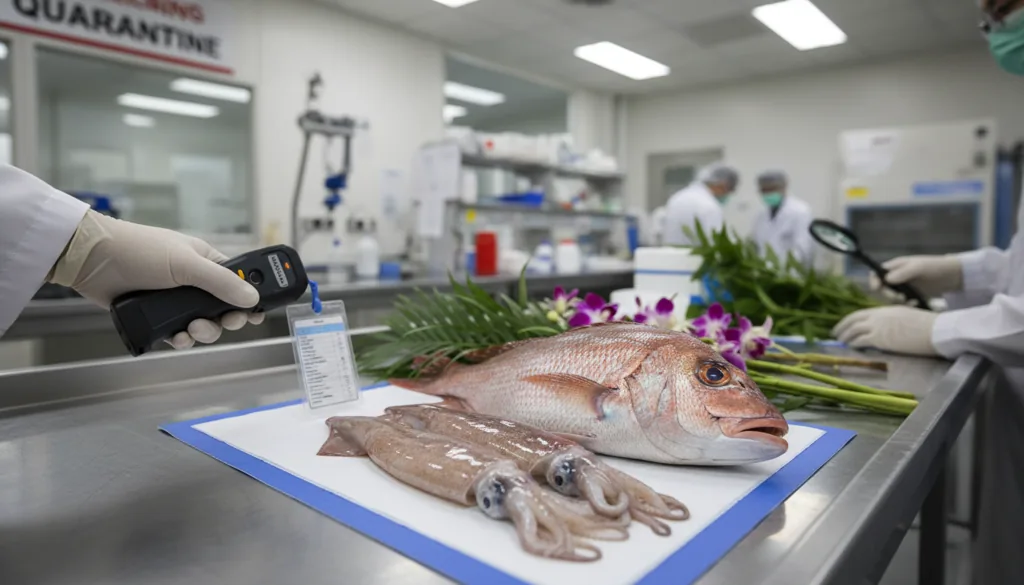
Indonesia has strengthened fish and plant quarantine protocols to prevent disease spread, particularly targeting high-risk aquatic and plant imports.
Indonesia has created a single national quarantine authority to inspect every plant, animal and fish shipment crossing its borders, with new powers to block or destroy goods that fail health checks from 6 June 2023.
The change merges three separate agencies into the Indonesian Quarantine Authority, a ministerial-level body that reports directly to the president. It covers everything from live cattle and frozen tuna to seeds, cut flowers and ornamental fish, and applies the same risk list and testing rules to every port of entry. Importers must now clear a single set of documents before any shipment is released, and the authority can order immediate destruction if a shipment carries undeclared pathogens or prohibited species.
The delivered cost of every tonne inside the new regime rises: every importer pays for pre-shipment testing, a pre-issued import permit, and on-arrival inspection by the same agency.
The authority that now inspects everything
The Indonesian Quarantine Authority began work on 6 June 2023 under Government Regulation No 29 of 20231. It absorbed the animal and plant quarantine functions of the Ministry of Agriculture and the fish quarantine functions of the Ministry of Fisheries and Marine Affairs2. The new body is responsible for preventing the entry and spread of pests and diseases that threaten human, animal and plant health, and for enforcing international standards set by the World Organisation for Animal Health, the International Plant Protection Convention and the Codex Alimentarius Commission1.
What changed, and what did not
The regulation covers all commodities and all trading partners1. It applies to every port, airport and land crossing, and to every mode of transport. The same risk list and testing protocols now apply to live cattle, frozen shrimp, orchid cuttings and ornamental fish, and the same agency issues the import permit, inspects the shipment and orders destruction if the goods fail the checks3.
What the new rules demand
Every shipment must carry a pre-issued import permit from the Indonesian Quarantine Authority1. The permit is issued only after the importer submits a health certificate from the country of origin, a laboratory test report for the specific pathogens on the Indonesian risk list, and a declaration that the goods do not contain any prohibited species3. The permit is valid for 30 days and must be presented to the authority at the port of entry before the shipment is unloaded3.
On arrival, the authority inspects every shipment for the pathogens and pests named in the risk list. If the goods fail the inspection, the authority can order immediate destruction at the importer’s expense1. The same rule applies if the shipment contains any species prohibited under Indonesian law or the Convention on International Trade in Endangered Species of Wild Fauna and Flora4.
Who pays for the new regime
The importer pays for all testing, inspection and destruction costs1. The authority does not charge a fee for the import permit, but the importer must pay for the laboratory tests required to obtain it. If the authority orders destruction, the importer must also pay for the disposal of the goods5. The delivered cost of every tonne inside the quota therefore rises by the cost of the tests, the permit and the risk of destruction.
Every cost lands on the importer
| Component | Charge | Charged on |
|---|---|---|
| Import permit | No fee | Issued by the authority |
| Laboratory tests | Importer pays | Required to obtain the permit |
| On-arrival inspection | Importer pays | Every shipment at the port |
| Destruction and disposal | Importer pays | If the goods fail the checks |
The authority has already destroyed 312 tonnes of imported meat-and-bone meal from Brazil after laboratory tests detected undeclared porcine DNA5. The shipment was ordered destroyed under Article 48 of Law Number 21 of 2019, which requires destruction of any goods that do not match the health certificate or that pose a biosecurity risk5.
The risk list that drives the checks
The authority uses a single risk list for all commodities3. The list names the pathogens and pests that must be tested for before shipment, and the prohibited species that cannot be imported at all. It is based on international standards and is updated annually1. The current list includes bacterial diseases of fish, viral diseases of livestock, and fungal diseases of plants, as well as invasive species and genetically modified organisms3.
The list is applied to every shipment, regardless of origin. A shipment of frozen tuna from Thailand must be tested for the same bacterial diseases as a shipment of live cattle from Australia, and a shipment of orchid cuttings from the Netherlands must be inspected for the same fungal diseases as a shipment of palm seeds from Malaysia3.
What the change replaces
The new regime replaces a system in which animal, plant and fish quarantine functions were split between two ministries2. The Ministry of Agriculture was responsible for animal and plant quarantine, and the Ministry of Fisheries and Marine Affairs was responsible for fish quarantine. Each ministry had its own risk list, its own testing protocols and its own import permit, and each could order destruction of goods that failed its checks6.
The split system and the single authority
| Question | Before 6 June 2023 | From 6 June 2023 |
|---|---|---|
| Who inspects | Two ministries, by commodity | One authority, all commodities |
| Risk list | One per ministry | Single national list |
| Import permit | Separate permit per agency | One permit from the authority |
| Destruction power | Each ministry, own checks | One agency, one set of checks |
The split system placed the same instrument in several categories at once. A shipment of live fish for aquaculture could be inspected by both the fish quarantine agency and the animal quarantine agency, and a shipment of seeds could be inspected by both the plant quarantine agency and the fish quarantine agency if the seeds were to be used in aquaculture3. The new regime eliminates the overlap and applies the same rules to every shipment.
The next date in the documents
The authority’s 2025 draft plan sets a target of reducing the percentage of shipments that fail inspection to 5% by the end of the year7. The plan also calls for increased monitoring of emerging and re-emerging diseases, and for closer coordination with international bodies to align Indonesian standards with global best practice7. The authority will review the risk list and the testing protocols in March 2027, and will publish any changes at least six months before they take effect3.
The dates that bind
Sources
- ↩ Government Regulation No 29 of 2023 referring to the Regulation of the Implementation of Law Number 2i Year 2019 about Animal, Fish and Plant Quarantine _notification https://docs.wto.org/imrd/directdoc.asp?DDFDocuments/T/G/SPS/NIDN146.DOCX
- ↩ Perpres 45 Year 2023 on Quarantine Bodies https://ppid.riau.go.id/berita/10484/inilah-perpres-45-tahun-2023-tentang-badan-karantina-indonesia
- ↩ Strategic Plan for Animal, Fish, and Plant Quarantine Modernization https://ppid.kkp.go.id/media/uploads/document_information_public/1._RENSTRA_2020-2024_BKIPM_LAMPUNG_1kAIzGc.pdf
- ↩ Quality Control and Supervision Body for Product Outcomes https://kkp.go.id/download-pdf-akuntabilitas-kinerja/akuntabilitas-kinerja-pelaporan-kinerja-laporan-kinerja-balai-kipm-surabaya-i-tahun-2023.pdf
- ↩ Why Must 312 Metric Tons of Imported Feed Containing Pork Be Destroyed? Government Explanation https://bpjph.halal.go.id/read/mengapa-312-ton-pakan-impor-mengandung-unsur-babi-harus-dimusnahkan-ini-penjelasan-pemerintah
- ↩ Steps of Quarantine – Indonesia Quarantine Agency https://karantinaindonesia.go.id/bali/profil/sejarah
- ↩ Draft Plan for the Period 2025 by the Indonesian Quarantine Agency https://karantinaindonesia.go.id/repository/main-web/performance-reports/01KWTJ9T4QZKD9JNHWGJ6CMXQ0.pdf