
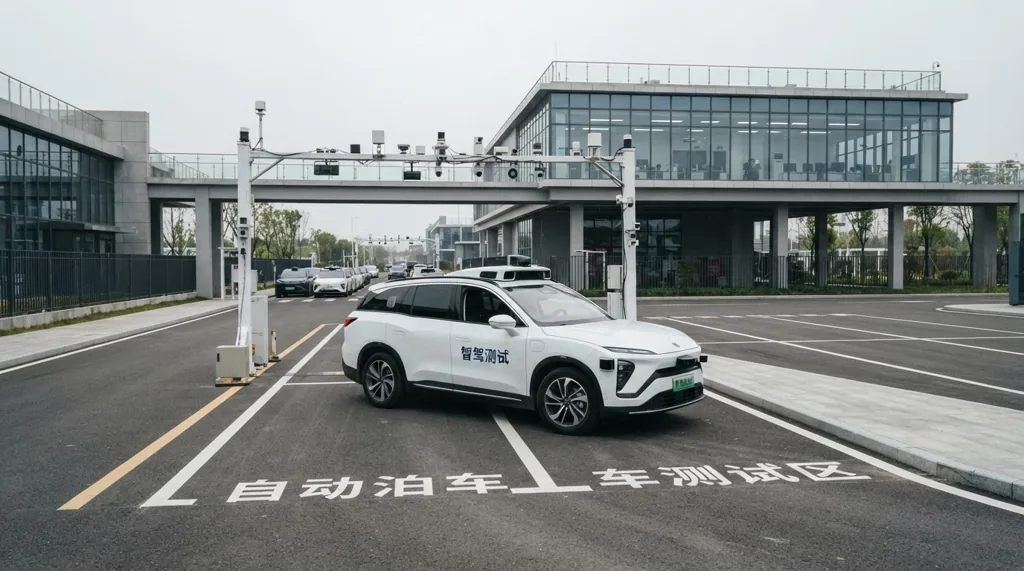
China has enacted national standards establishing safety requirements for automated parking systems and vehicle data security protocols for intelligent and connected vehicles.
China told the World Trade Organization on Nov. 18, 2026 about two draft vehicle standards covering self-parking systems and car data security1.
The drafts come from China’s Ministry of Industry and Information Technology (MIIT), which proposed both texts and is responsible for them2. One sets safety rules for cars and trucks that park themselves. The other sets rules for how vehicles collect, store, send and delete personal and sensitive data3.
In short, a car or truck with a self-parking system will have to pass new safety tests before it is approved in China. Every passenger car and commercial vehicle will also have to meet stricter data rules, including a ban on sending data directly abroad.
What did China notify on Nov. 18?
China filed the two drafts with the World Trade Organization (WTO) as notices on technical barriers to trade, meaning product rules that affect trade1. The listing kept by Estonia’s national standards body shows both notifications dated Nov. 18, 20261.
The two drafts side by side
| Question | Self-parking draft | Car data draft |
|---|---|---|
| WTO notice | G/TBT/N/CHN/2381 | G/TBT/N/CHN/2385 |
| Notified | Nov. 18, 2026 | Nov. 18, 2026 |
| Vehicles covered | M and N with level 3 or 4 parking | M and N category vehicles |
| Start date | Not yet set | Not yet set |
The first filing is G/TBT/N/CHN/2381. It covers "intelligent and connected vehicles: safety requirements for automated parking system"1. The second is G/TBT/N/CHN/2385, which covers data security for vehicles in the M and N categories1.
Both texts are marked as drafts for public comment2. Neither text gives a publication date or a start date yet. The cover pages leave those dates blank3.
China notified several other vehicle drafts on the same day. They include a standard for a parking assistance system combined with driving assistance on small cars and vans, and one for exterior vehicle lighting1. Those are separate measures and are not covered here.
Which vehicles does the parking standard cover?
The parking draft applies to vehicles in categories M and N that have a level 3 or level 4 automated parking system2. Both passenger vehicles and goods vehicles in these classes are therefore included.
The draft defines an automated parking system as hardware and software that can carry out the whole driving task for the purpose of parking2. It must be able to park in, pull out and drive slowly around a car park, called "parking cruise"2.
The two levels differ in one way. A level 3 parking function still needs a backup user who can take over. A level 4 function does not need a backup user2.
A system may skip the parking cruise ability in one case. The vehicle must also carry a self-driving function at the same level that meets standard GB 44721 and works in the same car parks2.
What safety rules must self-parking cars meet?
The draft sets a basic test. The system must be at least as safe as a qualified and attentive driver2. It must not create unreasonable risk for people in the car or other road users.
While it is switched on, the system must spot several kinds of collision risk2:
- Other vehicles, including bicycles and obstacles that appear suddenly.
- People on foot, including adults, children and small children.
- Car park fittings and fixed obstacles.
- Objects it cannot identify.
The draft adds a test target shaped like a small child in a separate annex2. This means makers abroad must show that their sensors see very small pedestrians.
Speed is also limited. The design speed for parking into a space must not exceed 10 km/h, and the same cap applies to pulling out2.
How must the system brake and stop?
When something goes wrong, the system must bring the car to a safe stop. The draft calls this a minimal risk manoeuvre2. The car should move to a place where it does not block traffic, or at least stop safely, and use its hazard lights.
Braking and acceleration limits, m/s²
During this stop, the system must not brake harder than 4.0 m/s², except in special cases described in the maker’s safety file2. These cases include a serious system failure or a collision that is about to happen.
Some level 4 vehicles let passengers stand or have no seat belts. In those vehicles the system must not order acceleration or braking above 2.4 m/s²2. A level 4 system must also keep the car stopped until it confirms that the cause of the stop has gone.
What must parking end with?
Small cars and vans in the M1 and N1 classes face extra rules. After parking, the system must put the car in park, set the parking brake and switch itself off2. Larger vehicles must use a non-driving gear and set the parking brake.
For spaces at a right angle to the aisle, small cars and vans must be able to reverse into the space2. If they offer other ways to park, they must still let the driver choose to reverse in.
When a stand-alone parking-in function starts, the car must be no more than 15 m from the target space2. After parking, the car must turn off its power system and lock its doors, except in cases such as charging or loading goods.
What must drivers be told and trained on?
The vehicle maker must give users instructions for the parking system in a form the public can reach. The draft names the maker’s website, the car’s screen or a mobile device as examples2. This is in addition to the normal owner’s manual.
The instructions must explain the system’s limits, how to switch it on and off, and what it does when a crash cannot be avoided2. They must also explain how to take over and what to do after an accident.
Each time the car’s power system restarts, it must check that the person in the driver’s seat has completed training on the system2. It can do this in one of three ways:
- Training the driver in the car and confirming the training is done.
- Recognising the driver by biometric checks.
- Logging the driver into an account while the car is stopped.
The driver must also confirm that the instructions were read. If no confirmation is detected for 30 days, the car must ask again before the next use2. Vehicles with the system must also carry a data recorder for the parking system that meets the draft’s annex A2.
What does the vehicle data security standard change?
The second draft is numbered GB 44464. It replaces GB/T 44464—2024, the general vehicle data standard first issued in 20243. This is its first revision.
The new draft applies to M and N category vehicles. It excludes special-purpose vehicles built on an already approved second-stage chassis or complete vehicle3. It covers personal information and "important data" handled by the vehicle maker and by the vehicle itself3.
The draft defines important vehicle data as data that could harm national security, the public interest or the economy if it were changed, leaked or misused3.
Several rules from the 2024 version have been removed. The separate rules on sending personal information and important data abroad were deleted3. In their place is one short rule: a vehicle must not send data directly abroad3. A note says this does not limit actions users choose, such as browsing foreign websites or installing third-party apps.
What must carmakers do about personal data?
Vehicle makers must set up a data security management system. It must include an internal audit at least once a year3. They must also check and sign data security agreements with suppliers and service providers who handle the data3.
Inside the car, the rules focus on consent:
- Off by default. A vehicle must be set not to collect personal information unless the user chooses otherwise or an exception applies3.
- Separate consent. Sensitive information needs separate consent, and so does giving personal information to a third party3.
- Visible signals. When collecting location or sensitive cabin data, the vehicle must show light, sound or touch signals until collection ends3.
- Basic functions stay on. A car cannot refuse basic functions, such as brakes, steering, lights, air conditioning and seat heating, because a user refuses consent3.
Cabin data must not leave the vehicle without consent or an exception3. Data stored in the car that is important or sensitive must be protected by encryption or other security methods. Users must also have a way to delete personal data from the car3.
How must cameras blur faces and number plates?
Cameras outside the car may record people for driving safety without consent. That footage must be made anonymous inside the vehicle before it is sent out3. The car can delete the frames, lower the resolution or blur faces and number plates.
Blurring rules for outside cameras
| Requirement | Standard / Details |
|---|---|
| Faces | Blur at 28 pixels or more |
| Number plates | Blur at 16 pixels or more |
| Catch rate | At least 90% of faces and plates |
| Result | Blurred faces and plates not recognisable |
The draft sets clear thresholds. A face must be blurred when its box is at least 28 pixels on its shortest side3. A number plate must be blurred at 16 pixels or more.
The system must catch at least 90% of faces and number plates that meet these rules3. Blurred faces and plates must not be recognisable afterwards.
How will vehicles be tested?
Both drafts include a section on deciding when two vehicles count as the same type for testing2. Each also has a section on putting the standard into effect3.
For data security, testers will check the maker’s documents. These documents must be in Chinese, formally issued with version numbers, and kept safe from changes for at least 3 years3. The maker must also hand over a list of data handling activities for each vehicle function, a list of consent exceptions and details of cameras, lidar and radar sensors3.
For self-parking, the draft lists track tests, road tests and computer simulation tests in its annexes2. It also requires a safety file from the maker, which testers will check.
How does this fit China’s wider vehicle standards work?
MIIT is running a wider programme of vehicle safety standards. In June 2026, it published final drafts of two national standards, including the automated driving system safety standard, for a short public review4. That review ran from June 17 to June 24, 20264.
This site reported on Oct. 1 that China had set a national safety standard for self-driving vehicles. The parking draft is a separate measure. It covers systems built only for parking and links to standard GB 44721 for some driver display rules2.
Key points on China’s self-parking and car data drafts
Both measures are drafts, and their start dates are not yet set.
| Question | Answer |
|---|---|
| What happened? | Two draft vehicle standards notified to the WTO |
| When? | Nov. 18, 2026 |
| Who proposed them? | Ministry of Industry and Information Technology |
| Parking draft goods | M and N vehicles with level 3 or 4 self-parking |
| Parking speed limit | 10 km/h |
| Emergency braking limit | 4.0 m/s² |
| Data draft goods | M and N category vehicles |
| Data draft replaces | GB/T 44464—2024 |
| Data abroad | Vehicles must not send data directly abroad |
| Face blurring catch rate | At least 90% |
| Start date | Not yet set in the drafts |
Both texts are still drafts for public comment2. When China fixes the publication and start dates, carmakers and importers will know when vehicles must pass the new self-parking and data tests.
Sources
- ↩ TBT notifications – EVS standard evs.ee | en https://www.evs.ee/en/wtonotifications/tbtnotifications
- ↩ 26_06028_00_x.pdf https://members.wto.org/crnattachments/2026/TBT/CHN/26_06028_00_x.pdf
- ↩ 国家标准 https://members.wto.org/crnattachments/2026/TBT/CHN/26_06049_00_x.pdf
- ↩ 关于公开征求《智能网联汽车 自动驾驶系统安全要求》等2项强制性国家标准(报批稿)、《车载事故紧急呼叫系统》强制性国家标准外文版(报批稿)意见的公示 https://www.ncsti.gov.cn/kjdt/tzgg/202606/t20260618_250015.html