
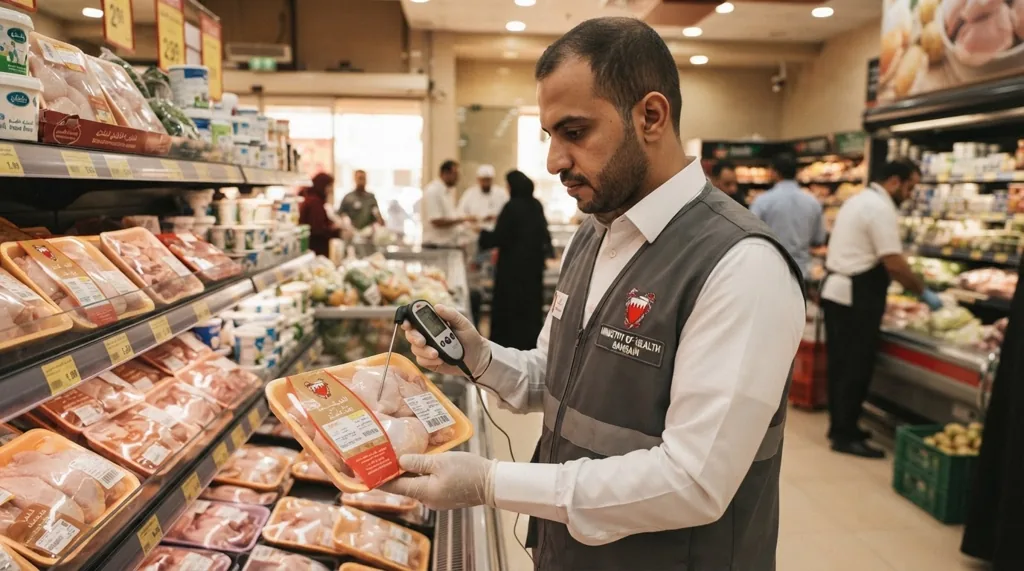
Bahrain has established maximum residue limits for veterinary drugs in food to ensure food safety and protect consumer health.
Bahrain and six Gulf partners revised draft limits for animal drug traces in meat, milk, fish and honey on Aug. 31, 2026.
The revised text is a Gulf draft technical regulation called "Maximum Residues Limits (MRLs) of Veterinary Drugs In Food"1. It was sent to the World Trade Organization (WTO) on behalf of the United Arab Emirates, Bahrain, Kuwait, Oman, Qatar, Saudi Arabia and Yemen1.
In short, food of animal origin shipped to Bahrain will have to stay under a fixed ceiling for each animal medicine. A shipment of chicken, beef, lamb, fish or honey with higher traces could fail food-safety checks once the rule is adopted.
What is the Gulf veterinary drug rule?
A maximum residue limit (MRL) is the highest amount of a drug trace allowed to remain in a food. Farmers give animals medicines against worms, insects and parasites, and small amounts can stay in the meat, milk or honey. The draft sets the maximum permissible limits for residues of veterinary medicines in food products and food of animal origin1.
The Gulf draft at a glance
| Point | What the draft says |
|---|---|
| Name | Maximum Residues Limits (MRLs) of Veterinary Drugs In Food |
| Draft reference | GSO 2481/2024 |
| Bahrain’s WTO reference | G/SPS/N/BHR/201/Add.2 |
| Goods covered | Food products and food of animal origin |
| Status | Revised draft, not yet adopted |
The rule is a Gulf technical regulation, which means it is a binding product rule rather than a voluntary standard. The draft text carries the label GSO 2481/2024, a reference that marks it as a Gulf standard (GSO)2.
Bahrain filed the notice under its own WTO reference, G/SPS/N/BHR/201/Add.21. The same text was filed by the six other states under their own numbers. This means the same limits are planned for all seven markets.
Why did Bahrain notify the WTO again?
This is not a new rule from nothing. Bahrain’s Ministry of Industry and Commerce already lists a Gulf technical regulation with the same title, GSO 2481:2015, approved on 5 November 20153. Its standards store now marks that 2015 edition as "Historical"3.
How the Gulf rule got here
The Gulf states first notified a draft update to the WTO on 27 May 20194. A first addendum followed in August 2019, after the states reviewed comments from other WTO members4. The new filing is the second addendum.
The Aug. 31 addendum is marked as a change to the content or scope of the earlier draft1. It is not marked as the adoption or entry into force of the rule1. So the limits are still a proposal, and other countries can comment before the Gulf states adopt them.
Which foods and drugs does the draft cover?
The draft text lists each drug with its safe daily intake, the trace that laboratories measure, and the limits for each animal and body part2. The limits are given in micrograms per kilogram (μg/kg), or millionths of a gram in each kilogram of food2.
The pages attached to the notice name these drugs:
- Clopidol, a medicine against a gut parasite disease in poultry, with limits for chicken2.
- Diflubenzuron, an insect-control product, with a limit for salmon2.
- Flumethrin, an insect-control product, with an entry for honey2.
- Imidacloprid, a parasite treatment, with an entry for finfish2.
- Ivermectin, a worm medicine, with limits for cattle, sheep and goats2.
- Nicarbazin, a poultry parasite medicine, with limits for broiler chickens2.
Each entry gives a reference to the Codex Alimentarius Commission (CAC), the United Nations body that sets world food standards2. For example, the clopidol limits cite the Commission’s 2024 session, and the ivermectin limits for cattle cite its 2017 session2. So the Gulf draft follows limits that have already been agreed at world level.
What are the limits for chicken?
Chicken meat and offal carry the highest numbers in the draft. For clopidol, the limit is 8,800 μg/kg in chicken muscle2. The limit is 10,400 μg/kg in liver, 4,100 μg/kg in kidney and 2,600 μg/kg in skin and fat2.
For nicarbazin in broiler chickens, the limit is 4,000 μg/kg in muscle and 4,000 μg/kg in fat2. Liver may hold up to 15,000 μg/kg, and kidney up to 8,000 μg/kg2. The trace that laboratories measure for nicarbazin in chicken is a substance called 4,4ʹ DNC2.
Exporters of frozen chicken, chicken parts and chicken liver are most directly affected. Each part of the bird has its own limit, so a shipment of liver is tested against a different number than a shipment of breast meat.
What are the limits for beef, lamb and milk?
For ivermectin, the draft sets limits for cattle and for sheep and goats2. In cattle, the limit is 30 μg/kg in muscle, 800 μg/kg in liver, 100 μg/kg in kidney and 400 μg/kg in fat2. Milk from cattle has a limit of 10 μg/kg2.
Ivermectin limits in cattle, μg/kg
In sheep and goats, the muscle limit is also 30 μg/kg2. The limits for other parts are lower than for cattle: 60 μg/kg in liver, 20 μg/kg in kidney and 100 μg/kg in fat2.
The trace measured for ivermectin is called ivermectin B1a2. The draft also notes that an older safe daily intake for this drug was withdrawn and replaced2. Sellers of beef, mutton, goat meat and dairy products to Bahrain need their suppliers to keep within these numbers.
What changes for fish and honey?
For diflubenzuron, the draft carries a limit of 10 μg/kg for salmon, measured in muscle with skin in natural proportions2. This entry refers to the Commission’s 2021 session2.
For imidacloprid in finfish, the draft lists a limit of 600 and refers to muscle with skin2. This entry refers to the Commission’s 2024 session2.
Honey is treated differently. For flumethrin, the draft says no limit is necessary in honey2. It explains that traces from proper use of this insect-control product are unlikely to harm human health2.
Who is affected by the Bahrain draft?
The rule touches several groups along the supply chain:
- Farms and meat plants abroad that sell chicken, beef, lamb, goat meat, milk, fish or honey to the Gulf.
- Exporters who must show that their products meet the Gulf limits.
- Importers in Bahrain, whose shipments face food-safety checks against these limits.
- Testing laboratories, which must measure the right trace for each drug.
Because the same text was notified by seven states, one set of tests could serve several Gulf markets1. An exporter that ships to Saudi Arabia and Bahrain would face the same limits in both, once the rule is adopted.
Bahrain already publishes a separate Gulf standard on veterinary drug limits on its standards store5. That standard, GSO CAC/MRL 2:2021, copies the world Codex list of limits and was approved on 1 July 20215. The new draft would set the limits as a binding Gulf technical regulation.
When can comments be sent on the draft?
The comment period is 60 days from circulation, ending on Oct. 30, 20261. Comments go to the Saudi Food and Drug Authority (SFDA), which handles the notice for the Gulf states1. The SFDA is also the contact point for the full text1.
The notice does not give a date for adoption or for the rule to take effect1. Once the Gulf states adopt the rule, a further WTO notice is expected to report its adoption or entry into force. Until then, the 2015 Gulf rule remains the latest adopted edition listed on Bahrain’s standards store3.
Key points on Gulf veterinary drug limits
The table sums up the draft as notified to the WTO.
| Question | Answer |
|---|---|
| What changed? | Revised draft limits for veterinary drug traces |
| Who notified it? | Bahrain and six other Gulf states |
| Document name | Maximum Residues Limits (MRLs) of Veterinary Drugs In Food |
| Draft reference | GSO 2481/2024 |
| Bahrain’s WTO reference | G/SPS/N/BHR/201/Add.2 |
| Which foods? | Chicken, cattle, sheep, goats, milk, fish, honey |
| Example limit | Ivermectin, 30 μg/kg in cattle muscle |
| Highest limit listed | Nicarbazin, 15,000 μg/kg in chicken liver |
| Notice date | Aug. 31, 2026 |
| Comment deadline | Oct. 30, 2026 |
| Who takes comments? | Saudi Food and Drug Authority |
| Start date | Not yet set |
The next date in the documents is Oct. 30, 2026, when comments on the draft close1. After that, the Gulf states can adopt the limits, and shipments of meat, milk and fish to Bahrain would be tested against them.
Sources
- ↩ NOTIFICATION http://www.spsvietnam.gov.vn/Data/File/Notice/12221/NARE178A2.pdf
- ↩ م ق س 1741 https://members.wto.org/crnattachments/2026/SPS/SAU/26_04483_00_e.pdf
- ↩ GSO 2481:2015 – Standards Store – Ministry of Industry & Commerce – Kingdom of Bahrain https://bsmd.moic.gov.bh/store/standards/GSO:693573/?lang=en
- ↩ G/SPS/N/ARE/178/Add.1 G/SPS/N/BHR/201/Add.1 G/SPS/N/KWT/52/Add.1 G/SPS/N/OMN/98/Add.1 G/SPS/N/QAT/102/Add.1 G/SPS/N/SAU/399/Add.1 G/SPS/N/YEM/43/Add.1 – VĂN PHÒNG SPS VIỆT NAM http://www.spsvietnam.gov.vn/en/gspsnare178add.1-gspsnbhr201add.1-gspsnkwt52add.1-gspsnomn98add.1-gspsnqat102add.1-gspsnsau399add.1-gspsnyem43add.1
- ↩ GSO CAC/MRL 2:2021 – Standards Store – Ministry of Industry & Commerce – Kingdom of Bahrain https://bsmd.moic.gov.bh/store/standards/GSO:794412?lang=en