
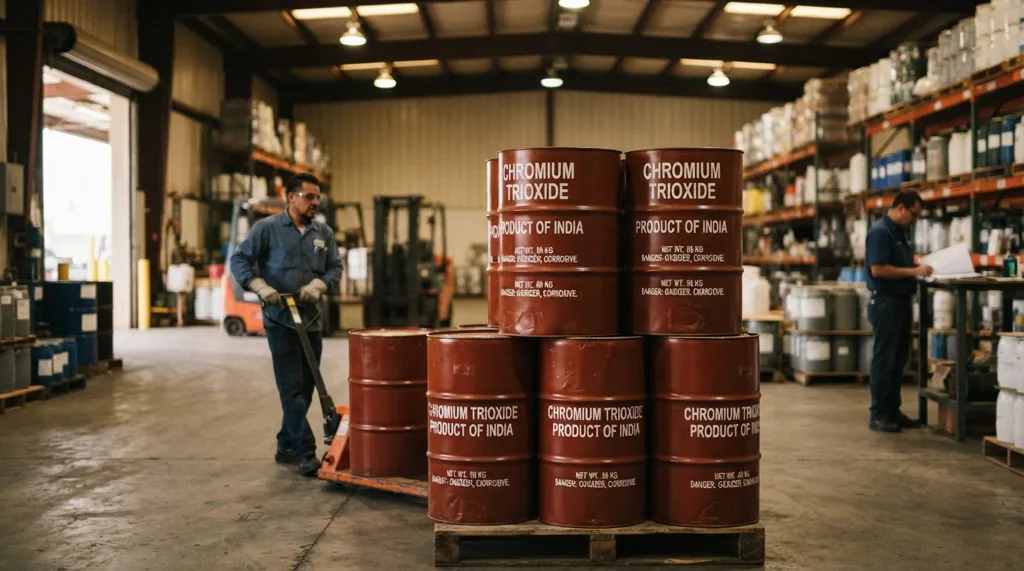
United States Commerce Department set a final countervailing duty rate of 29.35% on chromium trioxide from India, applicable from Oct. 8, 2026.
The U.S. Department of Commerce has found that chromium trioxide from India is subsidised and set a final countervailing duty rate of 29.35% for all Indian producers and exporters, in a notice applicable from Oct. 8, 20261.
The decision raises the rate sharply from the 2.44% that Commerce set in its preliminary finding in May2. The duty will only be collected if a second U.S. agency, the International Trade Commission, finds that the imports harm American producers1.
In short, Indian chromium trioxide shipped to the United States faces an extra 29.35% import charge if the trade commission agrees the imports cause harm. For now, no deposit for this subsidy duty is being taken at the border, but a separate anti-dumping case on the same goods is still running.
What did Commerce decide on Indian chromium trioxide?
Commerce published its final countervailing duty determination in the Federal Register on Oct. 8, 20261. A countervailing duty is an extra import tax that cancels out the help a foreign government gives its own producers. Commerce found that such help, called countervailable subsidies, went to producers and exporters of chromium trioxide in India1.
The investigation looked at subsidies during calendar year 2024, from Jan. 1 to Dec. 31, 20241. The notice was signed on Oct. 5, 2026, by Scot Fullerton, Commerce’s acting deputy assistant secretary for anti-dumping and countervailing duty operations1.
Commerce examined one company in detail: Vishnu Chemicals Ltd.1. Its staff checked the information from the company and from the Government of India on site in July 20261. They examined sales and accounting records and original documents1.
How high is the new duty rate?
The final rate is 29.35% of the value of the goods for Vishnu Chemicals Limited1. The same 29.35% applies to all other Indian producers and exporters1. This is an ad valorem rate, which means it is a percentage of the price declared to customs.
Subsidy duty rate on Indian chromium trioxide, %
The rate for all other companies comes from a simple rule in U.S. trade law. When only one company is examined, and its rate is not zero, tiny, or based only on substitute data, that rate applies to everyone else1. Vishnu Chemicals was the only company examined, so its rate became the rate for all1.
In the preliminary decision of May 14, 2026, both rates were 2.44%2. Commerce said it changed its subsidy calculations for Vishnu Chemicals and for all other producers after verification and comments from the parties1. The full reasons are set out in a separate Issues and Decision Memorandum1.
Why did the rate rise so much?
Commerce said that one or more respondents did not do their best to answer its requests for information1. In those cases, it used adverse facts available, which means it filled the gaps with information that works against the company1. Commerce also said it relied in part on facts available when making the final decision1.
The list of issues in the memorandum shows where the arguments lay. Points raised by the parties included:
- Errors in reporting related companies that Commerce found during verification, and whether to punish them for the whole case.
- An unreported loan programme discovered during verification.
- Coal supplied at a low price, described as coal "for less than adequate remuneration", and how to measure its benefit.
- Two Indian export programmes, the Advance Authorization Scheme and the Remission of Duties and Taxes on Export Products (RoDTEP).
- A coal cess refund and the ocean freight price used as a benchmark.
These topics are listed in an appendix to the final notice1. Comments 1 to 14 in that list cover these and other questions, such as whether benefits to a related firm, Vishnu Barium Private Limited, should count toward the Vishnu Chemicals rate1. The notice does not say in its own text how each question was decided.
Which goods does the duty cover?
The duty covers chromium trioxide in any form, dry or in solution1. It is an inorganic chemical with the formula CrO3 in dry form and H2CrO4 in solution1. Its main registry number is CAS 1333-82-01.
What the chromium trioxide case covers
| Point | Rule |
|---|---|
| Product | Chromium trioxide, dry or solution, CAS 1333-82-0 |
| Tariff code | HTSUS 2819.10.0000 |
| Blends | Covered at 90% or more chromium trioxide |
| Third-country processing | Still covered after blending, dissolving or repacking |
| Deciding test | The written description, not the code |
The dry form is often called chromic acid, and so is the solution1. Other names include chromic anhydride, chromium (VI) oxide and chromia1. It usually arrives in the United States as pellets, flakes, powder or beads1.
Purity, particle size and shape do not matter: all chromium trioxide is covered1. Some blends are also covered:
- Blends with 90% or more chromium trioxide by formula weight, such as the chemical mixed with a catalyst for metal finishing, are covered. Only the chromium trioxide in the blend counts1.
- Goods processed in a third country, for example dissolved in water, blended, flaked or repacked, still count as Indian goods under the case1.
The goods enter under U.S. tariff code HTSUS 2819.10.00001. Import papers may also show CAS numbers 12324-05-9, 12324-08-2 and 1362947-20-31. The written description of the product, not the code, decides what is covered1.
What happens at the border now?
After the May preliminary decision, Commerce told U.S. Customs and Border Protection (CBP) to collect cash deposits on the goods1. A cash deposit is money the importer pays at entry as a guarantee against the final duty. CBP also suspended liquidation, which means it held off on closing the customs accounts for these entries1.
Subsidy deposits on chromium trioxide
That covered goods entered for consumption on or after May 14, 20261. Provisional measures in a countervailing case only last for a limited time. Commerce therefore told CBP to stop suspending liquidation for entries made on or after Sept. 11, 20261. Entries made between May 14 and Sept. 10, 2026, stay suspended1.
So, in practice, shipments entering now do not pay a countervailing duty deposit. That changes only if the trade commission rules that the imports cause harm. In that case Commerce will issue a countervailing duty order, restart the suspension and require cash deposits at the new 29.35% rate1.
How does the anti-dumping case affect the same goods?
Commerce also ran a separate case on the same goods for dumping, which means selling abroad below the normal price at home. On Oct. 8, 2026, it published a final finding that Indian chromium trioxide is being sold in the United States at less than fair value3. That case covered sales from July 1, 2024, to June 30, 20253.
The final dumping margin is 14.44% for Vishnu Chemicals and for all other exporters3. Commerce based the Vishnu Chemicals margin on adverse facts available, and took the all-others margin from the only margin alleged in the petition3. CBP keeps suspending liquidation for those goods entered on or after May 22, 20263.
The two cases are linked. Commerce normally lowers the dumping deposit by the export subsidies already counted in the subsidy case3. The adjusted dumping deposit rate is 11.82%3. However, because the subsidy suspension has stopped, Commerce is not yet collecting deposits at that lower rate3. If the trade commission finds harm from both dumping and subsidies, the adjusted rate applies from the day its decision is published3.
Who brought the case and who is affected?
The petitioner, the party that asked for the case, is American Chrome & Chemical, Inc.2. Commerce opened the subsidy investigation on Jan. 5, 20262. It postponed the preliminary decision on Feb. 13, 20262. It later lined up the final subsidy decision with the final dumping decision at the petitioner’s request2.
The change reaches several groups:
- U.S. importers of the chemical would pay both the subsidy deposit and the dumping deposit if orders are issued.
- Vishnu Chemicals and other Indian exporters face the same 29.35% subsidy rate, so no Indian supplier has a lower rate.
- Buyers in metal finishing use the chemical, according to the scope, and depend on these imports1.
Traders who move the chemical through another country do not avoid the duty. The scope keeps Indian chromium trioxide covered after blending, dissolving or repacking abroad1.
When will the trade commission decide on chromium trioxide?
The International Trade Commission must now decide whether the U.S. industry is harmed or threatened with harm1. It must do so no later than 45 days after Commerce’s final decision1. If it finds no harm, the case ends and all deposits are refunded or cancelled1.
The commission is also looking at chromium trioxide from Turkey in the same proceeding4. Its revised schedule held a public hearing on Sept. 29, 20264. Final briefs after the hearing were due Oct. 7, 20264. The commission will release its final information on Oct. 26, 2026, and final party comments are due on Oct. 28, 20264.
Commerce plans to share its calculations with the parties within five days of the announcement1. If the commission finds harm, Commerce will issue the duty order and CBP will collect duties on goods entered from the start of the suspension1.
Key points on the chromium trioxide subsidy duty
The table sums up the final decision.
| Question | Answer |
|---|---|
| What changed? | Final subsidy finding on chromium trioxide |
| Who issued it? | U.S. Department of Commerce |
| Which country? | India |
| Which goods? | Chromium trioxide, dry or solution |
| Tariff code | HTSUS 2819.10.0000 |
| Final subsidy rate | 29.35% for all exporters |
| Preliminary rate | 2.44% |
| Dumping margin | 14.44%, adjusted deposit 11.82% |
| Company examined | Vishnu Chemicals Limited |
| Applicable from | Oct. 8, 2026 |
| Deposits stopped for entries from | Sept. 11, 2026 |
| Next step | Trade commission harm decision |
The next decision belongs to the International Trade Commission, which must rule within 45 days of Commerce’s final finding1. If it finds harm, Indian chromium trioxide will face a 29.35% subsidy deposit on top of the dumping deposit at the U.S. border1.
Sources
- ↩ Federal Register :: Chromium Trioxide From India: Final Affirmative Countervailing Duty Determination https://www.federalregister.gov/documents/2026/10/08/2026-20696/chromium-trioxide-from-india-final-affirmative-countervailing-duty-determination
- ↩ Federal Register :: Chromium Trioxide From India: Preliminary Affirmative Countervailing Duty Determination, and Alignment of Final Determination With Final Antidumping Duty Determination https://www.federalregister.gov/documents/2026/05/14/2026-09690/chromium-trioxide-from-india-preliminary-affirmative-countervailing-duty-determination-and-alignment
- ↩ Federal Register :: Chromium Trioxide From India: Final Affirmative Determination of Sales at Less Than Fair Value https://www.federalregister.gov/documents/2026/10/08/2026-20695/chromium-trioxide-from-india-final-affirmative-determination-of-sales-at-less-than-fair-value
- ↩ Federal Register :: Chromium Trioxide From India and Turkey; Revised Schedule for the Subject Investigations https://www.federalregister.gov/documents/2026/06/23/2026-12532/chromium-trioxide-from-india-and-turkey-revised-schedule-for-the-subject-investigations