
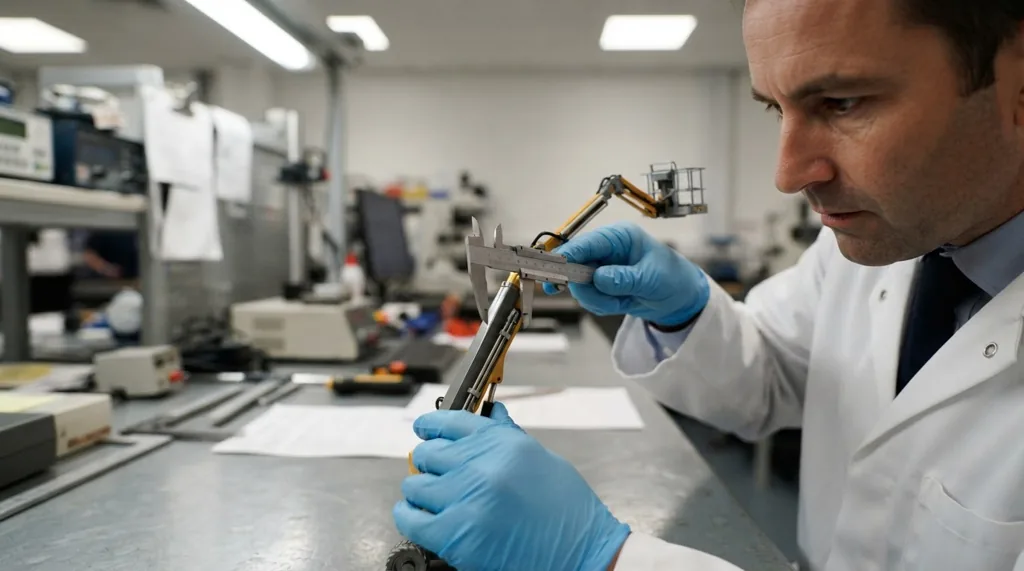
United Kingdom’s Trade Remedies Authority on Oct. 5, 2026 proposed five-year anti-dumping duties of 21.01% to 82.89% on boom lifts from China, with comments due by Oct. 20, 2026.
The UK Trade Remedies Authority said on Oct. 5, 2026 that it intends to recommend five-year anti-dumping duties of 21.01% to 82.89% on boom lifts from China1.
Boom lifts, also called cherry pickers, are machines that lift people, equipment or materials to work at height2. They are used in construction, maintenance and installation work across the UK2.
In short, Chinese boom lifts already pay a temporary duty at the UK border, and the authority now proposes final rates for the next five years. Shipments from most named Chinese makers would pay between 21.01% and 48.92%, while unnamed exporters would pay 82.89%1.
What did the Trade Remedies Authority announce on boom lifts?
The Trade Remedies Authority (TRA) is the independent UK body that checks whether imports are unfairly priced or surging2. It published its Statement of Essential Facts on Oct. 5, 20261. This document sets out the intended final determination, which is the decision the TRA plans to make, and the facts behind it.
The TRA found that boom lifts from China are being dumped in the UK1. Anti-dumping duty is an extra import tax on goods sold abroad below their normal price, meaning the price for the same goods in the exporter’s home market2. The TRA also found that this dumping has caused or is causing injury to UK producers1.
The TRA intends to recommend an ad valorem duty, a duty charged as a share of the value of the goods, for five years1. The final decision rests with the Secretary of State for Business, Innovation, Science and Trade2.
What rates does the TRA propose for each exporter?
The proposed rates differ by company. The TRA examined two large Chinese exporters in detail and set a separate rate for each1. Other exporters that took part in the case get an average rate, and all remaining exporters get the highest rate.
Proposed final anti-dumping duty, %
The proposed final rates are1:
- Zhejiang Dingli Machinery Co Ltd: 21.01%
- Lingong Heavy Machinery Co Ltd: 48.92%
- Non-sampled cooperating exporters and producers: 27.67%
- All other Chinese exporters: 82.89%
The 82.89% rate is the "residual" rate. It applies to any Chinese exporter without its own rate1. These are still proposals, and the TRA may change them after it reads new comments.
How do the proposed rates compare with the temporary duty?
The UK already charges a temporary duty on these goods. The government imposed provisional anti-dumping duties from Aug. 20, 2026, following a TRA recommendation2. The provisional rates ranged from 16.25% to 71.74%3.
Provisional and proposed final rates
| Exporter | Provisional, from Aug. 20, 2026 | Proposed final |
|---|---|---|
| Zhejiang Dingli | 16.25% | 21.01% |
| Lingong Heavy Machinery | 64.25% | 48.92% |
| Cooperating producers | 28.12% | 27.67% |
| All other exporters | 71.74% | 82.89% |
Under the provisional notice, Zhejiang Dingli paid 16.25%, Lingong Heavy Machinery paid 64.25%, and other cooperating producers paid 28.12%3. All other exporters paid 71.74%3.
The proposed final rates move in both directions. Zhejiang Dingli’s rate would rise from 16.25% to 21.01%, while Lingong’s would fall from 64.25% to 48.92%1. The rate for cooperating producers would fall slightly, from 28.12% to 27.67%. The residual rate would rise from 71.74% to 82.89%.
How does the temporary guarantee work?
During the provisional period, importers do not simply pay the duty. They must give a guarantee to cover the estimated duty, in the form of a bank guarantee, a bond or cash3. The guarantee is worked out by applying the provisional rate to the customs value of the goods3.
The guaranteed amount only becomes payable if final duties are imposed3. If the final rate is lower than the provisional rate, HM Revenue and Customs (HMRC), the UK tax and customs authority, collects only the final amount3. If the final rate is higher, HMRC collects only the amount secured under the provisional duty3.
This matters for the proposed rates. For Zhejiang Dingli and the residual group, the proposed final rate is higher than the provisional one. For past shipments under the guarantee, the notice caps collection at the provisional amount3.
If no final measure is imposed, HMRC returns bank guarantee documents or repays bonds and cash deposits through its usual channels3. The provisional duty lasts up to 6 months or until a final measure starts, whichever comes first3.
Which boom lifts and parts are covered?
The case covers boom lifts built to lift people, equipment or materials, with a maximum working height of 6 metres or more1. It also covers pre-assembled or ready-to-assemble sections of these machines1.
Single components shipped on their own are excluded. However, these main sections stay covered, whether shipped alone or together3:
- booms, including articulated, telescopic or straight booms, with or without jibs
- chassis
- boom turrets or turntables
- platforms or baskets
Sub-assemblies of each of these sections are covered too, assembled or not3. The provisional notice lists 15 UK Global Tariff commodity codes under headings 8427, 8428 and 8431, such as 8427 1010 10 and 8431 3900 903. Goods under these codes that do not match the goods description are excluded and enter at 0% with additional code 8C023.
Which Chinese companies are named in the boom lift case?
The TRA examined a sample of the largest exporters because many companies registered1. The sampled exporters were Zhejiang Dingli Machinery Co., Ltd and Lingong Heavy Machinery Co., Ltd1. The sampled importers were their UK arms, Zhejiang Dingli Machinery UK Limited and LGMG Machinery U.K. Limited1.
The provisional notice gave the cooperating-producer rate to 13 other Chinese makers, each with its own additional code3. They include Sunward Intelligent Equipment, Oshkosh JLG (Tianjin), Terex (Changzhou), Zoomlion Intelligent Access Machinery, Hunan Sinoboom, XCMG Group and Haulotte Access Equipment Manufacturing (Changzhou)3. The Statement of Essential Facts lists its own set of cooperating producers in an annex1.
To get a company rate, the importer must show HMRC a valid commercial invoice with a signed declaration3. An official of the company issuing the invoice must sign it and certify who produced the goods3. Without the invoice and declaration, the residual rate applies3.
Why did the UK act on Chinese boom lifts?
The case started with a complaint from Niftylift Limited, a UK maker of boom lifts based in Milton Keynes4. Niftylift filed its application on Sept. 30, 2025, and the TRA opened the investigation on Dec. 19, 20251.
The TRA looked at import volumes, production costs, prices and injury factors2. It found that Chinese boom lifts undercut UK prices by more than 25%2. The period of investigation ran from Oct. 1, 2024 to Sept. 30, 20252. The TRA studied injury to UK industry from Oct. 1, 2021 to Sept. 30, 20252.
The TRA identified two UK producers: Niftylift and Snorkel Europe Limited1. It also ran an Economic Interest Test, which weighs the gains and costs of a duty for the wider UK economy2. It concluded that the duty is in the UK’s economic interest2.
Who is affected by the proposed boom lift duties?
UK importers that buy Chinese boom lifts would pay the final duty on new shipments for five years1. For goods from exporters on the residual rate, that means an extra charge of 82.89% of the customs value1.
Chinese makers face different costs depending on their rate. Lingong Heavy Machinery would face a lower rate than now, while Zhejiang Dingli would face a higher one1. UK producers such as Niftylift would face less low-priced competition from China.
Customs brokers must enter the right additional code for each producer on import declarations3. A wrong code or missing declaration means the shipment pays the residual rate3.
What happens next for the boom lift duties?
Interested parties can comment on the Statement of Essential Facts until 23:59 BST on Oct. 20, 20261. Registered parties file through the Trade Remedies Service online platform, and others can send comments by email1.
Boom lift case dates
The TRA may then weigh any new evidence before it makes its final recommendation to the Secretary of State2. Final rates could still change. The provisional duties, which started on Aug. 20, 2026, last until a final measure starts or for at most 6 months3.
Key points on UK boom lift anti-dumping duties
The table below sums up the main facts of the case.
| Question | Answer |
|---|---|
| What changed? | TRA proposed final anti-dumping duties |
| Who issued it? | UK Trade Remedies Authority |
| Which goods? | Boom lifts from China, 6 metres or more |
| Highest proposed rate | 82.89% for all other exporters |
| Zhejiang Dingli rate | 21.01% |
| Lingong Heavy Machinery rate | 48.92% |
| Cooperating producers rate | 27.67% |
| How long? | Five years |
| Provisional duty since | Aug. 20, 2026 |
| Proof for a company rate | Commercial invoice with signed declaration |
| Comment deadline | Oct. 20, 2026 |
| Who decides? | Business and Trade Secretary of State |
The next date is Oct. 20, 2026, when comments on the proposal close1. After that, the TRA sends its final recommendation, and the provisional duties stay in place until a final measure starts3.
Sources
- ↩ CD-01724_AD0075-Statement of essential facts (SEF).pdf https://afd-2xllir3jmyeq6-d9fkagedfdg4aabu.a02.azurefd.net/content/CD-01724_AD0075-Statement%20of%20essential%20facts%20%28SEF%29.pdf
- ↩ TRA proposes new anti-dumping measure on boom lifts from China – GOV.UK https://www.gov.uk/government/news/tra-proposes-new-anti-dumping-measure-on-boom-lifts-from-china
- ↩ Trade remedies notice 2026/23: provisional anti-dumping duty on boom lifts originating from China – GOV.UK https://www.gov.uk/government/publications/trade-remedies-notices-boom-lifts-originating-from-china–2/trade-remedies-notice-202623-provisional-anti-dumping-duty-on-boom-lifts-originating-from-china–2
- ↩ TRA imposes anti-dumping duties on boom lifts from China – GOV.UK https://www.gov.uk/government/news/tra-imposes-anti-dumping-duties-on-boom-lifts-from-china