
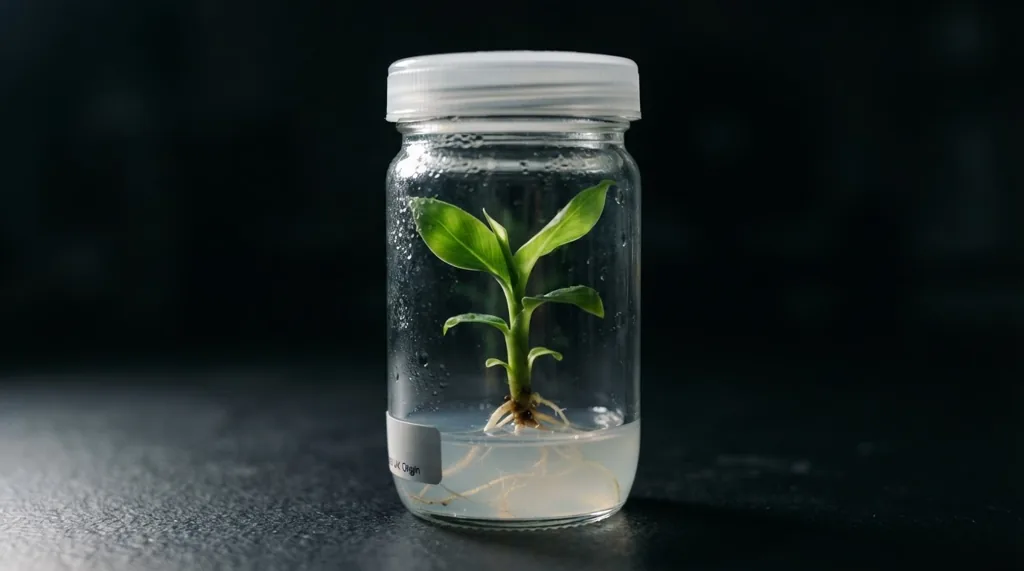
Colombia has established phytosanitary requirements for the importation of in vitro and ex-agar Musa acuminata plants from the United Kingdom for commercial, testing, and planting purposes, covering products classified under HS code 060220.
Colombia’s farm and plant-health agency, the Instituto Colombiano Agropecuario (ICA), on Sept. 23, 2026 set the plant-health rules for importing young banana plants grown in laboratories in the United Kingdom, with the rules taking effect once they appear in Colombia’s official gazette1.
The measure is ICA Resolution 00018773 of Sept. 23, 20261. It covers banana plants of the species Musa acuminata that are grown "in vitro" or "ex agar" and are shipped for commercial use, trials or planting2.
In short, Colombia now has a written list of conditions for these UK banana plantlets. Each shipment must carry a UK plant-health certificate that confirms lab tests for a banana virus and confirms the UK is free of a serious banana fungus, and ICA will inspect, sample and follow up the plants after they arrive1.
Which banana plants does the ICA resolution cover?
The resolution applies to banana plants of the species Musa acuminata1. It covers two forms of young plant: "in vitro" plants and "ex agar" plants1.
"In vitro" means grown in a laboratory container. "Ex agar" means a lab-grown plantlet that has been taken out of its growth gel. Both are young plants made in a lab, not fruit.
The plants must be of UK origin and shipped from the UK1. The Spanish text says "de origen y procedencia Reino Unido", which means both where the plants come from and where they are sent from1. The rules cover commercial use, trials and planting1.
The resolution applies to every person or company that imports these plants into Colombia, whether an individual or a business1. It does not name any company or give a quantity limit.
Why did Colombia’s ICA act?
The resolution says ICA’s job is to protect the health of farming in Colombia1. Its stated aim is to stop pests and diseases that could harm the country’s animals and plants from entering and spreading1.
ICA says it must carry out risk studies and other technical work to decide the right level of protection1. Those studies then set the plant-health conditions for each farm product that enters Colombia1. A 2023 ICA resolution, Resolution 8389, sets out how a party asks ICA for such a pest and disease risk study1.
The resolution also explains the role of the plant-health certificate. It says the national plant-protection agency of the exporting country must issue this certificate1. The certificate confirms that the plants were inspected or tested under official procedures and are considered free of the named quarantine pests1. Quarantine pests are pests that a country keeps out because they could cause serious harm there.
What must the UK plant-health certificate say?
The core of the resolution is in Article 3. The UK plant-health certificate must carry an additional declaration, which is an extra statement the exporting country’s officials write on the certificate1. The declaration has two parts:
- Banana bunchy top virus test. The shipment was found free of Banana Bunchy Top Virus (Babuvirus musae) using molecular biology tests, which are lab tests that look for the virus’s genetic material1. The test results must be attached to every shipment1.
- Free of Tropical Race 4. The shipment comes from a country free of Fusarium oxysporum f.sp. cubense Tropical Race 4, known as FOC R4T1. This is a fungus that attacks banana plants.
Papers each banana plantlet shipment needs
The second condition is about the country, not the single shipment. The certificate must state that the UK as a whole is free of this fungus1.
For an exporter, this means the lab work must be done before the plants leave. A shipment that arrives without the test results attached does not meet Article 31.
What rules apply to packing and labels?
The resolution adds rules on the packing itself. Shipments must use new packaging or containers1. Used boxes or trays are not allowed under this rule.
The packaging must also be marked with the plant’s botanical name, giving genus and species1. For these plants, that is Musa acuminata. The label lets inspectors at the border check quickly that the goods match the certificate.
What does the importer in Colombia have to do?
The importer must tell ICA whether the plants are a living modified organism, often called a genetically modified plant1. If the plants are modified, they must also meet Colombia’s current rules for such organisms1. The resolution does not list those other rules.
From the UK lab to the Colombian field
When the plants arrive, three more steps follow1:
- ICA carries out a plant-health inspection at the point of entry.
- ICA takes samples at the point of entry and sends them to its plant quarantine station.
- ICA follows up after entry at the places where the plants are grown.
The last step means ICA’s checks do not stop at the border. ICA staff will check the planting sites after the plants are in the ground1.
What powers do ICA inspectors have?
Article 4 gives ICA staff the status of sanitary police inspectors when they inspect, watch over and control these imports1. Civil and military authorities must support and protect them in this work, under Article 65 of Law 101 of 19931.
Every official control visit must be recorded in a written report, on paper or in digital form1. The parties present must sign it, and a copy stays at the site1.
Breaking any rule in the resolution can lead to penalties under Articles 156 and 157 of Law 1955 of 20191. These penalties apply without prejudice to any civil or criminal action1.
How did the rules move from draft to final?
ICA’s imports committee met on May 27, 2026 and agreed the requirements for these UK banana plantlets1. The committee, created by ICA Resolution 13633 of 2023, advises and decides on import requirements1.
Draft and final resolution
| Question | Draft | Final |
|---|---|---|
| Signed and dated? | No | Yes, Sept. 23, 2026 |
| SUCOP consultation | Will be held | Has been held |
| Article 3 requirements | Seven | Same seven |
ICA first published a draft resolution with the same title and the same seven requirements3. The draft was unsigned and undated3. It said that a national public consultation "will be" held on SUCOP, the online consultation platform of Colombia’s National Planning Department3.
The final text says the consultation has been held1. It also says that, because the rule affects international trade, it was to be notified through Colombia’s contact points at the World Trade Organization (WTO), CAN and the G3, so that others could comment1. The WTO’s member site carries the final resolution as part of Colombia’s notifications2.
ICA also filled in a competition review form under Decree 2897 of 20101. It found the rule does not affect free competition, so it did not send it to the Superintendence of Industry and Commerce, Colombia’s competition authority1.
The seven requirements in Article 3 of the draft match those of the final text word for word3. The main changes are the signature, the date and the completed consultation.
When do Colombia’s banana plantlet rules start?
The resolution was signed in Bogotá on Sept. 23, 2026 by Linda Luz Barbosa Díaz, acting head of ICA’s sanitary and plant-health regulation office1. Under Article 6, it takes effect from the date it is published in the Diario Oficial, Colombia’s official gazette1.
The dates so far
The resolution itself does not give the gazette date. It sets no transition period and no separate deadline for shipments already on the way1.
For UK labs and nurseries, the change is clear. They now have a fixed list of conditions for sending banana plantlets to Colombia, and each shipment must meet all of them1.
Key points on Colombia’s UK banana plantlet rules
The table sums up the resolution.
| Question | Answer |
|---|---|
| Who issued it? | ICA, Colombia’s farm and plant-health agency |
| What is it? | Resolution 00018773 of Sept. 23, 2026 |
| Which goods? | In vitro and ex agar Musa acuminata plants |
| From where? | Grown in and shipped from the UK |
| For what use? | Commercial use, trials or planting |
| Certificate statement 1 | Lab tests show no banana bunchy top virus |
| Certificate statement 2 | UK free of FOC Tropical Race 4 |
| Packing | New packaging, marked with botanical name |
| Importer duty | Say if plants are genetically modified |
| Checks in Colombia | Inspection, sampling, follow-up at planting sites |
| Penalties | Articles 156 and 157 of Law 1955 of 2019 |
| Start date | Publication in the Diario Oficial |
The next step is the resolution’s publication in the Diario Oficial, which brings it into force1. From then on, every UK banana plantlet shipment to Colombia must carry the virus test results with its plant-health certificate and pass ICA’s checks at entry and after planting1.
Sources
- ↩ 2026R00018773.aspx https://www.ica.gov.co/getattachment/53eff7b4-ee13-404c-a79a-1e7d8c84edf8/2026R00018773.aspx
- ↩ 26_05059_00_s.pdf https://members.wto.org/crnattachments/2026/SPS/COL/26_05059_00_s.pdf
- ↩ 26_03446_00_s.pdf https://members.wto.org/crnattachments/2026/SPS/COL/26_03446_00_s.pdf