
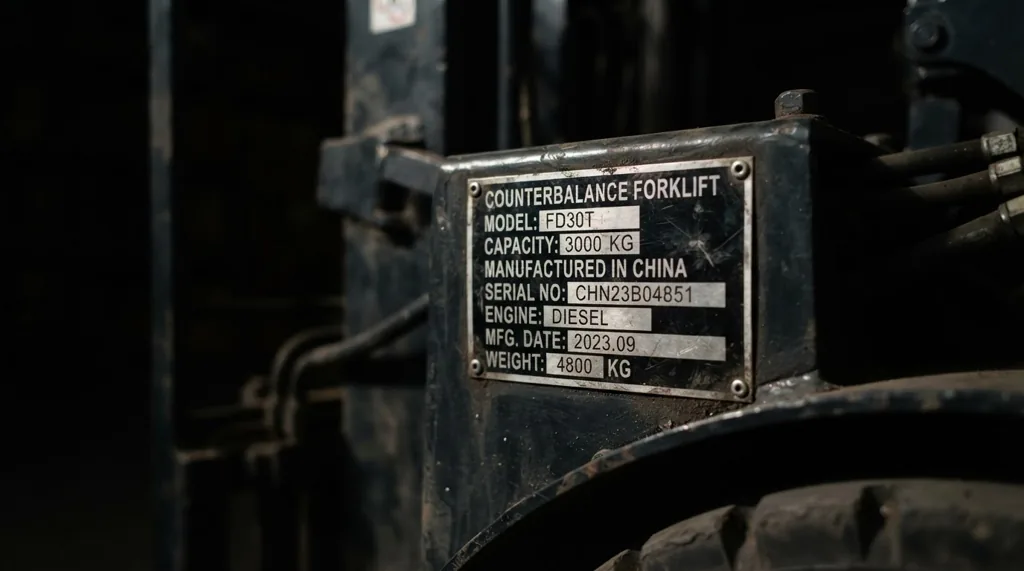
India opened an anti-dumping investigation on Sept. 30, 2026 into counterbalance forklifts up to 16 tonnes from China and Japan, which could lead to extra import duties.
India’s Directorate General of Trade Remedies (DGTR) opened an anti-dumping investigation on Sept. 30, 2026 into imports of counterbalance forklifts of up to 16 tonnes from China and Japan1.
The case follows a complaint by Godrej & Boyce Mfg. Co. Ltd., an Indian forklift maker1. It is listed on the DGTR website as an ongoing original investigation, listed alongside cases on persulphates, caprolactam and clavulanic acid2.
In short, India is checking whether Chinese and Japanese forklifts are sold in India below a fair price and are hurting Indian makers. No new duty applies yet, but the investigation could end with extra import taxes on these forklifts from both countries.
What has DGTR started on forklifts?
DGTR is the trade-defence office of India’s Ministry of Commerce & Industry. Its head, called the Designated Authority, signed the initiation notification under file number 6/60/2026-DGTR1. The case has the online case number SETU Case ID AD/OI/061/20263.
An anti-dumping duty is an extra import tax on goods sold abroad below their normal price. Before India can charge one, DGTR must investigate. It must find that the goods are dumped, that local makers are hurt, and that the dumping causes the harm.
The notification says DGTR will find out whether dumping exists, how large it is and what effect it has1. It will then recommend a duty amount that would be enough to remove the harm to Indian makers1. The notice does not set any rate. That comes only at the end of the case.
The legal basis is Section 9A of the Customs Tariff Act, 1975, read with Rule 5 of India’s Anti-Dumping Rules of 19951. The investigation will follow the procedure in Rule 6 of those rules1.
Which forklifts are covered?
The case covers counterbalance forklifts up to 16 tonnes that a driver rides and operates1. Both diesel and electric models are included, in Class I, IV and V1.
A counterbalance forklift carries a heavy weight at the back. This counterweight balances the load lifted on the forks at the front. The truck can then lift without side legs or other support1. The notice describes these machines as used to lift, carry and stack loads in factories, warehouses and logistics sites1.
The forklifts are covered in all forms in which they arrive1. These include:
- Completely Built Units (CBU), meaning finished forklifts.
- Semi Knocked Down kits (SKD), meaning partly assembled forklifts.
- Completely Knocked Down kits (CKD), meaning forklifts shipped in pieces for assembly in India.
So an importer cannot avoid the case by shipping a forklift as a kit. The unit of measure in the case is the number of pieces1.
Which forklift goods are left out?
Two groups of goods are outside the case. Standalone parts and components of counterbalance forklifts are excluded1. Spare parts shipped on their own are therefore not under investigation.
What the forklift case does not cover
Counterbalanced stackers are also excluded1. These are machines that a worker walks behind or stands on, with no seat for the operator1. Only rider-operated forklifts are in the case.
Which customs codes apply to forklift shipments?
The forklifts fall under tariff heading 8427 of India’s Customs Tariff1. They enter India under three codes: 84271000, 84272000 and 842790001.
How DGTR groups forklifts for price checks
| Question | Electric forklifts | Diesel forklifts |
|---|---|---|
| Capacity bands | Four | Six |
| Smallest band | Up to 2 tonnes | Up to 3 tonnes |
| Largest band | More than 5 up to 16 tonnes | More than 12 up to 16 tonnes |
| Grouped by battery or wheels? | Yes | No |
The notice says these codes are a guide only1. They do not decide what is covered. The product description decides. A forklift that matches the description is in the case under any code, and a part under one of these codes is not.
DGTR has also proposed product control numbers, or PCNs1. These are codes that sort forklifts into groups of similar models. They let DGTR compare like with like when it checks prices.
For electric forklifts, the groups depend on three things1:
- Wheel type: three-wheel, four-wheel or articulated.
- Battery type: lead acid, or other advanced batteries including lithium-ion.
- Lifting capacity: four bands, from up to 2 tonnes to more than 5 and up to 16 tonnes.
For diesel forklifts, the groups depend only on lifting capacity, in six bands1. They run from up to 3 tonnes to more than 12 and up to 16 tonnes1.
Why did India open the forklift case?
Godrej & Boyce says dumped imports from China and Japan are causing material injury, meaning serious harm, to its business1. It asked for both provisional and final anti-dumping duties1. The company told DGTR that imports from the two countries grew1. They rose in total and as a share of Indian demand over the period checked1. It also said the price of imports after landing in India was below its own selling price1.
According to the notice, the company’s costs rose but its selling prices did not rise to match1. It said its market share stayed flat while demand grew1. It also reported lower use of its factories, losses, cash losses and a negative return on its capital1. It said these losses grew worse in the latest year1.
DGTR found enough first evidence of harm to open the case1. It also found first evidence of a link between the low prices and the harm1. This is not a final finding.
How did DGTR check prices from China and Japan?
To find dumping, DGTR compares two prices. The normal value is a fair price for the goods. The export price is what Indian buyers pay. If the export price is lower, the gap is the dumping margin.
For China, Godrej & Boyce asked DGTR to treat the country as a non-market economy1. In that case, Chinese prices at home are not used unless Chinese producers prove that market conditions apply1. For opening the case, DGTR built China’s normal value from the Indian applicant’s costs, plus overheads and a reasonable profit1.
For Japan, the applicant said it could not find Japanese home prices or costs in public sources1. DGTR therefore also built Japan’s normal value from the Indian industry’s costs, plus overheads and a reasonable profit1.
The export price came from import data from DG Systems1. DGTR started from the price including freight and insurance. It then took off sea freight, insurance, port costs, inland freight, handling and bank charges1.
The comparison showed a dumping margin above the minimum level for both countries1. The notice gives no figure for the margin.
Who is the Indian industry in the forklift case?
Godrej & Boyce says it makes about 60-70% of eligible Indian production of these forklifts1. That is above the 25% share of Indian output that the rules require to bring a case1.
The notice names three other Indian producers1:
- KION India Private Limited
- Action Construction Equipment Limited
- Josts Engineering Company Limited
The applicant left KION India out of the eligible production1. It said KION India imported the goods from the two countries and is related to producers or exporters there1. DGTR noted that the applicant’s share is still above 25% even if the other producers are counted1.
Godrej & Boyce itself imported small numbers of forklifts from China during the period checked1. It said most of these went into its rental fleet for testing1. DGTR accepted the company as an eligible domestic producer1.
Which period will the forklift investigation examine?
The main period for checking dumping is April 1, 2025 to March 31, 20261. That is 12 months.
To judge harm, DGTR will look at a longer stretch. This covers three earlier years from April 1, 2022 to March 31, 2025, plus the main period1. Shipments in these years form the record. Shipments made now do not change the period checked.
Who must act, and by when?
DGTR is sending notice of the case directly to known producers and exporters in China and Japan1. It is also informing the two governments through their embassies in India, and known Indian importers and users1.
Time limits in the forklift case, days
Every party that wants a say must register on the SETU portal, DGTR’s online case system1. All papers must go through that portal under the case number1. DGTR may ignore papers sent by email or other means1.
The deadlines in the notice run as follows1:
- 37 days to file questionnaire answers and other papers. The clock starts when DGTR shares the public version of the complaint.
- 15 days to comment on which goods are covered and on the PCN groups. This runs at the same time as the 37 days.
- 7 days to comment on what the applicant has kept secret in its complaint.
- 3 days before a deadline, at the latest, to ask for more time.
If DGTR later changes the goods covered or the PCN groups, parties get 15 more days1. Further extensions are given only in exceptional cases1.
Each confidential paper must come with a public version1. Pages must be marked "confidential" or "non-confidential"1. A paper without a mark is treated as public1.
What happens to forklift exporters who do not reply?
A party that does not supply information in time may be declared non-cooperative1. DGTR can then decide on the facts it already has1. For an exporter, that means a decision made without its own figures.
Chinese and Japanese makers and Indian importers can see each other’s public papers through their SETU logins1. DGTR will post later steps on its website. These include hearings, disclosure of its findings, any changes and the final finding1.
Key points on India’s forklift anti-dumping case
The table sums up the case as the notice sets it out.
| Question | Answer |
|---|---|
| What happened? | Anti-dumping investigation opened |
| Who issued it? | DGTR, Ministry of Commerce & Industry |
| Date of notice | Sept. 30, 2026 |
| Which goods? | Rider-operated counterbalance forklifts up to 16 tonnes |
| Which forms? | Built units, SKD and CKD kits |
| What is excluded? | Standalone parts; counterbalanced stackers |
| Which countries? | China and Japan |
| Customs codes | 84271000, 84272000, 84279000 |
| Who complained? | Godrej & Boyce Mfg. Co. Ltd. |
| Period checked | April 1, 2025 to March 31, 2026 |
| Duty rate now | None set yet |
| Main deadline | 37 days to file papers on SETU |
For now, forklifts from China and Japan clear Indian customs with no new duty. The next dates are the 15-day and 37-day filing windows, which start when DGTR shares the complaint with the parties1.
Sources
- ↩ Forklift Eng NOI.pdf https://dgtr.gov.in/sites/default/files/2026-10/Forklift%20Eng%20NOI.pdf
- ↩ Anti-Dumping Investigations in India | Directorate General of Trade Remedies, MOCI, GOI https://www.dgtr.gov.in/en/anti-dumping-investigation-in-india
- ↩ Initiation of Anti-dumping investigation concerning imports of “Certain Counterbalance Forklifts” originating in or exported from China PR and Japan | Directorate General of Trade Remedies, MOCI, GOI https://www.dgtr.gov.in/en/anti-dumping-cases/initiation-anti-dumping-investigation-concerning-imports-certain-counterbalance