
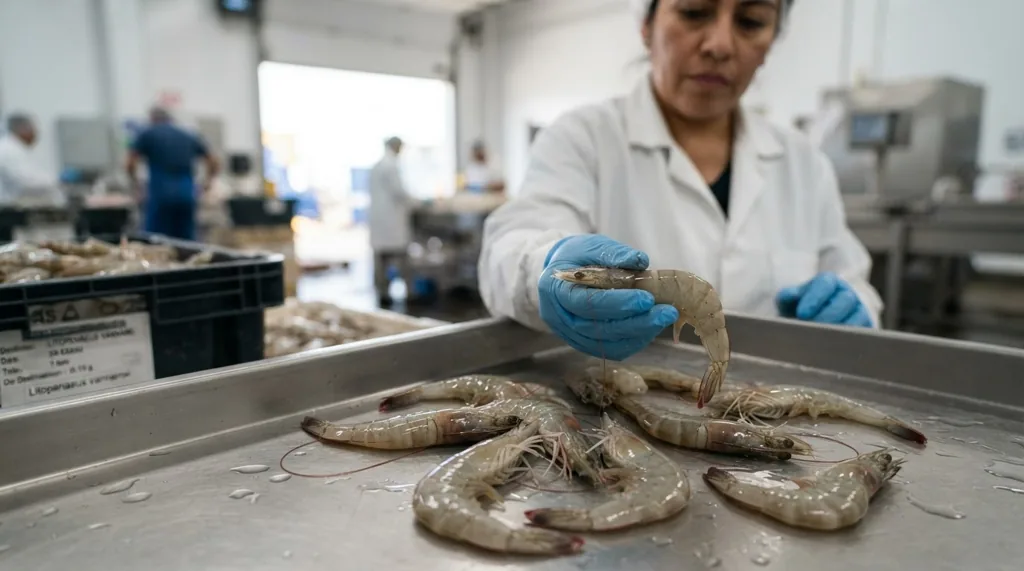
Colombia updates sanitary requirements for the importation of raw shrimps and prawns from Ecuador, covering fresh, chilled, and frozen forms, to ensure human consumption safety and quality standards.
Colombia’s farm health agency, the Colombian Agricultural Institute (ICA), issued Resolution 00018966 on Sept. 28, 2026, setting new health rules for raw shrimp and prawns from Ecuador, to apply from its publication in Colombia’s official gazette.
The resolution covers raw shrimp and prawns that are fresh, chilled or frozen and meant for people to eat1. It replaces import rules that ICA says were set more than 20 years ago1.
In short, every shipment of raw Ecuadorian shrimp entering Colombia must now carry a detailed animal-health certificate from Ecuador’s authorities, with negative laboratory tests for eight shrimp diseases. Shipments that arrive without these papers, or from a plant ICA has not recognised, cannot meet the new rules.
Why did ICA rewrite the Ecuador shrimp rules?
ICA says the old requirements were set through SISPAP, its information system for farm product imports and exports, more than 20 years ago2. In the agency’s words, those rules no longer give the level of health protection Colombia has chosen. That protection aims to stop animal diseases from entering, settling and spreading in the country2.
From approval to signature
To update the rules, ICA carried out a risk analysis, a study of how likely a disease is to arrive with the goods and how much harm it could do2. It did this under Decree 1071 of 2015 and in line with the World Trade Organization (WTO) agreement on food safety and animal and plant health measures2.
ICA’s Import Committee approved the update at a meeting on Sept. 23, 20252. This committee was created by ICA Resolution 13633 of 2023 to advise on and decide import health requirements for animals, plants and their products2.
What does the new resolution cover?
The resolution applies to raw shrimp and prawns (camarón y/o langostino) from the Republic of Ecuador1. It covers three forms of the product: fresh, chilled and frozen1. It only covers goods meant for human consumption1.
The rules apply to every person or company that imports these goods from Ecuador into Colombia1. The resolution does not list customs tariff codes. It also does not cover cooked shrimp or shrimp from any country other than Ecuador.
The certificate must state how the product was processed2. That means whether the shrimp are:
- with or without heads;
- peeled; or
- in the shell.
All these forms remain covered. The certificate simply has to say which one is in the shipment.
What must the Ecuadorian health certificate show?
Each shipment of fresh, chilled or frozen crustaceans must arrive with an animal-health certificate (certificado zoosanitario)2. The competent health authority of the country of origin, here Ecuador, must issue it2.
What travels with each shrimp shipment
The certificate must give these basic details2:
- the name and address of the exporter;
- the name and location of the processing plant;
- the name and location of the farm or the area of origin;
- the date the certificate was issued;
- the lot number;
- the date of harvest or catch;
- the date of processing.
It must also confirm a series of health conditions about the plant, the farm, the product and the packaging. These are set out in the sections below. A certificate that misses any of these details would not meet the resolution.
Which processing plants can ship to Colombia?
The plant of origin must be approved, identified and supervised by Ecuador’s official veterinary service at the time of production and shipment2. It must also be recognised by ICA2. This means a plant approved in Ecuador alone is not enough.
The farm or aquaculture site where the shrimp were raised must be under an official health monitoring programme2. The product, or the raw material it came from, must also fall under a programme that controls drug residues and food hygiene2.
The goods must carry an official stamp or printed seal2. This mark proves the shrimp came from the plants named on the certificate2.
Which shrimp diseases must be tested?
The farm of origin must run a farm monitoring programme every six months for diseases listed by WOAH, the World Organisation for Animal Health2. This programme must rest on sound disease-surveillance designs set by the health authority2. It must include PCR tests, a laboratory method that detects the genetic material of a virus or bacterium, with negative results2.
The eight diseases are2:
- infectious hypodermal and haematopoietic necrosis virus (IHHNV);
- yellow head virus genotype 1 (YHV);
- white spot syndrome virus (WSSV);
- Taura syndrome virus (TSV);
- infectious myonecrosis virus (IMNV);
- necrotising hepatopancreatitis caused by Hepatobacter penaei (NHP);
- acute hepatopancreatic necrosis disease (AHPN);
- decapod iridescent virus 1 (DIV1).
There is a second layer of testing. Each lot of product must also be tested by Rt-PCR with negative results for the same eight diseases2. The test results must be attached to the certificate2.
The certificate must also confirm that no deaths from these diseases were seen on the farm or in the area during the three months before processing2.
What are the rules on contact and packaging?
The shrimp must not have touched animals or products of lower health status2. They also must not have touched water or ice contaminated with germs that affect shrimp2.
The boxes or packaging must be new, used for the first time2. They must be drip-proof where needed and disinfected before leaving the plant2. They must also be packed in containers that stop waste water and other dirty material from leaking out during transport2.
What happens when a shipment reaches a Colombian port?
The importer must tell ICA’s port health office about the arrival 24 hours in advance2. When ICA thinks it necessary, it will take samples from the shipment for laboratory tests2.
ICA staff who inspect and control these imports act as health police inspectors under Article 65 of Law 101 of 19932. They can count on support from civil and military authorities2. Every official control must be recorded in a written or digital report signed by those present, with a copy left on site2.
Breaking any rule in the resolution will be punished under Articles 156 and 157 of Law 1955 of 20192. Civil or criminal action may also follow2.
Who is affected and what changes for each?
The change touches several groups along the supply chain:
- Colombian importers must check each certificate, attach the lot test results and give ICA a day’s notice of arrival.
- Ecuadorian shrimp farms must run disease monitoring every six months and keep a three-month record free of disease deaths.
- Ecuadorian processing plants must hold ICA recognition, stamp the goods and use new, disinfected boxes.
- Ecuador’s health authority must issue certificates that carry all the new details and declarations.
Who has to act
The heaviest new work falls on the Ecuadorian side, where the testing and paperwork start. Colombian importers carry the risk at the port if those papers are incomplete.
When do the new shrimp rules start?
The resolution takes effect on the date it is published in the Diario Oficial, Colombia’s official gazette1. From that date, all import procedures for these goods must follow the new requirements1.
There is a transition rule. Animal-health import documents issued before the resolution takes effect stay valid until the expiry date printed on them2.
The final text follows an earlier draft of the same resolution3. ICA ran a national and international public consultation, including notice to the WTO, before adopting it2. The requirements in the final text match those in the draft, item by item3.
Key points on Colombia’s Ecuador shrimp rules
The table sums up the main facts of the resolution.
| Question | Answer |
|---|---|
| Who issued it? | ICA, Colombia’s farm health agency |
| What is the measure? | Resolution 00018966 |
| When was it signed? | Sept. 28, 2026 |
| Which goods? | Raw shrimp and prawns, fresh, chilled or frozen |
| From where? | Ecuador only |
| Main document needed | Animal-health certificate from Ecuador |
| Diseases tested | 8, by PCR |
| Testing on each lot? | Yes, Rt-PCR, results attached |
| Plant approval | Must be recognised by ICA |
| Arrival notice | 24 hours before, to ICA port office |
| Start date | Publication in the Diario Oficial |
| Old documents | Valid until their expiry date |
The new rules apply from the day the resolution appears in the Diario Oficial1. After that, each raw shrimp shipment from Ecuador needs the full certificate and negative test results for every lot to clear ICA at the port.
Sources
- ↩ 2026R00018966.aspx https://www.ica.gov.co/getattachment/1cc119b2-75d8-41ad-926f-54d1b9e50c89/2026R00018966.aspx
- ↩ 26_05088_00_s.pdf https://members.wto.org/crnattachments/2026/SPS/COL/26_05088_00_s.pdf
- ↩ 26_02758_00_s.pdf https://members.wto.org/crnattachments/2026/SPS/COL/26_02758_00_s.pdf