
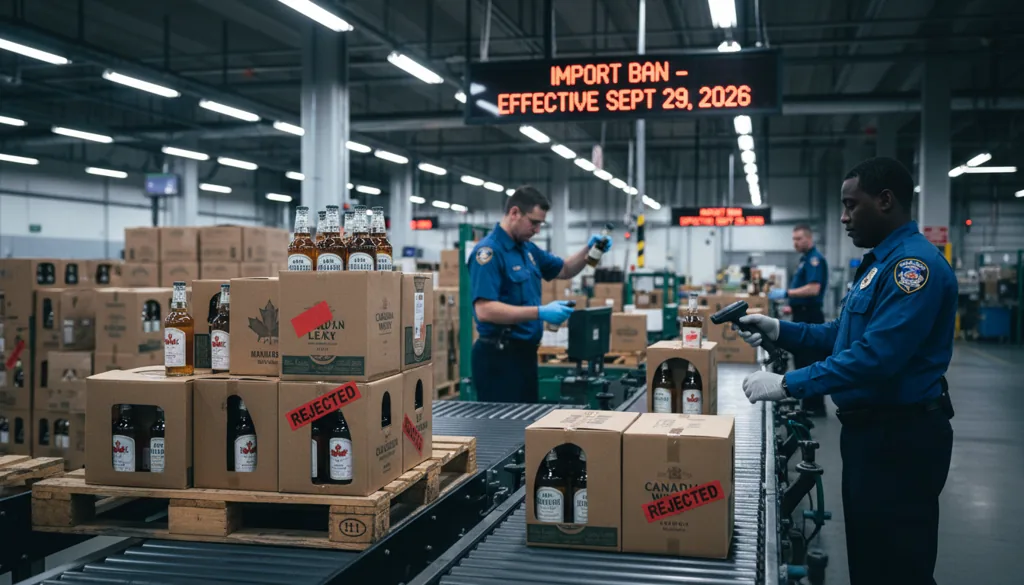
United States bans imports of certain Canadian alcoholic drinks, dairy products and motorcycles over 800 cc for goods imported from Sept. 29, 2026.
The United States has banned imports of certain Canadian alcoholic drinks, dairy products and large motorcycles, with the ban applying to goods imported from 12:01 a.m. eastern time on Sept. 29, 20261.
President Donald Trump signed the orders on Sept. 8, 2026, as part of five proclamations aimed at Canada1. They were published in the Federal Register on Sept. 14, 20262.
In short, many Canadian beers, wines and spirits, some dairy goods and motorcycles over 800 cc can no longer enter the United States. Until Sept. 29 these goods paid a 50% extra duty; now customs will refuse them.
Why did the United States ban these Canadian goods?
The bans use section 338 of the Tariff Act of 1930. This old law lets the President act when another country treats US goods worse than goods from other countries3. It allows extra duties of up to 50%, and it also allows a full ban if the other country keeps or increases its unfair treatment3.
From duty to ban
On July 20, 2026, the President put 50% duties on Canadian goods in three areas: alcoholic drinks, dairy and motor vehicles1. Each area had its own proclamation. Proclamation 11046 covered alcohol4. Proclamation 11047 covered dairy5. Proclamation 11048 covered motor vehicles3.
The White House said Canada bans the purchase and sale of US alcoholic drinks while not restricting drinks from other countries4. It said Canada gives out its cheese import quotas in a way that hurts US cheese5. It also objected to Canada’s tariffs on motor vehicles3.
The duties were first suspended for 3 days on Aug. 18, 2026, after Canada promised to remove these practices3. The White House said Canada broke that promise on Aug. 21, so the 50% duties took effect at 12:01 a.m. on Aug. 22, 20263.
Which Canadian alcoholic drinks are banned?
The alcohol order, Proclamation 11061, lists the banned goods by their US tariff code2. The list is wide. It includes:
- beer made from malt, sparkling wine and still grape wine
- cider, rice wine (sake) and other fermented drinks
- whisky, including bourbon and rye whisky
- vodka, gin, rum, brandy, tequila, mezcal and liqueurs
- drinking alcohol of 80% strength or more2
Outside the ban
Many of these lines carry a limit marked "Packaged" goods only2. For those lines, the ban covers only drinks in bottles, cans, boxes, kegs or similar containers sold straight to consumers2. On those lines, alcohol shipped in bulk rather than in such containers falls outside the ban.
Other lines have no such limit. These include wine in containers of 2 liters or less, and many spirits in containers of 4 liters or less2. The order says its product descriptions are for information only. Questions about the scope of a tariff code go to U.S. Customs and Border Protection (CBP), the US border agency2.
What happens to Canadian motorcycles and dairy?
The motor vehicles order, Proclamation 11063, bans one product line6. It covers motorcycles over 800 cc, including mopeds, with a piston engine (tariff code 8711.50.00)6. Smaller motorcycles are not on this list.
The dairy order bans certain dairy and other Canadian products that were paying the 50% duty under Proclamation 110475. The White House said Canada had kept its cheese quota practices in place after the duties started5. Goods that stay on the dairy duty list, rather than the ban list, keep paying the 50% duty5.
What about Canadian goods that stay on the 50% duty?
Goods not moved onto a ban list still pay the 50% duty3. On the same day, the President also signed orders that changed which goods pay that duty1.
Those orders removed some goods, such as rock salt and cement, from the duty1. They added new ones, from all-terrain vehicles (ATVs) to more dairy products1. These additions and removals took effect on Sept. 15, 20261.
The 50% duties apply even when a good qualifies under the US-Mexico-Canada Agreement (USMCA), the trade deal between the three countries1. They also come on top of duties under Section 232 of the Trade Expansion Act of 19621.
What happens to shipments already in the United States?
Some banned goods arrived in the United States before Sept. 29 but were not yet cleared for sale. Others were stored in a warehouse and not yet taken out for sale. These goods are not banned. They still pay the 50% duty rate set in July4.
Banned goods, by arrival date
| Question | Imported before Sept. 29, not cleared | Imported from Sept. 29 |
|---|---|---|
| Can it enter? | Yes | No, refused |
| Charge | 50% duty | None; entry refused |
| If a court strikes the ban | 50% duty | 50% duty |
Goods that reach the border on or after Sept. 29 are treated differently. Customs will refuse entry to any shipment on the ban lists4.
Each order also has a backup rule. If a court strikes down the ban for any import, the 50% duty applies to that import instead4. The rest of the ban stays in place4.
Who will run the ban at the border?
CBP may issue rules, guidance and instructions to run the bans4. Any CBP rule needs approval from the President or the US Trade Representative, where the law requires it4.
CBP must also decide whether the Harmonized Tariff Schedule of the United States needs more changes, and publish them in the Federal Register4. This can include corrections to the product lists. Such a notice would change exactly which tariff codes customs stops at the border.
Sources
- ↩ Fact Sheet: President Donald J. Trump Responds to Canada’s Retaliation – The White House https://www.whitehouse.gov/fact-sheets/2026/09/fact-sheet-president-donald-j-trump-responds-to-canadas-retaliation/
- ↩ 2026-18835.pdf https://public-inspection.federalregister.gov/2026-18835.pdf
- ↩ Excluding Certain Canadian Products from Importation into the United States in Response to Continued Discrimination Against the Commerce of the United States with Respect to Motor Vehicles – The White House https://www.whitehouse.gov/presidential-actions/2026/09/excluding-certain-canadian-products-from-importation-into-the-united-states-in-response-to-continued-discrimination-against-the-commerce-of-the-united-states-with-respect-to-motor-vehicles/
- ↩ Excluding Certain Canadian Alcoholic Beverages from Importation into the United States in Response to Continued Discrimination Against the Commerce of the United States with Respect to Alcoholic Beverages – The White House https://www.whitehouse.gov/presidential-actions/2026/09/excluding-certain-canadian-alcoholic-beverages-from-importation-into-the-united-states-in-response-to-continued-discrimination-against-the-commerce-of-the-united-states-with-respect-to-alcoholic-bever/
- ↩ Excluding Certain Canadian Products from Importation into the United States in Response to Continued Discrimination Against the Commerce of the United States with Respect to Dairy – The White House https://www.whitehouse.gov/presidential-actions/2026/09/excluding-certain-canadian-products-from-importation-into-the-united-states-in-response-to-continued-discrimination-against-the-commerce-of-the-united-states-with-respect-to-dairy/
- ↩ 2026-18837.pdf https://public-inspection.federalregister.gov/2026-18837.pdf