
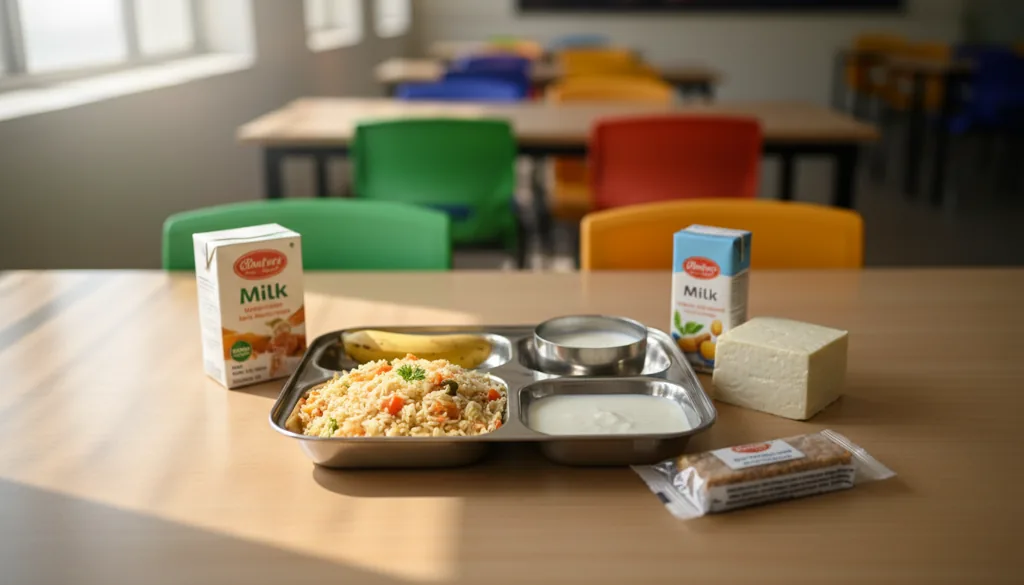
India is proposing amendments to its Food Safety and Standards Regulations to ensure safe food and balanced diets for children in school settings, targeting specific food and dairy products within the school meal context.
India’s food safety regulator has set strict limits on fat, sugar and salt in food sold to schoolchildren, cutting the delivered cost of compliant meals but imposing new testing and labelling rules on manufacturers, importers and school canteens from 1 August 2026.
The Food Safety and Standards Authority of India (FSSAI) published the draft Food Safety and Standards (Safe food and balanced diets for children in school) Amendment Regulations, 2026 on 10 August, defining “high in added fat, sugar or sodium” for the first time and banning such products from school premises. The ceiling for added fat is 4.2 g per 100 g in solids and 1.5 g per 100 ml in liquids; for added sugar it is 3 g per 100 g and 2 g per 100 ml; for salt it is 0.625 g per 100 g and 0.175 g per 100 ml1. The rules apply to all food sold, served or distributed in schools, including packaged snacks, dairy products, bakery items and ready-to-eat meals.
The school meal market
India’s mid-day meal scheme feeds 120 million children daily, and private schools add another 30 million meals. The combined market for school food is worth ₹18,000 crore ($2.2 bn; £1.7 bn) a year, split between domestic manufacturers and imports of dairy powders, breakfast cereals and fortified biscuits2. The new thresholds will force reformulation of popular products: a 100 g packet of potato chips typically contains 10 g of added fat and 0.8 g of salt, both now above the limit; a 200 ml flavoured milk drink can carry 12 g of added sugar, six times the new ceiling1.
New ceilings on added nutrients, solids
Importers must now submit a certificate of analysis for every shipment, showing compliance with the three ceilings, and school canteens must keep the certificate on file for two years1. The testing cost—₹1,200 to ₹1,800 per sample—falls on the company selling the product, whether domestic or foreign3. FSSAI has not set a penalty for non-compliance, but the 2006 Food Safety Act allows fines up to ₹10 lakh ($12,000; £9,200) and imprisonment for repeat offences1.
Who the rules bind
The regulations cover every “economic operator” in the school food chain: manufacturers, importers, distributors, school canteens and even street vendors operating within 50 m of a school gate2. Existing licences for school food businesses will be revalidated against the new limits by 31 October 2026; after that date, any product exceeding the ceilings is prohibited from sale in schools1.
Who has to act
The rules sit alongside a broader overhaul of food business licensing. From 1 April 2026, FSSAI licences and registrations become perpetually valid, removing the annual renewal fee, and turnover thresholds for state and central licences have been raised to ₹1.5 crore and ₹50 crore respectively3. However, the school food rules apply regardless of turnover, so a small bakery supplying a single school must still meet the same testing and labelling standards as a multinational cereal maker1.
What must be tested and labelled
Every product sold in schools must now carry a front-of-pack label showing the amount of added fat, sugar and salt per 100 g or 100 ml, expressed in grams and as a percentage of the daily recommended intake for children aged 6–121. The label must be in Hindi and English, and the font size cannot be smaller than 1.5 mm for the numerical value and 1 mm for the percentage1.
What the certificate and label must carry
Testing must be done by an FSSAI-accredited laboratory; importers can use either an Indian lab or a lab recognised under the Mutual Recognition Agreement with the exporting country3. The certificate must list the batch number, date of manufacture, expiry date and the actual test results for the three nutrients1. If a product fails the test, the entire batch is denied entry and must be re-exported or destroyed at the importer’s cost2.
The compliance calendar
The draft was open for public comment until 9 September 2026; FSSAI will publish the final rules by 30 September and they take effect on 1 August 20272. Manufacturers and importers have a nine-month grace period to reformulate, relabel and retest existing stock; after 1 August 2027, any non-compliant product found in a school canteen triggers an immediate recall and a mandatory inspection of the supplier’s premises1.
Dates that catch different things
| Date | Who it catches | What falls due |
|---|---|---|
| 30 Sep 2026 | All parties | Final rules published |
| 31 Mar 2027 | State governments | 10,000 food safety officers trained |
| 31 Oct 2026 | School food businesses | Licences revalidated against the new limits |
| 1 Aug 2027 | Manufacturers and importers | Non-compliant stock barred from schools; recall and supplier inspection on breach |
| Sep 2027 | FSSAI | Random surveillance of 10 % of schools each quarter begins |
State governments are responsible for enforcing the rules in 98 % of food businesses, including schools, and must train 10,000 food safety officers by 31 March 20273. FSSAI will conduct random surveillance in 10 % of schools every quarter, starting in September 2027, and publish the results on its website1.
What the rules leave alone
The regulations do not change the existing ban on carbonated drinks, energy drinks and foods containing artificial colours in schools1. They also leave untouched the mid-day meal scheme’s nutritional norms, which set minimum protein, vitamin and mineral levels for government-funded meals2. The new ceilings apply only to added fat, sugar and salt, so a plain roti or boiled egg remains exempt even if its natural fat content exceeds 4.2 g per 100 g1.
The rules are silent on how schools should verify the certificates submitted by suppliers. FSSAI has not mandated a digital portal for
Sources
- ↩ FSSAI Draft Regulations for Safe Food and Balanced Diets for School Children, 2026 https://fssai.gov.in/docs/food-law/notice-comment/Draft%20Food%20Safety%20and%20Standards%20(Safe%20food%20and%20balanced%20diets%20for%20children%20in%20school)%20Regulations,%202026.pdf
- ↩ DraftFood Safety and Standards (Safe food and balanced diets for children in school) Amendment Regulations, 2026 https://docs.wto.org/imrd/directdoc.asp?DDFDocuments/T/G/SPS/NIND358.docx
- ↩ FSSAI FAQs on Food Safety and Standards (Licensing and Compliance) https://fssai.gov.in/upload/advisories/2026/03/69c6a23234827order_27032026.pdf