
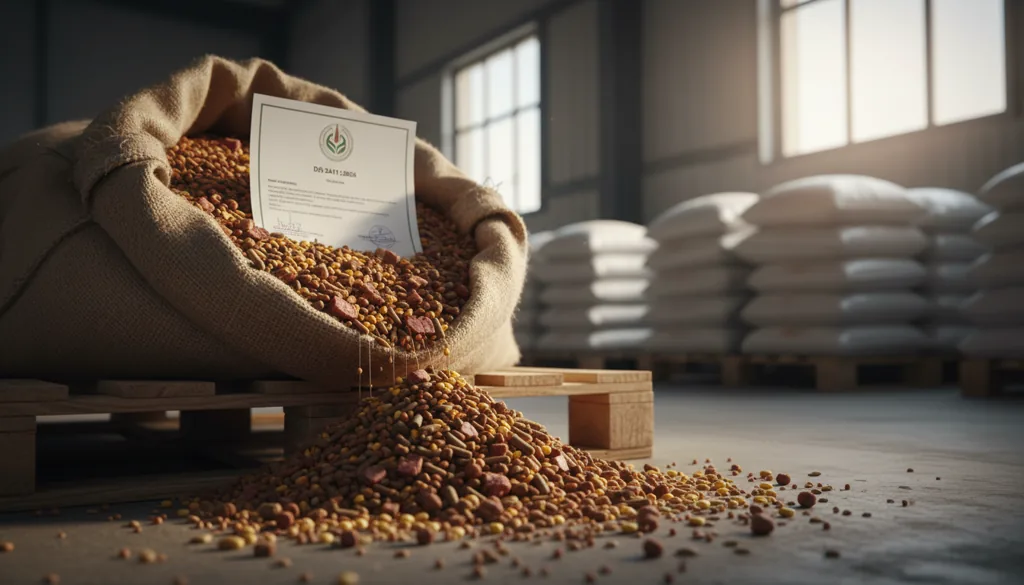
Jordan has established mandatory safety and nutritional standards for feedstuffs and feed additives intended for dogs and cats, ensuring compliance with quality and safety benchmarks.
Jordan’s animal feed standards come into force on 1 March 2027, setting mandatory safety and nutritional rules for all pet food sold in the kingdom. The new regime covers dry, wet and semi-moist formulations for dogs and cats, together with the vitamins and trace minerals that must be included1. Every tonne of imported or locally produced feed will have to meet the same benchmarks before it can be sold.
The rules apply to all shipments under HS code 2309—preparations of a kind used in animal feeding—and to the broader category of animal feeding stuffs classified under ICS 65.1201. Delivered costs will rise for importers: testing fees, registration charges and inspection levies are now fixed and non-negotiable. Local manufacturers face the same requirements, but the government has already begun subsidising the first wave of compliant factories.
It comes after years of unregulated imports and inconsistent local production. Until now, Jordan had no national standard for pet food; importers relied on foreign certificates that were often not recognised by border inspectors. The gap left consumers exposed to contaminated or nutritionally deficient products, while legitimate traders faced repeated delays and extra costs.
What the new standard demands
From 1 March 2027, every batch of dog or cat food must carry a certificate of conformity issued by the Jordan Standards and Metrology Organisation (JSMO)1. The certificate confirms that the product meets 13 pages of technical requirements covering protein, fat, fibre, moisture, ash and the maximum permitted levels of heavy metals, mycotoxins and pathogenic bacteria1. Lab tests must be performed by an accredited laboratory; the results are valid for 12 months1.
What every batch must carry
Importers must file the certificate with customs before the shipment arrives. If the document is missing or incomplete, the shipment will be held at the border until the tests are repeated at the importer’s expense1. Local producers face the same rules: factories must register with JSMO and submit samples from every production run1. The registration fee is 45 Jordanian dinars (JD) per product line, plus a 5-JD application fee2.
The standard also sets labelling rules. Every package must show the guaranteed analysis, the list of ingredients, the manufacturer’s name and address, the batch number and the expiry date in Arabic and English1. Any claim—“grain-free”, “high-protein”, “for senior dogs”—must be substantiated by the laboratory report1. Misleading labels can trigger a recall and a fine of up to 1,000 JD1.
Who pays the new costs
Testing fees are split between the government and the importer. The basic laboratory analysis costs 50 JD per sample; additional tests for salmonella, aflatoxins or heavy metals add 25 JD each2. If the sample fails, the importer pays for a second test at the same rate. Border inspections are free for the first three shipments per importer per year; after that, each inspection costs 10 JD2.
Fees under the new regime, JD
Registration is a one-time cost. A new product line costs 45 JD to register; renewals are 25 JD2. Factories must also pay an annual licence fee of 50 JD for the first production line and 25 JD for each additional line2. The fees are the same for local and foreign producers, but local factories receive a five-year exemption from operating-licence charges if they are located in one of the kingdom’s industrial or development zones3.
The government has already opened the first state-subsidised pet-food factory in Mafraq, with three production lines capable of turning out 6 tonnes of dry, wet and semi-moist feed every day3. The plant is expected to cover 25 % of domestic demand by the end of 2027, reducing the need for imports3. Four more factories are under construction in development zones, each supported by infrastructure grants and five years of rent-free operation3.
What the old regime left undone
Before the new standard, Jordan had no national rules for pet food. Importers brought in products certified under the Saudi SFDA.FD/2017 standard, the Egyptian ES 8447/2021 standard or the Indian IS 11968:2019 standard1. Border inspectors often rejected these certificates, forcing importers to send samples to local labs at their own expense. Delays of two to three weeks were common, adding storage costs and spoilage risks.
Pet food control, before and after
| Question | Old regime | From 1 March 2027 |
|---|---|---|
| National standard | None | Mandatory JSMO benchmark |
| Foreign certificates | Often rejected at border | Not needed — JSMO certificate |
| Labelling | Plain bags, no expiry date | Full Arabic and English disclosure |
| Claims | Unverified | Must be lab-substantiated |
| Clearance delays | Two to three weeks | Pre-filed certificate |
The old system also allowed unlabelled or mislabelled products to reach the market. Some importers repackaged bulk shipments in plain bags with no ingredient list or expiry date. Others made unsubstantiated claims—“organic”, “veterinary-approved”, “for sensitive stomachs”—that were never verified. The new standard closes these loopholes by requiring pre-market approval and on-package disclosure1.
The standard is the first in the region to align with neither Codex nor the World Organisation for Animal Health (OIE)1. Jordan’s Ministry of Agriculture said in a statement that it chose to develop its own benchmarks because existing international standards did not address the specific dietary needs of dogs and cats in the Middle East’s hot, dry climate1. The ministry also cited concerns about aflatoxin contamination in imported grains, which are not covered by the OIE’s feed-safety guidelines1.
What happens after 1 March 2027
The standard will be reviewed every two years. The first review is scheduled for March 2029, when JSMO will assess whether the rules have reduced the number of contaminated shipments and improved consumer safety1. If the data show persistent non-compliance, the ministry can lower the maximum permitted levels of heavy metals or mycotoxins without further public consultation1.
Dates to watch
Importers who fail to comply face escalating penalties. A first offence triggers a written warning and a 30-day deadline to correct the violation. A second offence within 12 months incurs a fine of 500 JD and a 90-day suspension of the importer’s licence. A third offence leads to permanent revocation1. Local producers face the same penalties, but factories in development zones receive a six-month grace period for minor labelling errors3.
The ministry has also launched a public-awareness campaign. Starting in January 2027, retailers must display a poster explaining the new labelling rules and the meaning of the JSMO conformity mark1. Consumers who report mislabelled or unsafe products will receive a 10-JD reward if the complaint is upheld1. The campaign is funded by a 1-JD levy on every tonne of imported or locally produced pet food2.
The new rules do not cover raw meat, bones or homemade diets. These products remain outside the standard’s scope, but the ministry said in a statement that it will monitor their safety through random market surveillance1. If contamination rates rise, the ministry can extend the standard to cover raw diets without a new notification to the World Trade Organisation1. For now, the focus is on manufactured dry, wet and semi-moist formulations—the products that make up 95 % of the Jordanian market3.
Sources
- ↩ Feedstuffs and feed additives – Food for Dogs and Cats https://docs.wto.org/imrd/directdoc.asp?DDFDocuments/T/G/SPS/NJOR47.docx
- ↩ Fees for Agricultural Services Related to Import, Export, or Transit https://traderepository.customs.gov.jo/arabic/page3.5.html
- ↩ Minister of Agriculture Opens First Animal Feed Factory in Mafraq https://www.moa.gov.jo/Ar/NewsDetails/%D9%88%D8%B2%D9%8A%D8%B1_%D8%A7%D9%84%D8%B2%D8%B1%D8%A7%D8%B9%D8%A9_%D9%8A%D9%81%D8%AA%D8%AA%D8%AD_%D8%A3%D9%88%D9%84_%D9%85%D8%B5%D9%86%D8%B9_%D9%84%D8%A3%D8%BA%D8%AF%D9%8A%D8%A9_%D8%A7%D9%84%D8%AD%D9%8A%D9%88%D8%A7%D9%86%D8%A7%D8%AA_%D9%81%D9%8A_%D8%A7%D9%84%D9%85%D9%81%D8%B1%D9%82