
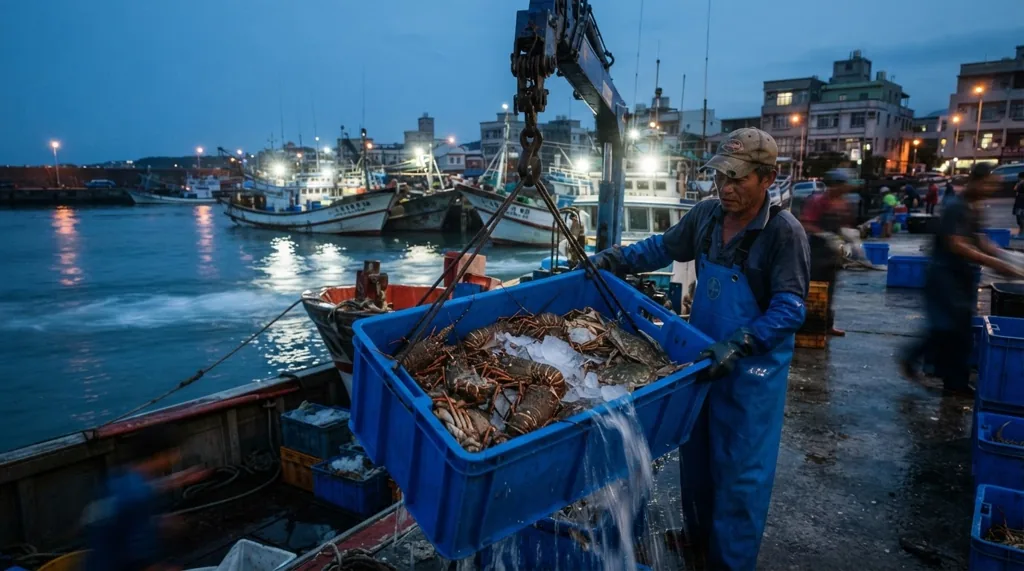
Oman has banned imports of some crustaceans and their products from Yilan County in Taiwan since Oct. 19, 2026.
Oman’s Ministry of Agriculture, Fisheries and Water Resources has banned imports of some crustaceans from Yilan County in Taiwan, in a decision published Oct. 18, 20261.
The measure is Ministerial Decision 260/2026. It appeared in issue 1670 of Oman’s Official Gazette, dated Oct. 18, 20262.
In short, shipments of the listed crustaceans from Yilan County can no longer enter Oman. Heat-treated products are the one exception.
What does Oman’s Yilan County ban cover?
The decision bans imports of crustaceans of the kinds listed in chapter 2.2.9 of a disease-testing handbook. That handbook is the Manual of Diagnostic Tests for Aquatic Animals of the World Organisation for Animal Health (WOAH), the global body for animal disease standards.
Ministerial Decision 260/2026 at a glance
| Point | Rule |
|---|---|
| Issued by | Ministry of Agriculture, Fisheries and Water Resources |
| Area | Yilan County, Taiwan |
| Goods banned | Crustaceans in WOAH manual chapter 2.2.9, their products, derivatives and waste |
| Exemption | Heat-treated goods meeting the WOAH aquatic code |
| Duration | Until the reason for the ban ends |
The ban is wide. It covers the animals themselves, and also their products, derivatives and waste. Derivatives are goods made from the animals, such as extracts or meal.
The ban applies only to goods from Yilan County in Taiwan. The title of the decision names that county and no other area1. Crustaceans from other parts of Taiwan are not named in the decision.
Which disease is behind chapter 2.2.9?
The decision does not name a disease in its own words. It points to a chapter of the WOAH manual instead.
A 2023 European Commission paper on WOAH standards lists that chapter. In that paper, chapter 2.2.9 is titled "Infection with yellow head virus genotype 1"3. The paper reviews this chapter as one of the manual’s chapters on crustacean diseases.
The same European Commission paper lists other crustacean chapters, such as chapter 2.2.6 on white tail disease3. Oman’s decision picks only chapter 2.2.9. So the species covered are those that chapter lists as able to carry this virus.
Why did Oman’s agriculture ministry act?
The decision says it follows a recommendation from Oman’s veterinary authority. That authority advised banning imports of some crustaceans, their products, derivatives and waste from Yilan County.
The ministry also cites the public interest. It does not give outbreak figures or case numbers.
The legal base is Oman’s Veterinary Quarantine Law, issued by Royal Decree 45/2004. The decision also rests on the law’s implementing rules, issued by Ministerial Decision 107/2008. The decision names both texts as the base for the ban.
Which crustacean goods are exempt?
One group of goods can still enter. The decision exempts heat-treated or processed products, derivatives and waste.
The heat treatment must follow the Aquatic Animal Health Code of WOAH. That code is the world body’s set of trade rules for fish and shellfish health. The decision refers to WOAH by both its current name and its older name, the International Office of Epizootics (OIE).
Goods that have not been heat-treated get no exemption. Live crustaceans of the listed kinds from Yilan County are banned outright.
How does the ban work at Oman’s border?
The decision is short. It has three articles:
- The first article sets the ban and the heat-treatment exemption.
- The second article orders the competent authorities to carry it out, each within its own duties.
- The third article orders publication in the Official Gazette and sets the start date.
Customs and veterinary officers at Oman’s ports carry out the ban. A shipment of the listed crustaceans from Yilan County would be refused entry. A shipment of heat-treated goods would need to show it meets the WOAH heat-treatment rules.
The decision itself lists no new forms or certificates. It sets no fines of its own.
When did the Yilan County ban start?
The minister signed the decision on Oct. 15, 2026. The signatory was Dr. Saud bin Hamoud bin Ahmed Al Habsi, the Minister of Agriculture, Fisheries and Water Resources.
The dates of the Yilan crustacean ban
The gazette issue carrying it is dated Oct. 18, 20262. The decision takes effect from the day after publication. That means the ban has applied since Oct. 19, 2026.
There was no grace period. Goods already at sea when the ban started gained no stated protection.
How long will the crustacean ban last?
The ban has no fixed end date. It stays in force until the reason for the ban ends. A further decision from the ministry must then lift it.
So importers cannot plan around a set date. The ban ends only when the ministry publishes a new decision.
Who is affected by the decision?
Several groups feel the change:
- Exporters in Yilan County lose the Omani market for untreated crustaceans of the listed kinds.
- Importers in Oman must source these goods from other places, or buy heat-treated products.
- Shipping agents and customs brokers must check where crustacean shipments from Taiwan come from.
- Food processors and restaurants in Oman using these goods may see a change in supply.
The origin inside Taiwan matters. A shipment of shrimp from Taiwan is not banned only for being from Taiwan. It is banned when it comes from Yilan County and is not heat-treated.
Is this part of a wider set of Oman bans?
The ministry issued several import bans in the same period. The decision just before it, Ministerial Decision 259/2026, deals with some species of fish from Singapore’s Northern Region. The one just after it, Ministerial Decision 261/2026, bans live cattle from Scotland.
These decisions follow the same pattern. Each targets one disease risk in one named area, not a whole country. Each lasts until the ministry lifts it.
For traders, the pattern means the origin area of a shipment matters as much as its country. Bans can be issued and published within days.
Key points on Oman’s Yilan crustacean ban
The table below sums up the decision.
| Question | Answer |
|---|---|
| What changed? | Import ban on some crustaceans |
| Who issued it? | Ministry of Agriculture, Fisheries and Water Resources |
| Legal instrument | Ministerial Decision 260/2026 |
| Which area? | Yilan County, Taiwan |
| Which goods? | Species in WOAH manual chapter 2.2.9 |
| Linked disease | Yellow head virus genotype 1 |
| Also banned | Products, derivatives and waste |
| Exemption | Heat-treated goods meeting WOAH code |
| Signed | Oct. 15, 2026 |
| Published | Oct. 18, 2026, gazette issue 1670 |
| In force | Oct. 19, 2026 |
| End date | When the ministry lifts it |
From Oct. 19, 2026, untreated crustaceans of the listed kinds from Yilan County are turned away at Oman’s border. Only heat-treated goods can still enter, until the ministry issues a new decision.
Sources
- ↩ التشريعات | وزارة العدل و الشؤون القانونية https://www.mjla.gov.om/decisions/ar/1083/show/2286/
- ↩ مكتبة الإصدارات | وزارة العدل و الشؤون القانونية https://www.mjla.gov.om/legislation/1
- ↩ ia_standards_oie_eu_position_aac-report_202302.pdf https://food.ec.europa.eu/system/files/2023-05/ia_standards_oie_eu_position_aac-report_202302.pdf