
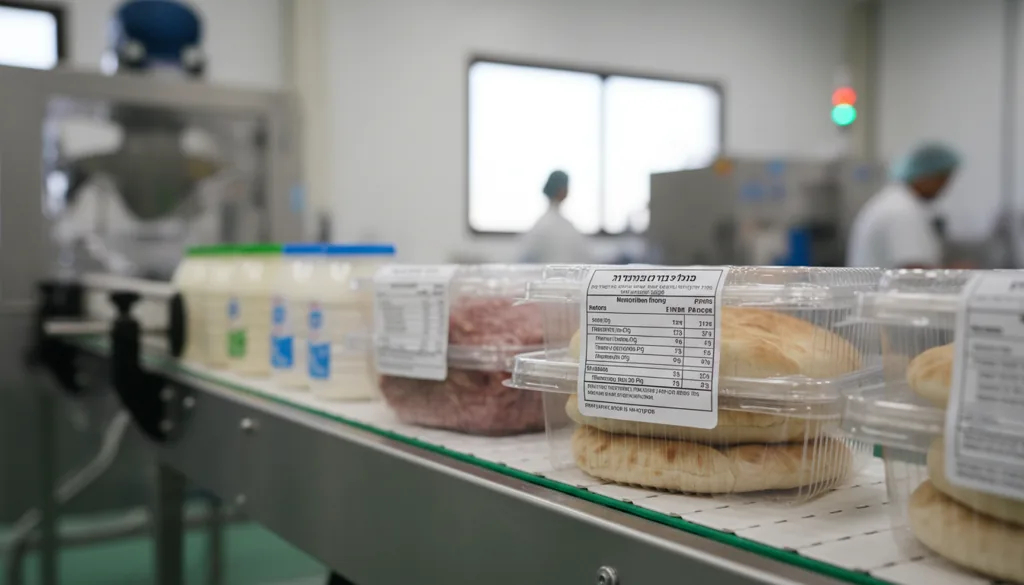
Israel has enhanced public health protection for food through updated labeling requirements and alignment with EU directives, including amendments to consumer food information and application of EU Annex changes.
Israel’s food labelling rules have been overhauled to align with European standards, cutting compliance costs for importers but leaving local producers to adjust to new packaging requirements by 1 January 2028.
The change, published on 1 April 2025, replaces Israel’s mandatory standard SI 1145 with EU Regulation 1169/2011 for all pre-packaged foods. It covers everything from breakfast cereals to frozen vegetables, and the delivered cost of every tonne inside the new rules falls by an estimated 3-5 % once testing and approval fees are removed1. Who pays for the transition is already clear: the company selling the product must redesign labels, relabel stock and absorb the one-time cost of printing new packaging1.
It comes after years of complaints that Israel’s patchwork of local and EU-derived rules forced importers to run two separate production lines for the same product. The old lists placed the same jar of honey in three categories at once, each with a different font size and allergen warning1.
What the new rules demand
Every pre-packaged food sold in Israel must now carry a nutrition declaration on the front or side of the pack1. The font size for mandatory information rises to 1.2 mm for the smallest letters, up from 0.9 mm under the old standard1. Allergen warnings must appear in bold or a contrasting colour, and the country of origin must be named for meat, fish, fruit, vegetables, olive oil and honey1.
What every pack must now carry
The rules also introduce a traffic-light system for salt, sugar and fat: red for high, amber for medium, green for low1. Retailers may not display a product that fails to meet the colour-coding thresholds unless it is sold in a dedicated “healthier choices” section1. The ministry said in a statement that the system is designed to “nudge consumers towards better diets without banning any food”1.
Who gains and who loses
Importers of European-branded goods are the biggest winners. A shipment of German muesli that once needed separate labels for Israel and the EU can now use the same packaging for both markets, cutting the delivered cost by roughly 4 %2. The ministry estimates that 80 % of the 1,463 tariff lines affected are already sold in the EU, so the testing and approval process is eliminated for those products1.
Where the cost lands
Local manufacturers face the opposite effect. A small bakery in Tel Aviv that prints its own labels must now invest in new software and reprint every pack, at a cost of around 15,000 shekels (£3,200) for a typical product line2. The ministry has not offered subsidies or tax relief for the transition, and the deadline of 1 January 2028 leaves little time for companies that have not yet started1.
What the old rules left behind
The old standard, SI 1145, required separate labels for products that contained even trace amounts of sesame, mustard or celery1. Under the new rules, those allergens must still be declared, but the font and placement rules are now the same as in the EU, so a single label can serve both markets1. The change also removes the requirement for a Hebrew-only ingredient list on the back of the pack; importers may now use a sticker or a separate leaflet in Hebrew as long as the main label is in one of the EU’s official languages1.
Old standard vs EU-derived rules
| Question | Old SI 1145 | New EU 1169/2011 |
|---|---|---|
| Trace sesame, mustard, celery | Separate labels required | Declared once, EU font and placement |
| Ingredient list language | Hebrew only, on the pack | Sticker or leaflet in Hebrew allowed |
| Label for dual markets | Two production lines | One label serves both |
| “Natural” claim | Banned unless 17 criteria met | Kept, carved out in annex |
| Permitted additives | Stricter than EU list | Kept, carved out in annex |
Some local requirements remain. Israel still bans the use of the word “natural” unless the product meets a list of 17 criteria, and the ministry has kept its own list of permitted food additives that is stricter than the EU’s1. Those rules are now carved out in a separate annex, so they do not conflict with the EU-derived labelling requirements1.
The wider push for cheaper food
The labelling reform is the latest step in a decade-long campaign to cut food prices by opening Israel’s market to imports. In 2014 the government launched the “Cornflakes Reform”, which slashed tariffs on breakfast cereals and allowed parallel imports of branded goods2. The result was a 403 % jump in pineapple consumption after prices fell by half, and a 210-store expansion of discount chains that now sell private-label products at 30 % below the branded equivalent2.
Share of market held by the three largest suppliers
Yet the market remains highly concentrated. The three largest suppliers control 99 % of the cream market, 93 % of instant coffee and 87 % of breakfast cereals2. The Competition Authority has not declared any of those groups a monopoly, and the ministry has not set a timeline for reviewing the remaining tariffs on products that Israel does not produce, such as bananas and avocados2.
What comes next for food
The ministry will review the new rules in March 2027, six months before they become mandatory1. Until then, companies may choose to follow either the old standard or the new one, but from 1 January 2028 only the EU-derived labels will be accepted1. The ministry said in a statement that it will publish guidance on the traffic-light system by 1 October 2025, and that it expects to issue the first fines for non-compliance in early 20281.
The dates that bind
The change leaves one question unanswered: whether the savings from cheaper imports will reach consumers or be absorbed by retailers. The State Comptroller’s report found that after the Cornflakes Reform, aggregate household savings on tuna products totalled 38 million shekels (£8.1 million), but state revenue fell by 11 million shekels (£2.3 million)2. The ministry has not said how it will measure the impact of the labelling reform on prices, or whether it will publish the results.
Sources
- ↩ Public Health Protection (Food) (Amendment of the Second Annex A) (Regulation 1169/2011 – Provision of Food Information to Consumers), 5776-2026 https://docs.wto.org/imrd/directdoc.asp?DDFDocuments/T/G/TBTN26/ISR1411.docx
- ↩ State Comptroller Report on the State’s Response to Concentration and Monopolies in the Food and Beverage Sector https://library.mevaker.gov.il/sites/DigitalLibrary/Documents/2024/2024.11-75A-PartB/EN/2024.11-75A-PartB-All-Abstracts-EN.pdf