
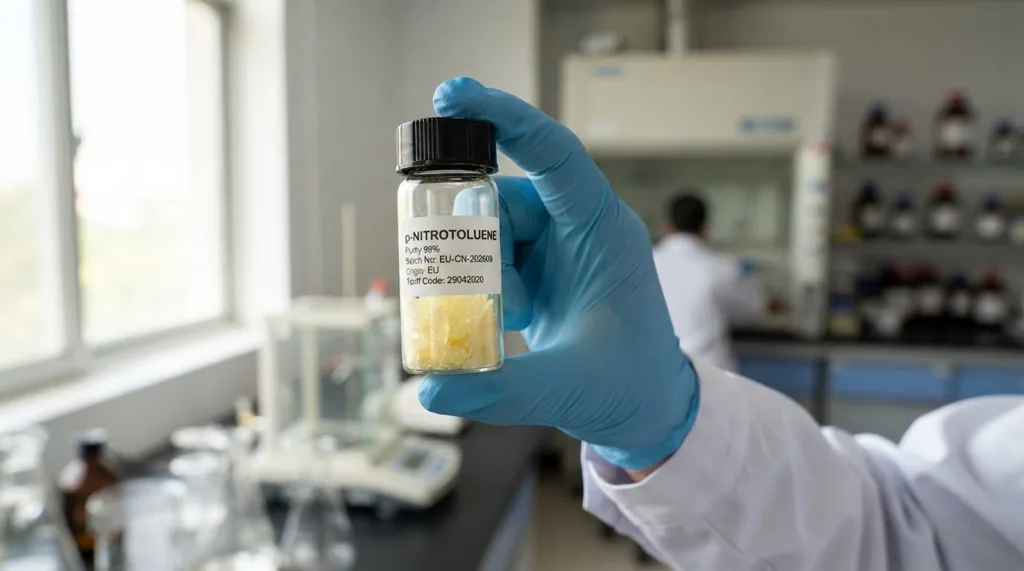
China opened an anti-dumping investigation into p-nitrotoluene imported from the European Union on Oct. 3, 2026.
China’s Ministry of Commerce (MOFCOM) opened an anti-dumping investigation on Oct. 3, 2026, into p-nitrotoluene, a chemical used to make dyes, pesticides and medicines, imported from the European Union1.
The ministry announced the case in MOFCOM Announcement No. 44 of 2026, issued by its trade remedy bureau1. An anti-dumping investigation checks whether foreign makers sell goods in China below their normal price and whether this harms Chinese producers.
In short, China is checking whether EU makers sell this chemical too cheaply in China. No new duty applies yet, but if the ministry finds dumping, EU shipments could later face an extra import tax.
What is p-nitrotoluene and which goods are covered?
The goods under investigation are p-nitrotoluene, also called 4-nitrotoluene1. In English it is also known as para-nitrotoluene, with the short names PNT, p-NT or 4-NT. Its chemical formula is C7H7NO2.
At room temperature (25°C), the chemical is usually a pale yellow to light brown solid that does not dissolve in water1. Factories use it to make other chemicals, such as p-toluidine, DSD acid, p-nitrobenzoic acid, toluene diisocyanate and tolidine. These end up in dyes, pigments, pesticides and medicines.
The product falls under Chinese tariff code 290420201. Other products under that code are not part of the case. Only goods that originate in the European Union are covered.
Why did MOFCOM open the EU case?
The case started with a complaint from Chinese industry. On Sept. 14, 2026, MOFCOM received an application from two companies on behalf of the Chinese p-nitrotoluene industry1. They asked the ministry to investigate imports from the EU.
The two applicants are:
- Jiangsu Huaihe Chemical Co., Ltd.
- Hubei Dongfang Chemical Co., Ltd.
The ministry checked that the two companies produce enough of the chemical to speak for the Chinese industry. It found that their combined output met the rules in Articles 11 and 13 of China’s Anti-Dumping Regulations1. It also found that the application contained the content and evidence required by Articles 14 and 15. It then opened the case under Article 16.
What does the ministry say about prices from the EU?
A MOFCOM spokesperson explained the case in a statement on the same day. According to the applicants’ first evidence, imports of p-nitrotoluene from the EU stayed at a high volume from 2022 to 20252. Over the same years, their price fell by nearly 60% in total.
The spokesperson said these dumped imports from the EU harmed the production and business of the Chinese industry2. The ministry said the application met the conditions for an investigation under Chinese law and World Trade Organization rules. It promised to protect the rights of all parties and to decide fairly.
The statement also set the case against the wider trade picture. It said the EU has opened 28 trade remedy investigations against China since 2025, and about 50% of them concern chemical products2. It added that the EU recently opened 3 cases in a row on Chinese chemicals such as PVC. The spokesperson called on the EU to solve trade concerns through dialogue.
Which periods will the investigation examine?
The ministry will look at two different periods. The dumping period runs from July 1, 2025, to June 30, 20261. For this period, MOFCOM will compare EU export prices to China with normal prices.
Length of each review period, months
The injury period runs from Jan. 1, 2022, to June 30, 20261. For this longer period, the ministry will study the harm to Chinese producers. That makes 54 months for injury against 12 months for dumping. The injury period covers the years in which, the applicants say, EU prices fell sharply.
Who must register by Oct. 23, 2026?
Interested parties must register with MOFCOM’s trade remedy investigation bureau within 20 days of the notice1. The notice was issued on Oct. 3, 2026, so the 20 days end on Oct. 23, 2026. Interested parties are the people and organizations defined in Article 19 of the Anti-Dumping Regulations.
This group can include EU makers and exporters, Chinese importers and Chinese producers. Registration requires basic company details, together with:
- the volume and value of the product exported to or imported into China;
- the volume and value of similar products made and sold;
- any links between companies.
The ministry provides a registration form on its trade remedy bureau website. Parties must file an electronic copy through the trade remedy online platform1. When the ministry asks, they must also send a paper copy with the same content and format.
Parties who want to comment on the product scope, the applicants’ standing or the countries covered also have 20 days from the notice1. They send their written comments to the trade remedy bureau.
How will the p-nitrotoluene investigation work?
Under Article 20 of the regulations, MOFCOM may use questionnaires, sampling, hearings and on-site checks1. The main tool is the questionnaire. The steps run in this order:
- Interested parties register within 20 days of the notice.
- The ministry usually issues questionnaires within 10 working days after the registration deadline.
- Parties download the questionnaires from the trade remedy bureau website.
- Parties send full and accurate answers within the set time.
Steps in the MOFCOM investigation
There are three questionnaires1. The one for foreign exporters and producers asks about company structure, the product, export sales to China and sales inside the EU. It also asks for business and financial data, production costs and an estimated dumping margin, which is the gap between the normal price and the export price. The other two are for Chinese producers and Chinese importers.
The public version of the application is available for parties to read and copy1. Parties may ask for confidential treatment of their information, giving reasons. If the ministry agrees, they must also provide a summary that others can read. Information not marked as confidential is treated as public.
What happens to companies that do not cooperate?
The notice warns about the cost of staying silent. Under Article 21, parties must give true information and the papers the ministry asks for1. If a party gives false information, does not supply needed information in time, or blocks the case in another way, MOFCOM may decide on the facts available and the best information it has.
In practice, an EU exporter that does not answer the questionnaire may lose the chance to show its own prices. The ministry could then rely on the applicants’ figures. That could mean a higher rate for that exporter if duties follow.
What changes for EU exporters and Chinese buyers?
For now, shipments of p-nitrotoluene from the EU enter China under the normal rules. The notice opens an investigation; it does not set any duty1.
The work starts now, however. EU makers that sell the chemical to China must decide whether to register and answer the questionnaire. Chinese importers and users in the dye, pigment, pesticide and medicine sectors may also register. They can tell the ministry how the case affects their supply.
Buyers in China face uncertainty over future costs. If the ministry later finds dumping and injury, an extra duty on EU supply would raise its price. Chinese producers such as the two applicants would then compete with dearer imports.
When will the investigation end?
The investigation began on Oct. 3, 2026, and should normally end before Oct. 3, 20271. In special cases, MOFCOM may extend it by 6 months.
Dates in the p-nitrotoluene case
| Date | What happens | Who it concerns |
|---|---|---|
| Sept. 14, 2026 | Application received | Two Chinese producers |
| Oct. 3, 2026 | Investigation opens | EU p-nitrotoluene imports |
| Oct. 23, 2026 | Registration and comments close | Exporters, importers, producers |
| Oct. 3, 2027 | Case should end; 6-month extension possible | All parties |
The notice does not set a date for a preliminary finding. The next fixed step is the registration and comment deadline 20 days after the notice, followed by the questionnaires.
Key points on the p-nitrotoluene anti-dumping case
The table below sums up the case.
| Question | Answer |
|---|---|
| What changed? | Anti-dumping investigation opened |
| Who issued it? | China’s Ministry of Commerce (MOFCOM) |
| Legal notice | MOFCOM Announcement No. 44 of 2026 |
| Which goods? | p-nitrotoluene (4-nitrotoluene) |
| Tariff code | 29042020 |
| From where? | European Union |
| Who applied? | Jiangsu Huaihe Chemical, Hubei Dongfang Chemical |
| Price claim | EU price fell nearly 60%, 2022-2025 |
| Dumping period | July 1, 2025 to June 30, 2026 |
| Registration deadline | 20 days from Oct. 3, 2026 |
| Duty now? | None yet |
| Expected end | Before Oct. 3, 2027, extendable 6 months |
Until a ruling, EU p-nitrotoluene pays no extra duty in China. The next date in the case is Oct. 23, 2026, when registration and comments close, and questionnaires should follow within 10 working days1.
Sources
- ↩ 商务部公告2026年第44号 公布对原产于欧盟的进口对硝基甲苯发起反倾销立案调查 https://www.mofcom.gov.cn/zcfb/gpmy/art/2026/art_0bd4dc72a6df4cdeb54f02012f5ea90f.html
- ↩ 商务部新闻发言人就对原产于欧盟的进口对硝基甲苯发起反倾销调查答记者问 https://www.mofcom.gov.cn/syxwfb/art/2026/art_c1e2b099e84d4b6d8e10e7cef5928511.html