
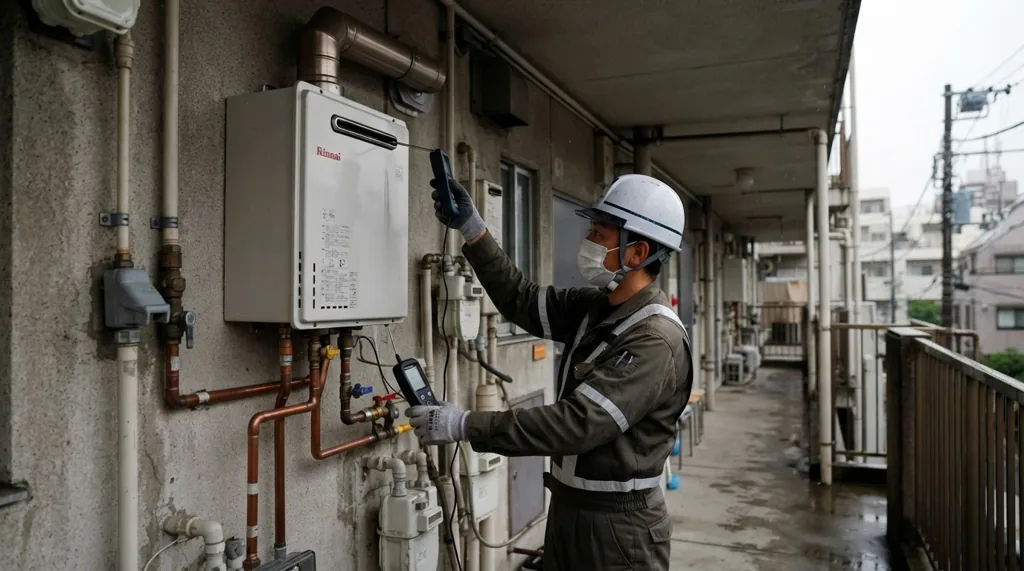
Japan has issued Committee on Technical Barriers to Trade notifications establishing technical requirements for gas water heaters to ensure safety and efficiency in the domestic market.
Japan’s energy agency on Oct. 22, 2026 proposed new energy rules for home gas and electric water heaters, with comments due Nov. 20, 20261.
The Agency for Natural Resources and Energy, part of Japan’s Ministry of Economy, Trade and Industry (METI), published two draft texts for public comment1. One amends the regulations under Japan’s energy-saving law. The other sets new standards that makers of household water heaters must follow2.
In short, companies selling home water heaters in Japan will have to set and publish their own limits on fossil fuel use. They must then ship enough efficient models to meet those limits every year from the 2034 financial year3.
What is Japan changing for home water heaters?
The draft standards cover both gas water heaters and electric water heaters under one set of rules1. Until now, Japan set separate efficiency targets for each type of product. The new rules look at all home water heaters together, whatever energy they use3.
The aim is to cut the fossil energy used for hot water. The rules count gas and electricity on one scale, so a gas heater and an electric heat pump can be compared directly3.
The agency calls these rules "judgment standards". In plain words, they are the targets the government uses to judge whether a maker is doing enough to sell efficient products1. The drafts rest on Article 149(1) of the Act on the Rationalization of Energy Use and Shift to Non-fossil Energy, Law No. 49 of 19791.
Why did the energy agency act on water heaters?
The agency gives clear figures for its decision. Homes use about 15% of Japan’s final energy, and hot water is the largest part of home use, at about 30%2.
The government already pays subsidies to help households buy efficient heaters. The agency says this is not enough for steady growth, and that rules are also needed2.
It names three types of "high-efficiency water heaters" it wants to spread2:
- Heat pump water heaters, which use electricity to move heat from the air into water.
- Household fuel cells, which make electricity and hot water from gas.
- Hybrid water heaters, which combine a heat pump with a gas burner.
The agency’s plan also counts on more gas heaters that recover heat from their own exhaust. These are called latent heat recovery gas water heaters3.
How the new water heater rules took shape
The work started at an energy-saving committee meeting on July 26, 2024. That meeting set out the broad outline of a system for home water heaters2.
From April 2025, a working group on household water heater standards studied the details2. METI announced the group’s final report on May 22, 20263.
The drafts published on Oct. 22 put that report into law. The agency says the ordinance and the standards are the changes needed to carry out the system the working group designed2.
How will fossil energy use be measured?
The rules first measure the yearly energy each heater uses for hot water. This is the total of its gas use and its electricity use3.
Each type of energy is then converted into fossil energy with fixed numbers3:
- Gas use, in megajoules (MJ), is multiplied by a fossil energy factor of 0.99.
- Electricity use, in kilowatt-hours (kWh), is multiplied by a fossil energy factor of 0.41.
- That electricity figure is then multiplied by 9.40 MJ per kWh, the average for power from fuel-burning plants.
The result is the heater’s fossil energy use. The working group said the method must stay the same until the target year, so that makers can plan ahead3.
What target must water heater makers meet?
The government sets a national guide figure of 5,605 MJ per heater per person3. This is the average fossil energy use per unit and per person that the plan expects in the 2034 financial year.
Expected share of home water heater shipments in 2034, %
Each maker then sets its own target value based on this guide and its own situation3. It does not have to copy the national figure exactly. But the government will check whether the target properly reflects the standards3.
The guide assumes a big change in what is sold. Efficient heaters would rise from 22% of shipments in 2023 to 39.3% in 20343. Heat recovery gas heaters would rise from 29% to 42.5%. Other heaters would fall from 49% to 18.1%3.
If those shares are reached, fossil energy use would fall by about 11.8% compared with the 2023 level, the report says3.
Which water heaters does the plan send where?
The working group also gave makers a plain guide on where each type of heater should go3. It splits homes into two groups.
The first group meets three conditions. The climate lets efficient heaters work well. The home has space for a larger unit, such as a new or existing detached house or a new apartment building. And the household uses enough hot water to make an efficient heater pay off3. For these homes, makers must ship efficient heaters.
The second group is all other homes where a heat recovery gas heater can be fitted. For these homes, makers must ship heaters at least as efficient as a heat recovery gas heater3.
In practice, a basic gas heater would be left mainly for homes where neither option fits. That is why the plan expects the share of "other" heaters to fall to 18.1%3.
Which water heaters are in and which are out?
The rules cover household water heaters that use gas or electricity3. Several products are left out3:
- Oil-fired water heaters.
- Heaters used for space heating.
- Heaters for commercial use.
Scope of the draft water heater rules
| Point | Rule |
|---|---|
| Goods covered | Household gas and electric water heaters |
| Goods left out | Oil-fired, space-heating and commercial heaters |
| Who must act | Manufacturers and others supplying the heaters |
| What is measured | Fossil energy use per heater per person |
| National guide figure | 5,605 MJ per heater per person |
The rules apply to "manufacturers and others", the term the drafts use for the companies that supply these heaters1. Foreign makers that sell heaters in Japan are likely to feel the change through their Japanese partners, who must plan their shipments around the targets.
What must water heater companies do and when?
The draft system gives companies a set of tasks with fixed dates3:
- Publish a plan for how they will ship heaters up to the 2034 target year, by the end of the 2027 financial year.
- Set and publish their own target value for fossil energy use per heater per person, also by the end of the 2027 financial year.
- Meet that target in the 2034 financial year and in every year after it.
Dates in the water heater plan
| Date | What falls due |
|---|---|
| Nov. 20, 2026 | Public comments on the drafts close |
| End of 2027 financial year | Companies publish shipping plans and targets |
| End of 2031 financial year | Work on product labels finishes |
| 2034 financial year | Companies must meet their targets, then every year |
Companies are also asked to review their targets as the market changes, and to raise them if needed3.
The government will check each company’s results in the target year3. It may issue a recommendation to improve energy performance if a plan does not follow the standards, or if a company misses its target3.
How do these rules link to the 2028 gas heater standard?
This is not the first change for gas water heaters. In April 2025, METI published a separate report on new energy standards for gas water heaters with a 2028 target year4.
That standard requires gas water heaters shipped from the 2028 financial year to reach an average thermal efficiency of 87.5%4. Gas heaters shipped in 2022 averaged 85%, so this asks for about a 3% gain4.
The agency proposed that amendment on Dec. 15, 2025 and took comments until Jan. 19, 20265. It received one comment and changed the draft. The final notice was issued on March 31, 20265.
The 2028 standard sets targets by type of gas heater4:
- Instant gas water heaters with natural draft: 77.6%.
- Instant gas water heaters with a fan: 85.6%, adjusted by a factor for how the unit is built.
- Gas bath boilers: 89.8%, adjusted by a similar factor.
- Gas heaters that also heat rooms: 91.3%.
Under that standard, a company can still pass if its average across all its gas heaters beats the target, even if one category falls short. It may also count its hybrid heaters and household fuel cells in that average4.
The new draft goes further. The 2028 standard looks at the efficiency of gas heaters alone. The new rules judge all home gas and electric heaters together by their fossil energy use3.
What happens next for the water heater drafts?
The comment period runs from Oct. 22 to Nov. 20, 20262. Comments must be written in Japanese on the agency’s form. They can be sent through the e-Gov website, by post or by email2.
The agency says it will consider the comments in its final decision. It will not answer each comment one by one2.
The working group also asked for work on product labels. Labels should be easy for buyers to understand and should not mislead them. The group set a deadline to finish that work by the end of the 2031 financial year3.
Key points on Japan’s water heater energy rules
The table sums up the main facts of the draft rules.
| Question | Answer |
|---|---|
| What changed? | Draft energy rules for home water heaters |
| Who issued it? | Agency for Natural Resources and Energy, METI |
| Which goods? | Household gas and electric water heaters |
| What is left out? | Oil-fired, space-heating and commercial heaters |
| What is measured? | Fossil energy use per heater per person |
| National guide figure | 5,605 MJ per heater per person |
| Efficient heater share in 2034 | 39.3%, up from 22% in 2023 |
| Expected fossil energy cut | About 11.8% against 2023 |
| Who must act? | Makers and other suppliers of the heaters |
| Plans and targets due | End of the 2027 financial year |
| Target year | 2034 financial year and each year after |
| Comment deadline | Nov. 20, 2026 |
The comment period closes on Nov. 20, 2026. After that, companies supplying home water heaters to Japan have until the end of the 2027 financial year to publish their shipping plans and fossil energy targets3.
Sources
- ↩ エネルギーの使用の合理化及び非化石エネルギーへの転換等に関する法律施行規則の一部を改正する省令案及びガス温水機器及び電気温水機器のエネルギー消費性能の向上に関するエネルギー消費機器等製造事業者等の判断の基準等に対する意見公募要領|e-Govパブリック・コメント https://public-comment.e-gov.go.jp/servlet/Public?CLASSNAME=PCMMSTDETAIL&id=620340015&Mode=0
- ↩ download https://public-comment.e-gov.go.jp/pcm/download?seqNo=0000322769
- ↩ 家庭用給湯器の省エネ・非化石エネルギー転換に向けた新しい制度に関する報告書を取りまとめました(METI/経済産業省) https://www.meti.go.jp/press/2026/05/20260522001/20260522001.html
- ↩ ガス温水機器の新たな省エネ基準に関する報告書を取りまとめました(METI/経済産業省) https://www.meti.go.jp/press/2025/04/20250418002/20250418002.html
- ↩ ガス温水機器のエネルギー消費性能の向上に関するエネルギー消費機器等製造事業者等の判断の基準等の一部を改正する告示案に対する意見募集の結果について|e-Govパブリック・コメント https://public-comment.e-gov.go.jp/pcm/1040?CLASSNAME=PCM1040&id=620125016&Mode=1