
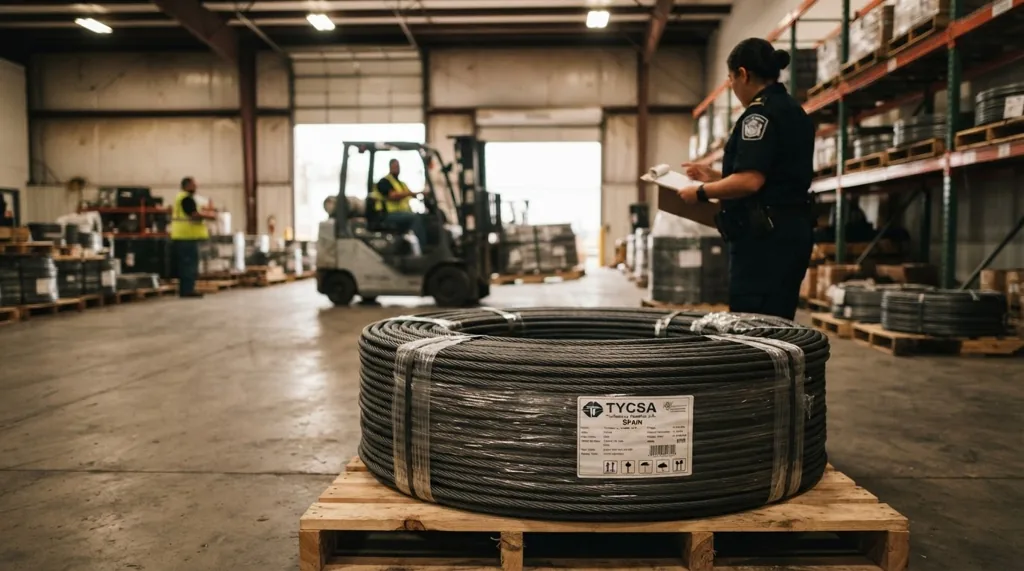
The United States sets a 13.57% anti-dumping duty on TYCSA’s steel wire strand from Spain, for shipments from Oct. 26, 2026.
The U.S. Department of Commerce set a final 13.57% anti-dumping duty on Spanish steel wire strand from TYCSA, starting Oct. 26, 2026.
The decision closes a yearly review of sales made between June 1, 2024, and May 31, 20251. It covers prestressed concrete steel wire strand, the steel cable used to strengthen concrete in bridges and buildings.
In short, a U.S. importer bringing in this strand from TYCSA must now pay a cash deposit of 13.57% of the shipment’s value at the border. Strand from Spanish makers without their own rate stays at 14.75%.
What did Commerce decide on Spanish strand?
Commerce found that Global Special Steel Products S.A.U., which trades as Trenzas y Cables de Acero PSC, S.L. (TYCSA), sold strand in the United States below its normal value1. Selling below normal value is called dumping. An anti-dumping duty is an extra import tax that makes up the difference.
The final margin for TYCSA is 13.57%1. A margin is the gap between the fair price and the U.S. price, shown as a share of the U.S. price. Commerce made no changes to its calculations after the preliminary results in June1.
The decision appears in a notice from the International Trade Administration (ITA), the Commerce unit that runs trade cases. It was published in the Federal Register, the U.S. government’s daily journal, on Oct. 26, 20261. It was signed on Oct. 20, 20261.
How does the 13.57% rate compare with earlier years?
The rate for TYCSA has moved with each review. When the duty order began in 2021, TYCSA and all other Spanish makers faced a rate of 14.75%2.
Anti-dumping rate for TYCSA, %
In the previous review, covering June 1, 2023, to May 31, 2024, Commerce set TYCSA’s rate at 11.32%3. That result was published on April 13, 20263. The new rate of 13.57% is therefore 2.25 percentage points higher than last year’s.
For importers, this means a larger cash deposit on each new shipment from TYCSA. On a shipment worth $100,000, the deposit rises from $11,320 to $13,570 under the new rate.
Which steel strand goods does the order cover?
The duty order covers prestressed concrete steel wire strand, often called PC strand2. It is made from wire of steel that is neither stainless nor galvanized. It is used in concrete that is stretched before or after it is poured, known as pretensioned and post-tensioned concrete2.
The order covers:
- covered and uncovered strand, of all types and grades2
- all diameters, although U.S. sales normally range from 0.25 inches to 0.70 inches2
- goods classified under U.S. tariff codes 7312.10.3010 and 7312.10.30122
The tariff codes are given for customs convenience only. The written description of the goods decides what is covered2.
One product is left out. Strand made from galvanized wire is excluded only when its zinc coating meets or exceeds 0.40 ounces per square foot, the standard in ASTM-A-4752.
Why does the United States charge duties on this strand?
The duties date back to an investigation that ended in 2021. On April 9, 2021, Commerce found that strand from Spain and six other countries was sold at unfairly low prices2. The other countries were Indonesia, Italy, Malaysia, South Africa, Tunisia and Ukraine.
On May 24, 2021, the U.S. International Trade Commission (ITC), an independent agency that judges harm to U.S. industry, found that these imports had hurt American producers2. Commerce then issued the duty orders, applying from June 4, 20212.
The U.S. companies that asked for the duties are Insteel Wire Products Company, Sumiden Wire Products Corporation and Wire Mesh Corp.1. They are called the petitioners in the case.
How did the yearly review of TYCSA work?
Each year, companies can ask Commerce to recalculate the duty for a past period. Commerce opened this review on July 25, 2025, after timely requests4. It sent its questionnaire to TYCSA on Aug. 8, 20254.
Steps in the TYCSA review
The case was delayed by the federal government shutdown in late 2025. Commerce paused all deadlines by 47 days on Nov. 14, 2025, and by another 21 days on Nov. 24, 20254. It later extended the preliminary deadline twice, by 31 days and then by eight days4.
The steps after that were these:
- Commerce published the preliminary results on June 22, 2026, with the same 13.57% rate4.
- TYCSA filed its written arguments, called a case brief, on July 13, 20261.
- The petitioners answered with a rebuttal brief on July 20, 20261.
- Commerce issued the final results, with a deadline of Oct. 20, 20261.
The arguments covered two points. One was early payment discounts on TYCSA’s sales in Spain. The other was which importer should be named in the instructions to customs1.
What changes for importers of Spanish strand?
The new rate affects money paid at the border. U.S. Customs and Border Protection (CBP), the border agency, collects the cash deposits.
Cash deposit rates from Oct. 26, 2026
| Supplier | Deposit rate |
|---|---|
| TYCSA | 13.57% |
| Companies reviewed before, not this time | Own rate from most recent review |
| New exporter of a reviewed producer’s strand | Producer’s most recent rate |
| All other makers and exporters | 14.75% |
The deposit rules apply to shipments entered on or after Oct. 26, 2026, the publication date1. They also cover goods taken out of a bonded warehouse for sale in the United States from that date. The rates by supplier are:
- TYCSA: 13.57%, the new final margin1
- Companies reviewed before but not this time: their own rate from the most recent review in which they took part1
- A new exporter selling strand made by a reviewed producer: the producer’s most recent rate1
- All other makers and exporters: 14.75%, the "all-others" rate from the 2021 investigation1
These deposit rates stay in force until Commerce announces a change1.
What happens to past shipments from TYCSA?
The review also sets the final duty on shipments that entered during the review period. Commerce calculated a separate rate for each importer1. It took the total amount of dumping found on that importer’s sales and divided it by their total value.
If an importer’s rate is below 0.5%, customs will clear the entries without anti-dumping duty1. That level is treated as too small to count.
Some TYCSA strand reached the United States through a middleman, such as a reseller or trading company. Where TYCSA did not know the goods were going to the United States, those entries will be charged 14.75%, unless the middleman has its own rate1.
Importers must also file a certificate saying whether the foreign seller paid back any of their anti-dumping duty. If they fail to file it, Commerce may assume repayment took place and charge double anti-dumping duties1.
When will customs collect the final duties?
Commerce plans to send its instructions to CBP no earlier than 35 days after publication1. Customs then sets the final duty on each past entry, a step called liquidation.
A party may challenge the results at the U.S. Court of International Trade. If a timely summons is filed there, customs will hold the entries until the time to ask for a court order has passed1. That window ends within 90 days of publication1.
Will the strand duties on Spain continue?
The order itself is under a separate check. Every five years, the ITC must decide whether ending a duty order would likely bring back harm to U.S. industry.
On April 7, 2026, the ITC decided to hold full five-year reviews of the strand orders5. These cover Spain and 14 other countries, including Argentina, Italy, Turkey and the United Arab Emirates5. The ITC said it would announce a schedule later5.
Until those reviews end, the Spanish duty order stays in place. The 13.57% rate for TYCSA will apply to new shipments until a later review changes it.
Key points on the Spanish steel strand duty
The table below gathers the main facts from the final results.
| Question | Answer |
|---|---|
| What changed? | Final anti-dumping rate for TYCSA set |
| Who issued it? | U.S. Department of Commerce, International Trade Administration |
| Which goods? | Prestressed concrete steel wire strand from Spain |
| Tariff codes | 7312.10.3010 and 7312.10.3012 |
| New rate for TYCSA | 13.57% |
| Previous rate for TYCSA | 11.32% |
| Rate for other Spanish makers | 14.75% |
| Review period | June 1, 2024, to May 31, 2025 |
| Who pays? | U.S. importers, through cash deposits to customs |
| Start date | Shipments entered on or after Oct. 26, 2026 |
| Next step | Customs instructions no earlier than 35 days later |
| Order’s future | ITC full five-year reviews under way |
From Oct. 26, 2026, every new shipment of TYCSA strand entering the United States carries a 13.57% cash deposit1. Commerce’s instructions for settling past entries will follow no earlier than 35 days after that date1.
Sources
- ↩ Federal Register :: Prestressed Concrete Steel Wire Strand From Spain: Final Results of Antidumping Duty Administrative Review; 2024-2025 https://www.federalregister.gov/documents/2026/10/26/2026-21791/prestressed-concrete-steel-wire-strand-from-spain-final-results-of-antidumping-duty-administrative
- ↩ Federal Register :: Prestressed Concrete Steel Wire Strand From Indonesia, Italy, Malaysia, South Africa, Spain, Tunisia, and Ukraine: Antidumping Duty Orders https://www.federalregister.gov/documents/2021/06/04/2021-11760/prestressed-concrete-steel-wire-strand-from-indonesia-italy-malaysia-south-africa-spain-tunisia-and
- ↩ Federal Register, Volume 91 Issue 70 (Monday, April 13, 2026) https://www.govinfo.gov/content/pkg/FR-2026-04-13/html/2026-07057.htm
- ↩ Federal Register :: Prestressed Concrete Steel Wire Strand From Spain: Preliminary Results of Antidumping Duty Administrative Review; 2024-2025 https://www.federalregister.gov/documents/2026/06/22/2026-12500/prestressed-concrete-steel-wire-strand-from-spain-preliminary-results-of-antidumping-duty
- ↩ Federal Register :: Prestressed Concrete Steel Wire Strand From Argentina, Colombia, Egypt, Indonesia, Italy, Malaysia, Netherlands, Saudi Arabia, South Africa, Spain, Taiwan, Tunisia, Turkey, Ukraine, and the United Arab Emirates; Notice of Commission Determination To Conduct Full Five-Year Reviews https://www.federalregister.gov/documents/2026/07/07/2026-13709/prestressed-concrete-steel-wire-strand-from-argentina-colombia-egypt-indonesia-italy-malaysia