
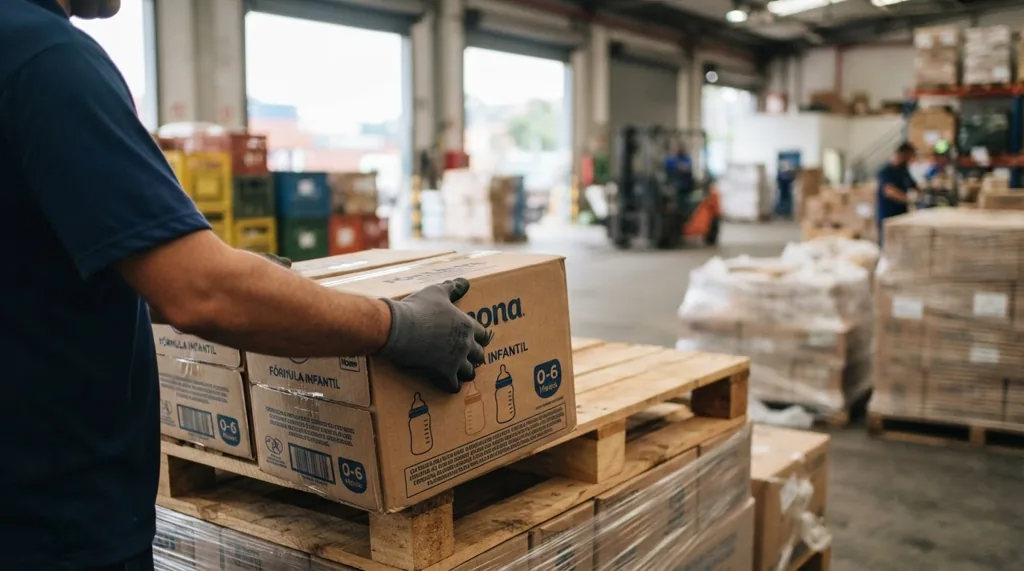
Brazil sets 0% import duty quotas for special infant formulas, contact lenses and two inputs, with the first opening Oct. 26, 2026.
Brazil’s trade committee set 0% import duty quotas for special infant formulas, contact lenses and two industrial inputs, with the first opening Oct. 26, 2026.
The decision is Resolution 975 of the Executive Management Committee (Gecex) of Brazil’s Chamber of Foreign Trade (Camex). It was dated Oct. 19, 2026, and published in the Official Gazette on Oct. 21, 20261.
In short, a shipment of these goods pays no import duty while the yearly quota still has room. Once the quota is used up, the normal duty applies again.
What does Gecex Resolution 975 change?
The resolution adds 11 product lines to Annex IV of Gecex Resolution 272 of Nov. 19, 20211. Annex IV is Brazil’s list of temporary duty cuts for supply reasons. These are cuts allowed when a product is not made, or not made in enough quantity, inside Mercosur, the South American trade bloc.
When each 0% quota opens
| Quota opens | Goods | Quota size |
|---|---|---|
| Oct. 26, 2026 | Special infant formulas and medical foods | 1,422 tonnes, shared |
| Oct. 26, 2026 | Polyamide-6 for sausage casings | 2,600 tonnes |
| Nov. 14, 2026 | Sodium metabisulphite | 24,650 tonnes |
| Jan. 1, 2027 | Contact lenses | 61.3 million units, shared |
Each line on the list has a duty rate, a quota and a start and end date1. For all 11 lines in this resolution, the duty rate is 0% within the quota1. The resolution took effect on the day it was published1. However, each quota has its own start date, set out in the annex.
The legal basis is Mercosur’s Common Market Group Resolution 49/19, which lets member states cut duties when supply is short1. The committee also cites four decisions of the Mercosur Trade Commission, Nos. 192/26, 207/26, 208/26 and 209/261. These approvals matter because Brazil shares a common outside tariff with its Mercosur partners.
Which infant formulas and medical foods are covered?
Seven product lines fall under one code, 2106.90.90, in the Mercosur Common Nomenclature (NCM), the bloc’s product code list1. They are powdered or liquid foods for babies and patients with special diet needs. Each is a separate "Ex" line, a narrow product description inside the wider code.
The seven lines are:
- Ex 002: a powder for tube or oral feeding of patients who need to heal the lining of the gut.
- Ex 003: an infant formula based on soy protein for babies allergic to cow’s milk protein.
- Ex 005: a powder or ready-to-drink food for children or adults who cannot absorb whole protein well.
- Ex 033: an infant formula for babies who cannot digest lactose, the sugar in milk.
- Ex 035: an infant formula made with free amino acids for babies with severe cow’s milk allergy.
- Ex 040: a powder for children aged 1 to 10 with severe allergy to cow’s milk or to several foods.
- Ex 041: an infant formula with broken-down whey protein and no lactose, for babies allergic to milk or soy.
These seven lines share one joint quota of 1,422 tonnes1. The quota runs from Oct. 26, 2026 to Oct. 25, 20271. Goods that fit a line but arrive after the joint quota is full pay the normal duty.
How much duty did these goods pay before?
The committee’s records show the size of each cut. The infant formulas and medical foods go from 14.4% to 0%2. Contact lenses go from 16.2% to 0%2. The plastic for sausage casings, polyamide-6, goes from 12.6% to 0%2. Sodium metabisulphite, a chemical, goes from 9.0% to 0%3.
Import duty before the cut to 0%, %
So the biggest saving per shipment falls on contact lenses. A lens importer saves the whole 16.2% duty on each shipment that enters within the quota.
What are the rules for contact lenses?
Two lines under code 9001.30.00 cover contact lenses1. Ex 001 covers silicone-hydrogel lenses for short sight, long sight and astigmatism1. Ex 002 covers ordinary hydrogel lenses for the same eye conditions1.
Contact lens quota, old and new
| Question | Current quota | New quota |
|---|---|---|
| Set by | Gecex Resolution 844 | Gecex Resolution 975 |
| Joint quota | 40,375,000 units | 61.3 million units |
| Ends | Dec. 31, 2026 | Dec. 31, 2027 |
The two lines share a joint quota of 61.3 million units1. This quota runs from Jan. 1, 2027 to Dec. 31, 20271. That is later than the other goods because the current lens quota runs until Dec. 31, 20264.
The new quota is bigger than the old one. The current joint quota, set by Gecex Resolution 844 of Dec. 30, 2025, is 40,375,000 units4. The Brazilian Optical Industry Association (Abióptica) asked for the increase in its request of March 25, 20264.
Why did Brazil cut the duty on contact lenses?
The ministry’s technical note on lenses gives the reasons. Abióptica said no factory in Brazil or elsewhere in Mercosur makes these lenses4. The note also said the products are essential for treating eye conditions4.
A public consultation ran from March 25 to May 9, 20264. No company or group objected to the request, and none wrote in support4. The note said the lack of objection from local industry supports the view that supply is short4.
Trade figures show Brazil depends on imports. Imports under the lens code were worth $22,851,943 in 20254. That is up from $17,673,619 in 20224. Brazil ran a trade deficit on these goods in every year from 2022 to 20254.
Ireland supplied 43.0% of the lenses by weight in 20254. The United States supplied 26.7%, the United Kingdom 10.1% and South Korea 7.7%4. None of these imports had any tariff preference, because Brazil has no trade deal covering them with these suppliers4.
Why is the lens quota larger than the use so far?
Only 37% of the current quota was used between Jan. 1 and April 30, 20264. That came to 14,976,676 units4. Even so, the note backed the larger quota. It said earlier quotas had higher use, which shows the demand changes with the season4.
Past figures support this. Under earlier resolutions, lens quotas were often used at 93% to 100%4. The note also said the expected value of the cut is above $1 million, the reference level for these cases4.
Which industrial inputs are covered?
Two chemical and plastic inputs also get a 0% quota. The first is sodium metabisulphite at least 98% pure by weight, under code 2832.10.10, Ex 0011. Its quota is 24,650 tonnes1. It runs from Nov. 14, 2026 to Nov. 13, 20271. The request came from the chemical maker Oxiteno3.
The second is a plastic called polyamide-6 in pellets, under code 3908.10.25, Ex 0031. It must be made for producing plastic casings for cooked sausages1. The resolution also sets technical limits on its thickness when melted and its melting point1. Its quota is 2,600 tonnes, from Oct. 26, 2026 to Oct. 25, 20271.
The polyamide quota is twice the amount asked for. The request from Viscofan do Brasil sought 1,300 tonnes2. The committee’s tariff body recommended 2,600 tonnes, and Gecex accepted this2.
Are these new cuts or renewals?
Most of them are renewals of existing cuts. The committee’s June records list the lens and polyamide requests as renewals2. Its May records list the sodium metabisulphite request as a renewal too3. The formula request from Nestlé Brasil is listed as a late renewal, filed after the usual deadline2.
Gecex approved the requests at two meetings, its 237th and 238th, in May and June 20261. The requests then went to Mercosur for approval before Brazil could publish the cuts2.
Who must act, and how will quotas be shared?
The resolution does not yet say how each quota will be shared out. It tells the Foreign Trade Secretariat (Secex) of the trade ministry to issue a separate rule on this1. Until that rule appears, importers do not know how much of each quota they can claim.
Secex also tracks how much of each quota is used. Its monitoring gave the lens figures for early 20264. For importers of these goods, the Secex rule and the remaining quota balance decide whether a shipment enters duty-free.
Buyers also stand to gain. The lens note says the main beneficiary is the patient and final buyer, who will pay less4. Makers abroad, such as lens suppliers in Ireland and the United States, face no duty on shipments within the quota.
Key points on Brazil’s 0% duty quotas
The table sums up the main facts of the resolution.
| Question | Answer |
|---|---|
| What changed? | 0% import duty within quotas |
| Who issued it? | Gecex, Brazil’s Chamber of Foreign Trade |
| Which measure? | Gecex Resolution 975 of Oct. 19, 2026 |
| When was it published? | Oct. 21, 2026 |
| Which goods? | Special infant formulas, medical foods, contact lenses, two inputs |
| Formula quota | 1,422 tonnes, Oct. 26, 2026 to Oct. 25, 2027 |
| Contact lens quota | 61.3 million units, calendar year 2027 |
| Sodium metabisulphite quota | 24,650 tonnes, from Nov. 14, 2026 |
| Polyamide-6 quota | 2,600 tonnes, from Oct. 26, 2026 |
| Lens duty before | 16.2% |
| Who sets quota sharing? | Foreign Trade Secretariat (Secex) |
The first quotas, for infant formulas, medical foods and polyamide-6, open on Oct. 26, 2026. The next step is the Secex rule on how importers can claim a share of each quota1.
Sources
- ↩ RESOLUÇÃO GECEX Nº 975, DE 19 DE OUTUBRO DE 2026 – RESOLUÇÃO GECEX Nº 975, DE 19 DE OUTUBRO DE 2026 – DOU – Imprensa Nacional https://www.in.gov.br/web/dou/-/resolucao-gecex-n-975-de-19-de-outubro-de-2026-739398503
- ↩ Deliberações da 238ª Reunião Ordinária do Comitê-Executivo de Gestão (Gecex) — Ministério do Desenvolvimento, Indústria, Comércio e Serviços https://www.gov.br/mdic/pt-br/assuntos/camex/outros-documentos/deliberacoes/deliberacoes-da-238a-reuniao-ordinaria-do-comite-executivo-de-gestao-gecex
- ↩ Deliberações da 237ª Reunião Ordinária do Comitê-Executivo de Gestão (Gecex) — Ministério do Desenvolvimento, Indústria, Comércio e Serviços https://www.gov.br/mdic/pt-br/assuntos/camex/outros-documentos/deliberacoes/deliberacoes-da-237a-reuniao-ordinaria-do-comite-executivo-de-gestao-gecex
- ↩ SEI/MGI – 62212437 – Extrato https://www.gov.br/mdic/pt-br/assuntos/camex/outros-documentos/notas/deferimentos/238a-reuniao-ordinaria-do-comite-executivo-de-gestao-gecex/extrato-publico-da-nota-tecnica-sei-no-1051_2026_mdic-lentes-de-contato.pdf/@@download/file