
United States trade commission ruled on Oct. 16, 2026, that Czech and Indian rail couplers harm U.S. makers, clearing permanent duties.
The United States International Trade Commission (USITC) ruled Oct. 16, 2026, that Czech and Indian freight rail couplers harm U.S. makers1.
That vote clears the way for permanent duties. The U.S. Department of Commerce will now issue anti-dumping orders on couplers from both countries and an anti-subsidy order on couplers from India1.
In short, U.S. buyers of these couplers will keep paying cash deposits at the border, and the duties become long-term. Czech couplers face a deposit of 73.74% of their value, and Indian couplers face rates that depend on the maker2.
What did the USITC decide on rail couplers?
The commission found that a U.S. industry is "materially injured" by imports of freight rail couplers and their parts from the two countries1. Material injury means real harm to U.S. producers, such as lost sales or lower prices.
Commerce had already found that the goods are sold in the United States at less than fair value. It had also found that the government of India subsidizes them1. The commission’s job was to decide whether those imports hurt U.S. factories.
Five commissioners voted yes: Chairman Brett W. Doyle and Commissioners Jason E. Kearns, Peter-Anthony Pappas, Bart Thanhauser and David Foley Jr.1. Commissioner Samuel T. Negatu did not take part in the vote1.
The commission will publish its full reasons in a public report, USITC Publication 5805. It expects to post the report on its website by Nov. 30, 20261.
What are anti-dumping and anti-subsidy duties?
An anti-dumping duty is an extra import tax on goods sold abroad below their normal price. Commerce measures the gap between that normal price and the U.S. price, called the dumping margin3.
An anti-subsidy duty, also called a countervailing duty, is an extra import tax that cancels out help a foreign government gives its makers. Commerce found such help for Indian coupler makers4.
These duties are collected by U.S. Customs and Border Protection (CBP), the border agency. Importers pay a cash deposit when the goods enter the country. The final amount owed is settled later, when Commerce gives further instructions3.
Which rail coupler parts are covered?
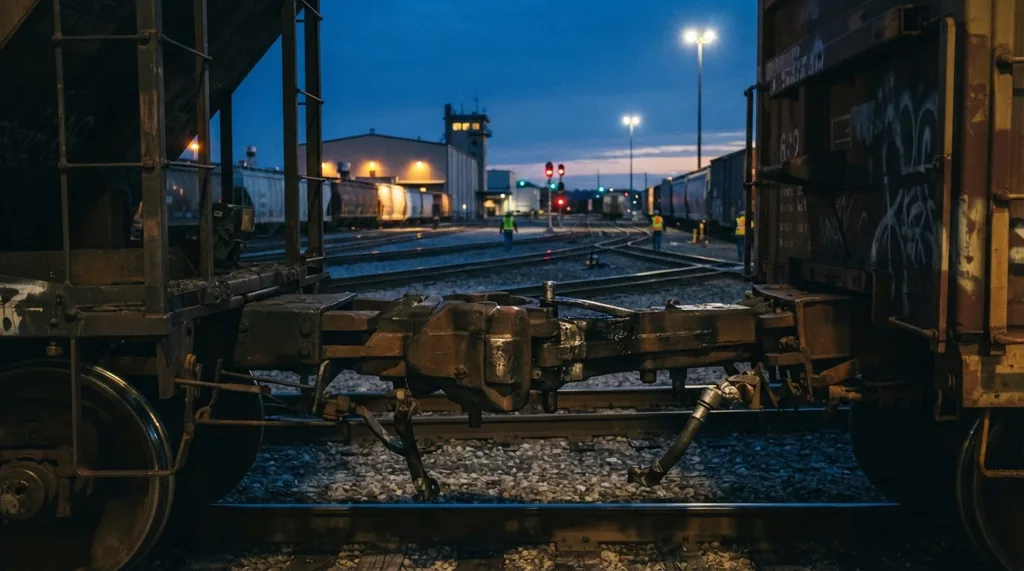
A coupler is the device that joins two freight railcars. Commerce says it has two main parts: the knuckle and the coupler body3. The duties cover these parts, set by the Association of American Railroads (AAR), the North American rail industry group3:
- E coupler bodies
- E/F coupler bodies
- F coupler bodies
- E knuckles
- F knuckles
What the coupler duties cover
| Item | Rule |
|---|---|
| Coupler bodies and knuckles | E, E/F and F bodies, E and F knuckles covered, even imported alone |
| Locks, pins, throwers, rotors | Covered only inside an assembly |
| Condition | Finished or unfinished, assembled or not |
| Standards | AAR M-211 or M-215, or equal standards |
These five parts are covered even when they are imported on their own3. The goods are covered whether finished or unfinished, assembled or not, and mounted or not3.
Smaller parts are treated differently. Coupler locks, lock lift assemblies, knuckle pins, knuckle throwers and rotors are covered only inside an assembly. When imported separately, they are not covered3.
Finished couplers in the case meet AAR standards M-211 or M-215, or equal domestic or international standards3. M-211 sets approval rules for factories that make couplers and coupler parts3.
What about couplers fitted to a railcar?
A coupler attached to a finished railcar is still covered. In that case, only the coupler or its covered parts pay the duty, not the whole railcar3.
The country of origin is the country where the parts were cast or forged. Casting and forging are the first steps of shaping the metal3. Work done later in a third country does not change the origin.
That later work includes welding, grinding, heat treatment, painting, machining and assembly3. So an Indian or Czech casting finished in another country, or fixed to a railcar there, still counts as Indian or Czech3.
Which tariff codes do the couplers use?
Commerce lists the main Harmonized Tariff Schedule of the United States (HTSUS) codes as 8607.30.1010, 8607.30.1050 and 8607.30.10905. These are the U.S. customs codes for the goods.
Couplers on finished railcars may also enter under 7326.90.8688, 8606.10.0000, 8606.91.0000, 8606.92.0000, 8606.99.0130 or 8606.99.01605. Some covered goods may also enter under 7325.99.50005.
Commerce says these codes are for convenience only. The written description of the goods decides what is covered, not the code5.
How high are the duties on Czech couplers?
Commerce examined one Czech maker, CKD Kutná Hora A.S. (CKD). It set CKD’s dumping margin at 73.74%3. The same rate applies to all other Czech producers and exporters, because CKD was the only company examined3.
Commerce checked CKD’s sales and cost records in June 2026. It then changed some of its calculations after its preliminary decision3. Its review looked at sales from July 1, 2024, to June 30, 20253.
When the final finding was published on Sept. 24, 2026, Commerce told CBP to collect cash deposits at that rate3. Entries made on or after May 6, 2026, remain open for final duty3. That was the day Commerce published its preliminary finding.
How high are the duties on Indian couplers?
Indian couplers face two separate duties: one for dumping and one for subsidies. The rates differ by company2.
Final subsidy rates on Indian couplers, %
Commerce set these dumping margins for Indian makers5:
- Bhilai Engineering Corporation Ltd.: 71.01%
- Jupiter Wagons Ltd.: 71.01%
- Kharagpur Metal Reforming Industries Pvt Ltd.: 2.32%
- Texmaco Rail and Engineering Limited: 15.79%
- All other Indian makers: 5.24%
The 71.01% rates for Bhilai and Jupiter rest on "adverse facts". Commerce uses this method when a company does not give the information it asks for5.
Commerce also set these subsidy rates4:
- Kharagpur Metal Reforming Industries: 9.71%
- Texmaco Rail and Engineering: 75.00%
- Bhilai Engineering Corporation: 75.00%
- Jupiter Wagons: 75.00%
- All other Indian makers: 9.71%
The three 75.00% rates also rest on adverse facts4. The subsidy review covered April 1, 2024, to March 31, 20254.
Why is the Indian dumping deposit lower than the margin?
Commerce lowers the dumping deposit to avoid charging twice for the same export subsidies. The lower figure is called the cash deposit rate5.
After this adjustment, the deposit rates are 71.01% for Bhilai and Jupiter, 0.00% for Kharagpur, 12.10% for Texmaco and 1.55% for all others5.
In September, Commerce did not yet tell CBP to collect these adjusted rates5. Commerce said the deposit rate will switch to the adjusted figure on the day the commission’s final vote is published in the Federal Register, the U.S. government’s daily journal5.
What happened to the Indian subsidy deposits?
Commerce first found subsidies in a preliminary decision published on March 3, 2026. CBP then collected cash deposits on Indian couplers4.
Key dates in the coupler case
Those temporary measures could only last a limited time. CBP stopped holding entries made on or after July 1, 20264. Entries made from March 3 to June 30, 2026, stay open for final duty4.
With the commission’s yes vote, Commerce will issue an anti-subsidy order. It will then restart the hold on entries and require cash deposits at the final subsidy rates4.
For an Indian coupler made by Texmaco, this means two deposits: 12.10% for dumping and 75.00% for subsidies. For Kharagpur goods, the deposits are 0.00% and 9.71%4.
Who asked for the rail coupler duties?
The case was brought by the Coalition of Freight Coupler Producers. Its members are McConway & Torley LLC and the United Steelworkers union, both of Pittsburgh, Pennsylvania2.
The Indian government took part in the subsidy case. It filed written arguments with Kharagpur and Texmaco in August 20264. Its points included how Commerce valued Indian state purchases of freight rail couplers4.
The case numbers are A-851-806 for the Czech dumping case, A-533-940 for the Indian dumping case and C-533-941 for the Indian subsidy case2. Commerce says it now keeps 851 anti-dumping and anti-subsidy orders in place2.
Who pays and what changes at the border?
The U.S. importer pays the deposits, not the foreign maker. Railcar builders and rail operators that buy Czech or Indian couplers will face higher landed costs.
Customs brokers must enter the correct deposit rate for each producer and exporter. When an exporter is not on Commerce’s list but the producer is, the producer’s rate applies3. Otherwise the all-others rate applies3.
Makers in third countries that use Czech or Indian castings are also affected. Their couplers keep the origin of the casting, so the duties follow the parts3.
Key points on the freight rail coupler duties
The table below sums up the case.
| Question | Answer |
|---|---|
| What changed? | USITC found harm to U.S. industry |
| When was the vote? | Oct. 16, 2026 |
| Who issues the orders? | U.S. Department of Commerce |
| Which goods? | Freight rail couplers and their parts |
| Which countries? | Czech Republic and India |
| Czech dumping rate | 73.74% for all makers |
| Indian dumping deposits | 0.00% to 71.01% by maker |
| Indian subsidy rates | 9.71% to 75.00% by maker |
| Main tariff codes | 8607.30.1010, 8607.30.1050, 8607.30.1090 |
| Origin rule | Where parts were cast or forged |
| Who pays? | U.S. importers, through cash deposits |
| Next date | USITC report by Nov. 30, 2026 |
Commerce’s next step is to publish the duty orders. The commission’s full report on the case is due on its website by Nov. 30, 20261.
Sources
- ↩ Freight Rail Couplers and Parts Thereof from Czech Republic and India Injure U.S. Industry, Says USITC | United States International Trade Commission https://www.usitc.gov/press_room/news_release/2026/er1016_69361.htm
- ↩ Final Affirmative Determinations in the Antidumping and Countervailing Duty Investigations of Freight Rail Couplers from the Czech Republic and India https://www.trade.gov/final-affirmative-determinations-antidumping-and-countervailing-duty-investigations-freight-rail
- ↩ Federal Register :: Certain Freight Rail Couplers and Parts Thereof From the Czech Republic: Final Affirmative Determination of Sales at Less Than Fair Value https://www.federalregister.gov/documents/2026/09/24/2026-19520/certain-freight-rail-couplers-and-parts-thereof-from-the-czech-republic-final-affirmative
- ↩ Federal Register :: Certain Freight Rail Couplers and Parts Thereof From India: Final Affirmative Countervailing Duty Determination https://www.federalregister.gov/documents/2026/09/24/2026-19522/certain-freight-rail-couplers-and-parts-thereof-from-india-final-affirmative-countervailing-duty
- ↩ Federal Register :: Certain Freight Rail Couplers and Parts Thereof From India: Final Affirmative Determination of Sales at Less Than Fair Value https://www.federalregister.gov/documents/2026/09/24/2026-19521/certain-freight-rail-couplers-and-parts-thereof-from-india-final-affirmative-determination-of-sales