
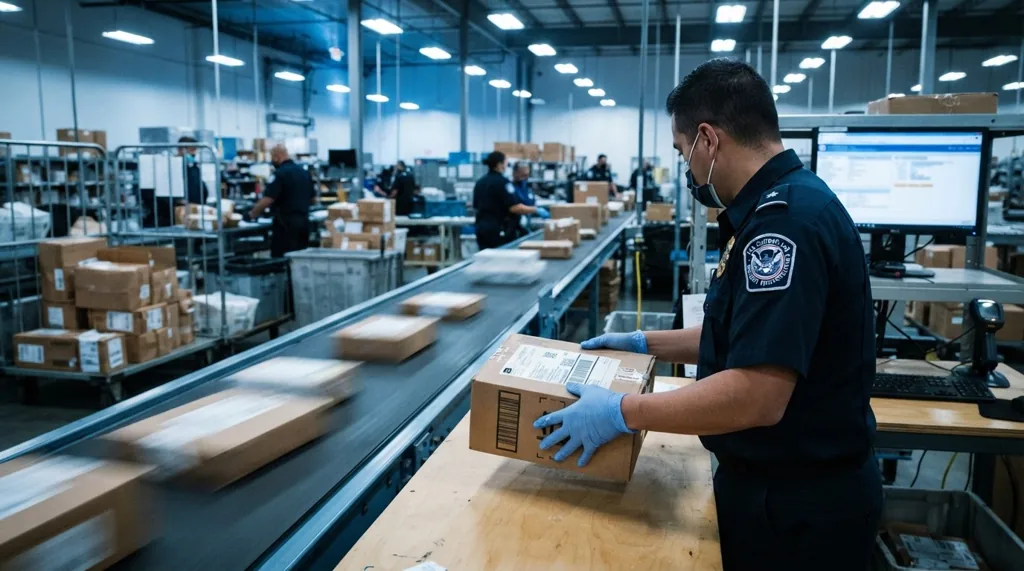
United States Customs and Border Protection delayed full customs entry for some low-value mailed goods until Jan. 20, 2027.
U.S. Customs and Border Protection (CBP) has delayed a rule requiring full customs entry for some mailed goods until Jan. 20, 2027.
The change comes in a final rule that the Federal Register made public on Oct. 22, 20261. The rule had been due to apply from Oct. 22, 20261.
In short, low-value parcels sent by international post can keep using the simpler mail entry until Jan. 20, 2027. This holds even when they face extra tariffs, need another agency’s approval, or claim a free trade agreement rate.
What does the CBP mail rule change?
The new document is titled "Indefinite Suspension of the De Minimis Exemption for Mail Shipments and New Postal Informal Entry Process; Delayed Compliance Extension"1. It moves only one date. The compliance date is now Jan. 20, 2027 for two parts of the mail rules, 19 CFR 145.12(a)(2)(v) and (vi)1.
Those two parts require a formal entry, the full customs declaration normally used for shipments worth more than $2,5002. Under the rule, formal entry applies to some mailed goods even when they are worth less1. CBP says the extension adds no new requirement on anyone1.
Which mailed goods need a formal entry?
The two delayed parts cover three groups of goods sent through the international postal network1. They are:
- Goods checked by another agency, called partner government agency (PGA) requirements in the rule2.
- Goods facing duties under Chapter 98 or Chapter 99 of the Harmonized Tariff Schedule of the United States (HTSUS), the U.S. tariff list2.
- Goods claiming duty-free treatment under Chapter 98 of the tariff list or under a free trade agreement2.
Mailed goods covered by the delayed rules
| Group | What it covers |
|---|---|
| Rule (v) | Goods checked by another government agency |
| Rule (vi): tariffs | Duties under Chapter 98 or Chapter 99 |
| Rule (vi): claims | Duty-free under Chapter 98 or a free trade agreement |
| New compliance date | Jan. 20, 2027 |
Chapter 99 holds extra tariffs on top of normal rates. The Entry Type 13 notice gives Section 201, 232 and 301 duties as examples3. Until Jan. 20, 2027, these three groups do not have to use formal entry for low-value mail1.
Which mailed goods are not affected by the delay?
Other formal entry rules for mail still apply. Every mail import worth more than $2,500 needs formal entry2. So do goods under an import quota and goods covered by an anti-dumping or countervailing duty order2. These are extra duties on goods sold below normal price or helped by foreign subsidies.
Formal entry is also needed for alcoholic drinks, cigars, cigarettes and other tobacco products2. CBP may also demand formal entry for any mailed shipment of any value to protect revenue2. The extension does not touch any of these rules.
Why did CBP push back the date?
CBP says importers, customs brokers and logistics companies need more time1. They must update their computer systems and write procedures for sending the required data1. They also need to build the technology to meet the rules1.
The agency warns that without extra time, important international postal shipments to Americans could be disrupted1. It also wants to spare companies unnecessary costs linked to the old date1.
Why was there no public comment period?
U.S. law usually requires a proposal and public comments before a final rule1. CBP used a "good cause" exception, saying comments were impracticable1.
A comment period would have run past the Oct. 22, 2026 date1. Companies would then have faced the old deadline anyway1. CBP also says the delay does not weaken its safety goals, because the informal mail process stays in place1.
How did the June 2026 de minimis rule start this?
On June 24, 2026, CBP published an interim final rule in the Federal Register1. It ended the de minimis exemption, the duty-free entry for goods worth $800 or less, for mail4. That suspension took effect on June 24, 2026, and the rest of the rule on July 24, 20261.
The dates for mail entry
The June rule also created a new informal entry process for mailed goods worth $2,500 or less4. It listed the goods that must still use formal entry, and set Oct. 22, 2026 as the date for parts (v) and (vi)4. The new document moves that date by about three months.
CBP based the June rule on Executive Order 14324 of July 30, 2025, as changed by Executive Order 14388 of Feb. 20, 20261. It also relied on its own powers under Section 321 of the Tariff Act of 19301. The June rule gave reasons such as protecting revenue and stopping illegal imports, including drugs such as fentanyl4.
How does the informal mail entry work until January?
Under the informal mail process, a party with the right to make entry sends data to CBP by email2. The deadline is the 7th day of the following month after the shipment arrives2. Duty must be paid through Pay.gov by the same day2.
The data CBP requires includes2:
- the filer code and bond number
- a description of the goods and their country of origin
- all 10-digit tariff codes, the duty rate, the value and the total duty owed
- the carrier, flight number, foreign post tracking number, arrival port and arrival date
Rates of duty are those in force when the entry is properly sent to CBP2. During the delay, importers keep using this same process1.
What role does the Entry Type 13 test play?
CBP also runs a voluntary electronic test called the Entry Type 13 test1. It began on Sept. 22, 20261. It lets filers send informal entries for mail worth $2,500 or less through the Automated Commercial Environment (ACE), CBP’s online trade system3.
Two ways to enter low-value mail
| Question | Informal mail entry | Entry Type 13 test |
|---|---|---|
| How data is sent | By email | Electronically in ACE |
| Value limit | $2,500 or less | $2,500 or less |
| Goods with extra tariffs after Jan. 20, 2027 | Formal entry needed | Allowed |
| Quota or anti-dumping goods | Formal entry needed | Formal entry needed |
The test opens an informal route for goods that face other agencies’ rules or extra tariffs3. For test users, CBP waives the formal entry rules in parts (v) and (vi)3. Goods under quotas or anti-dumping and countervailing duties still need formal entry3.
Owners, buyers and licensed customs brokers can join without a separate application3. Filers need a customs bond, a guarantee that duties will be paid3. Foreign postal operators, the U.S. Postal Service, freight forwarders and carriers must hire a licensed broker to act as importer3.
Who is affected and what happens on Jan. 20, 2027?
Importers buying low-value goods by international post gain three more months. So do the brokers and logistics firms that file for them1. Foreign sellers who ship by post to U.S. buyers also gain time.
Companies that are ready may follow the formal entry rules earlier by choice1. From Jan. 20, 2027, filers of covered goods can choose formal entry or the Entry Type 13 test, if their shipments qualify1. Shipments that do neither will no longer fit the simple mail process.
Key points on the mail formal entry delay
The table sums up the change.
| Question | Answer |
|---|---|
| What changed? | Formal entry date for some mail delayed |
| Who issued it? | U.S. Customs and Border Protection |
| Which rules? | 19 CFR 145.12(a)(2)(v) and (vi) |
| Which goods? | Mail needing other agencies’ approval |
| Which tariffs? | Chapter 98 or 99 duties |
| Which claims? | Chapter 98 or free trade agreement duty-free |
| Value limit for informal mail entry | $2,500 or less |
| Old date | Oct. 22, 2026 |
| New date | Jan. 20, 2027 |
| Alternative | Voluntary Entry Type 13 test |
| Who gains time? | Importers, brokers, logistics firms |
From Jan. 20, 2027, mailed goods in these groups must use formal entry or the Entry Type 13 test1. Until then, the current informal mail process stays in place1.
Sources
- ↩ 2026-21600.pdf https://public-inspection.federalregister.gov/2026-21600.pdf
- ↩ eCFR :: 19 CFR Part 145 — Mail Importations https://www.ecfr.gov/current/title-19/chapter-I/part-145
- ↩ Federal Register :: Test of the New Electronic Informal Entry Process for Mail https://www.federalregister.gov/documents/2026/06/24/2026-12668/test-of-the-new-electronic-informal-entry-process-for-mail
- ↩ Regulations.gov https://www.regulations.gov/document/USCBP-2026-0761-0001