
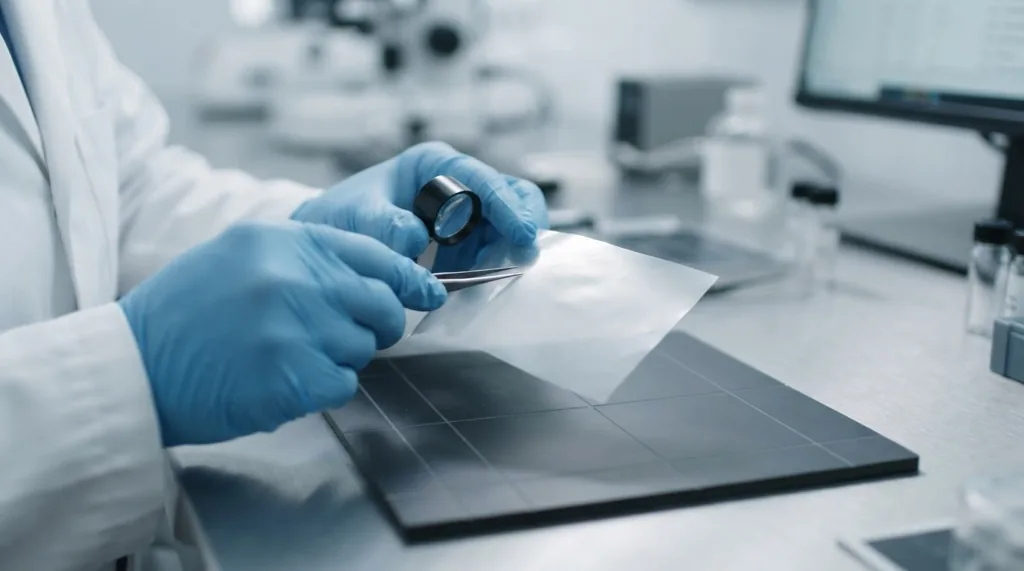
Taiwan will charge a temporary extra import tax of up to 40.21% on Chinese nylon film from Oct. 19, 2026.
Taiwan’s Ministry of Finance will charge a provisional anti-dumping duty of up to 40.21% on certain nylon film from mainland China from Oct. 19, 2026.
The ministry published the notice on Oct. 13, 2026, and the duty runs for up to four months1. An anti-dumping duty is an extra import tax on goods sold abroad below their normal price.
In short, most shipments of this thin nylon packaging film from China will pay an extra 40.21% at Taiwan’s border. Film made and shipped directly by three companies of the Yuncheng group pays 0%1.
What is changing for Chinese nylon film?
From Oct. 19, 2026, Taiwan customs will collect a temporary extra duty on the covered film2. The Ministry of Finance calls the goods "Certain Polyamide Film". Polyamide is the chemical name for nylon.
The duty is provisional. This means it is charged while the investigation continues, before any final decision. The ministry said it acted to stop further harm to Taiwan’s own film makers during the investigation2.
The notice is No. 1151027218 and is signed by the finance minister1. It rests on the rules for countervailing and anti-dumping duties, Articles 12 to 141.
Which nylon film does the duty cover?
The notice describes the goods in some detail. The duty applies to film or foil that contains more than 50% nylon-6 by weight1. Nylon-6 is one common type of nylon.
What the film must be to pay the duty
| Test | Covered film |
|---|---|
| Material | More than 50% nylon-6 by weight |
| Thickness | 0.0114 mm to 0.0315 mm |
| Width | More than 5 mm |
| Surface | Printed, coated or treated, or plain |
| Tariff codes | 39209229105 and 39209229203 |
The film is covered whether or not it is printed, coated or given any surface treatment1. It may be in rolls or cut into rectangles. It must not be processed any further.
The film must also meet two size limits:
The notice lists two reference tariff codes: 39209229105 and 392092292031. These codes guide customs, but the product description decides what is covered.
According to the notice, the film is used to package food, chemicals, medical and drug products, and electronic materials1.
Which nylon film is left out?
Two kinds of film are excluded from the duty. The first is film with metal on its surface1.
The second is film that blocks oxygen very well. At a thickness of 0.015 mm, it lets through less than 15 mL of oxygen per square metre per day1. The test is done at 20°C to 23°C and relative humidity of 50% to 65%1.
This article calls it high-barrier film. Film that passes this test does not pay the duty. An importer that claims this exclusion will need to show the film meets it.
How much is the extra duty?
The ministry set two rates, based on its preliminary finding1:
- Yuncheng group: 0%. This covers the group’s plastics maker in Kunshan and two related new-materials makers, one of them in Heshan1.
- All other makers or exporters: 40.21%1.
Provisional duty by maker, %
The ministry’s tariff rate review committee found that every Chinese company in the case dumped its film, except the Yuncheng group2. The committee decided this at its 72nd meeting on Sept. 24, 20262.
The 0% rate has a strict condition. It is based on data the three Yuncheng companies gave during the investigation1. So the film must be made by these companies in mainland China and shipped directly to Taiwan to get 0%1. Yuncheng film sold through a trader or shipped through a third place falls under the 40.21% rate.
Which companies does the case name?
The notice names 12 foreign makers and exporters in mainland China1. Besides the three Yuncheng companies, they are firms based in:
- Xiamen and Fujian: two related industrial companies.
- Cangzhou and Dezhou: three related film and packaging companies.
- Chongqing and Wuhu: two related plastics and film companies.
- Jiaxing: one chemical fibre company.
- Foshan: one plastics technology group.
The notice also names four importers in Taiwan1. It adds that the duty applies to any other maker, exporter or importer of the covered film, even if not named1.
None of these nine other Chinese companies received its own rate. All of them pay 40.21%1.
Why did Taiwan act against nylon film imports?
The case started after a complaint by a Taiwanese company, 力麟科技, according to the case title1. The Ministry of Finance opened the investigation on April 10, 20263.
How the nylon film case moved
Taiwan’s Ministry of Economic Affairs studied harm to local industry. Its trade remedy review board met on June 9, 20264. It found reasonable signs that local makers suffered serious harm, which the law calls material injury4.
The ministry looked at data from January 2022 to March 20264. It found that imports of this film from mainland China grew sharply each year4. Their prices kept falling. From 2025, they were below the price of Taiwanese film sold at home4.
The ministry described three stages of harm:
- In 2023 and 2024, Taiwanese makers cut prices to compete, and their losses at home grew4.
- In 2025, they stopped the price war. They then lost much of their sales and market share at home, but still made losses4.
- In January to March 2026, they raised prices a little and costs fell. Losses shrank, but the makers still made no profit4.
The ministry said this shows the Chinese imports hurt local industry4.
How does Taiwan’s anti-dumping process work?
Two ministries share the work. The Ministry of Finance studies the dumping, meaning prices below normal value. The Ministry of Economic Affairs studies harm to local industry4.
The case moves in steps:
- The Ministry of Economic Affairs makes a first finding on harm. Here, that came on June 9, 20264.
- The Ministry of Finance then has 70 days to make a first finding on dumping and decide on a provisional duty4.
- The Ministry of Finance makes its final dumping finding within 60 days after the day the preliminary notice was published1.
- If it finds dumping, the Ministry of Economic Affairs has 40 days to make its final finding on harm1.
- The Ministry of Finance then has 10 days to send the case to its tariff rate review committee1.
The committee mainly looks at dumping and harm. It may also weigh the effect on Taiwan’s wider economy before deciding on a final duty2.
The Ministry of Economic Affairs also held a public hearing on May 12, 2026, as part of its first study of harm3. It sent questionnaires to Taiwanese makers, importers and buyers of the film5.
When do the duties start and end?
The provisional duty starts on Oct. 19, 20261. Under Article 13 of the duty rules, it can last at most four months1.
That limit can grow to six months. This happens if foreign exporters with a large share of the trade ask for it1.
The results are not final. The notice warns that on-site checks or new evidence may lead to different dumping margins or a different conclusion1. A dumping margin is the gap between the export price and the normal price.
Interested parties may send written comments on the notice. They have 20 days from the date of the notice to send them to the Customs Administration, the agency that runs Taiwan’s border1.
Who pays more for nylon film from China?
Taiwanese importers pay the duty when the film clears customs. A 40.21% duty on film from most Chinese makers will raise their landed cost sharply.
Buyers that pack food, medicine, chemicals or electronics use this film1. They may face higher prices or switch to other suppliers. Film from the Yuncheng group, shipped directly, keeps its 0% rate during the provisional period1.
Chinese makers other than Yuncheng lose their price edge in Taiwan while the duty applies. Exporters of excluded film, such as metal-coated or high-barrier film, are not affected1.
The full preliminary dumping report is available from the Customs Administration website1. The Ministry of Economic Affairs published its report on harm from July 9, 20264.
Key points on Taiwan’s nylon film duty
The table below sums up the provisional duty.
| Question | Answer |
|---|---|
| What changed? | Provisional anti-dumping duty on nylon film |
| Who issued it? | Taiwan’s Ministry of Finance |
| Which goods? | Nylon-6 film, 0.0114 mm to 0.0315 mm thick |
| From where? | Mainland China |
| Reference tariff codes | 39209229105 and 39209229203 |
| Rate for Yuncheng group | 0%, if shipped directly |
| Rate for all others | 40.21% |
| What is excluded? | Metal-surface film and high-barrier film |
| Start date | Oct. 19, 2026 |
| How long? | Up to four months, or six on request |
| Comment deadline | 20 days from Oct. 13, 2026 |
| Next step | Final dumping finding within 60 days |
The Ministry of Finance must now reach its final dumping finding within 60 days of its preliminary notice1. Until then, most nylon film from mainland China will pay 40.21% at Taiwan’s border from Oct. 19, 20261.
Sources
- ↩ 力麟科技股份有限公司申請對自中國大陸產製進口特定聚醯胺薄膜課徵反傾銷稅、臨時課徵反傾銷稅及回溯課徵反傾銷稅案,經本部初步認定部分涉案廠商有傾銷情事,自115年10月19日起臨時課徵反傾銷稅。-財政部關務署 https://web.customs.gov.tw/singlehtml/698?cntId=4cff4b2084f848f6ab58d626ac5f2a51
- ↩ 財政部公告對自中國大陸產製進口特定聚醯胺薄膜臨時課徵反傾銷稅-財政部全球資訊網 https://www.mof.gov.tw/singlehtml/384fb3077bb349ea973e7fc6f13b6974?cntId=1f8298ddd6d446b68eee11db408d7628
- ↩ 經濟部國際貿易署 ::: 公告訊息 https://www.trade.gov.tw/Pages/Detail.aspx?nodeID=39&pid=814110&dl_DateRange=all&txt_SD=&txt_ED=&txt_Keyword=&pageindex=2&history=
- ↩ 本部新聞 – 新聞與公告 – 中華民國經濟部(Ministry of Economic Affairs,R.O.C.)全球資訊網 https://www.moea.gov.tw/MNS/populace/news/News.aspx?kind=1&menu_id=40&news_id=122969
- ↩ 我國反傾銷稅/平衡稅案件一覽表 – 案件調查 – 我國貿易救濟案件專網 https://traderemedy.trade.gov.tw/web/main/case/wfrmTradeCases.aspx?menu_id=1522&caseid=112&datatype=2&progkind=1